Abstract
Living Value Theory's account of symbols begins from the observation that coordination is under way before anything is articulated, and it defines the symbolic achievement as the deposit of distinctions in durable, portable, recoverable form. This article asks the companion question. How does prior living coordination remain consequential for later living coordination when no symbolic distinction was deposited at all? The answer proposed is immedial coordination: living coordination through nonrecursive differences produced or modified by earlier living coordination, where those differences become consequential without symbolic stabilisation and without the recursive availability of their producer. Immedial coordination is a temporal relation between prior living coordination, the alteration or sedimentation of nonrecursive ground, and subsequent living uptake, and it is neither a sixth mediation, nor a class of entities, nor a low-level analogue of multisymbolization. Most uptake proceeds seamlessly at L1. Occasionally a residual condition catches at L2, is recursively opened, becomes askable at L3 and may be stabilised at L4, and an immedial difference may then enter an evidential practice. Symbols make absence active by reference, and immedial coordination makes absence consequential by residue. The article develops the concept through a predator's scent, two worn doors and anthropogenic climate change, draws the boundary between residue, cue, communication and sign, proposes a method for an anthropology of what nobody said, and concludes that the symbolically recoverable history is only a small subset of the history that remains coordinationally present.
I. Begin Before the Sign: A World Already Marked by Life
A small animal reaches the edge of a clearing and changes course. Nothing in the clearing looks back at it. A predator crossed the open ground an hour earlier, and the soil, the grass and the air still carry some of the consequences of that crossing: a scent, a line of flattened vegetation, a patch of disturbed earth. The predator is absent. No proposition about the predator needs to arise in the animal for its movement to be altered, because the animal is coordinating with a world that another life has already changed.
Two adjacent public toilet doors have aged differently. Thousands of hands have pushed, pulled, rubbed and kicked at paint, handles, locks, edges and the surfaces around them, and the accumulated movements have left different patterns of wear on the one door and on the other. Nobody intended the pattern, and no one person produced it. Almost everybody who uses the doors coordinates through it without noticing: a hand finds a handle polished smooth, a shoulder meets a panel that gives a little more than it once did. Then one person, waiting with nothing to do, notices that the two doors do not look alike and asks why.
A species shifts its seasonal behaviour or its range as the climate changes. The people whose industrial activity accumulated over two centuries are mostly absent from the encounter, and many of them are dead. Their prior coordination has nevertheless altered the multiversal dwelling within which later organisms have to live, and the organisms coordinate with that altered ground whether or not they, or anyone, can say what altered it.
These scenes establish what the article is about. It concerns no objects called traces or residues. Its topic is a relation: living beings coordinating through conditions whose present form has been shaped by earlier living coordination. The conditions differ enormously in scale, duration and origin, and the living activities involved differ as much, since an animal avoiding a scent, a person pushing a door and an organism adjusting to a changed climate are doing quite different things. The same formal relation between earlier coordination, altered ground and later uptake is visible in each. What matters in the clearing, at the door and in the shifted range is how the past of one coordination enters the present of another.
The companion article, What Do Symbols Do? (see What Do Symbols Do?), argued that the ordinary question about symbols starts too late. It presupposes a symbol already present and distinct, and leaves unasked what living coordination had to become before a distinction could acquire a portable form. Coordination precedes articulation. L1 and L2 contain no hidden sentences waiting to be extracted, and symbols arrive late as one historically produced capacity within a world already being kept going. That article described what symbols do once they exist, in particular how they make distinctions durable, portable and recoverable so that they can organise coordination across absence. The present article moves one step earlier with respect to historical persistence. Before asking how symbols preserve prior coordination, it asks how prior coordination can alter the future without any symbol being made.
Four exclusions should be stated at once. Immedial coordination is no unmediated experience, since it runs through the mediations like any other living coordination. It is no sixth mediation, and it adds nothing to the five (see What Are the Five Mediations?). It is no hidden semiotics of animal life, because it contains no sentences and no signs. It is no kind of object, and it would be a mistake to treat scents, wear and carbon as members of a class called immedia. The term names a relation across time between living coordination, altered ground and later living coordination.
The claim behind the puzzle is large. Life was coordinating across absence long before there were symbols. Organisms met the consequences of earlier organisms for billions of years before any lineage could make a distinction portable, and the symbolic capacities that came late in one lineage were laid over this older arrangement without replacing it. A theory of historical depth that begins from symbols will therefore describe only the most recent and most articulate part of how the past stays active. The sections that follow set out the concept (Section II), place it in the architecture of mediations, levels and counterparts (Section III), argue that its ordinary condition is invisibility (Section IV), and show how recursive opening turns it into evidence (Section V). They then follow it from footprints to climate (Section VI), draw its boundary with signs (Section VII) and propose a method for working with it (Section VIII).
The governing puzzle follows. How can a past living coordination remain active in the present without representing itself there?
II. Symbols and Immedial Coordination: Two Ways Absence Becomes Consequential
What Do Symbols Do? describes a sequence with three terms. Recursive multisymbolization, the living activity of articulating and depositing a distinction, produces a nonrecursive symbolic deposit. A later party then encounters, reads or acts on the deposit, and this subsequent uptake is again recursive (see What Do Symbols Do?). The sequence lets a distinction organise coordination across absence, distance, death and institutional turnover. Durable notation, which depends on a carrier that holds its form, an invariance later parties can recover, a route by which the deposit is met again and an institution that reproduces competent uptake, is one special achievement within this field (see On the Origins of Writing). Ordinary symbolic coordination does not require it, since a spoken warning, a gesture, a command or a name is symbolic without any durable notation.
Immedial coordination has a formally similar temporal structure and a different middle term. In the symbolic sequence, living coordination leads to symbolic articulation and stabilisation, then to a nonrecursive symbolic deposit, then to later symbolic uptake. In the immedial sequence, living coordination leads to an alteration produced in the world, then to nonrecursive persistence of that alteration, then to later coordination through the altered condition. The resemblance is important because it explains why residues are so readily mistaken for signs. Both allow something absent to affect the present. The difference lies in how.
Symbols make absence active by reference. A symbol can make a person, a rule, a promise or a danger that is not present matter to what happens now, and in the symbolic sequence the distinction is articulated in a form that later uptake can take up as symbolic. Immedial coordination makes absence consequential by residue. The predator's passage matters to the animal because the world holds what the passage did, and nothing needs to stand for the predator. A second formulation points the same way. Symbols make distinctions travel, and immedial coordination lets consequences persist.
Several properties that the symbol article attributes to symbolic forms are therefore optional or absent in the immedial case. Symbolic deposits are durable, portable, inspectable and contestable (see What Do Symbols Do?). Immedial conditions need possess none of these. A scent may dissipate in minutes. A path may last generations. A changed atmosphere may persist for centuries. A worn surface is inspectable only if someone chooses to inspect it, and contestable only after someone has asked about it. None of them has to preserve an invariant that can be recognised as the same message by a later party.
What differs is less the manner of encounter than what competent uptake requires once the encounter has happened. Symbols can be met incidentally as well, in graffiti glimpsed from a train, an overheard phrase or a sign come upon by chance. What marks symbolic uptake is that it requires some capacity to take the difference as symbolic, together with the practices that reproduce that capacity, such as schooling, custody and training. Immedial uptake requires no such capacity. It requires only that the later being be able to coordinate with the nonrecursive ground in question through whatever embodied, relational or material capacities it has. A scent is not equally available to a human and to a fox, and a smooth handle is met differently by a hand and by a paw. Immedial residues can nonetheless be taken up across species and across strangers without anyone sharing a symbolic competence, which is why a single path can guide deer, foxes and walkers alike.
Intention needs careful handling, because paradigmatic immedial effects are unaddressed. The door was not worn in order to tell later users anything. Industrial emissions were not released in order to communicate an industrial history to future organisms. A predator's scent was not necessarily left as a message. Intention should nevertheless not be made definitional. Some organisms alter their environments deliberately, and some animal markings are apparently directed toward later uptake by others of the same species. Intentionality alone does not turn an alteration into a symbol. The decisive question is whether later coordination depends upon the difference functioning as a symbolically articulated distinction and being taken up as such. Where it does, a symbolic sequence is at work. Where an altered condition can reorganise later coordination without symbolic uptake, the sequence is immedial.
The concept supplies the null category that the critique of universal semiosis requires. What Do Symbols Do? objects that a theory taking every living process as semiosis loses the power to say when no symbolic operation is occurring (see What Do Symbols Do? and The Embodied Limits of Peircean Semiotics). Without a null category, every biological difference is a sign and nonlinguistic life is language in disguise. Immedial coordination explains how differences can matter profoundly without being signs at all. A footprint need not mean fox before another organism can alter its movement because of it.
III. Where Immedial Coordination Sits in the Five-by-Five-by-Three
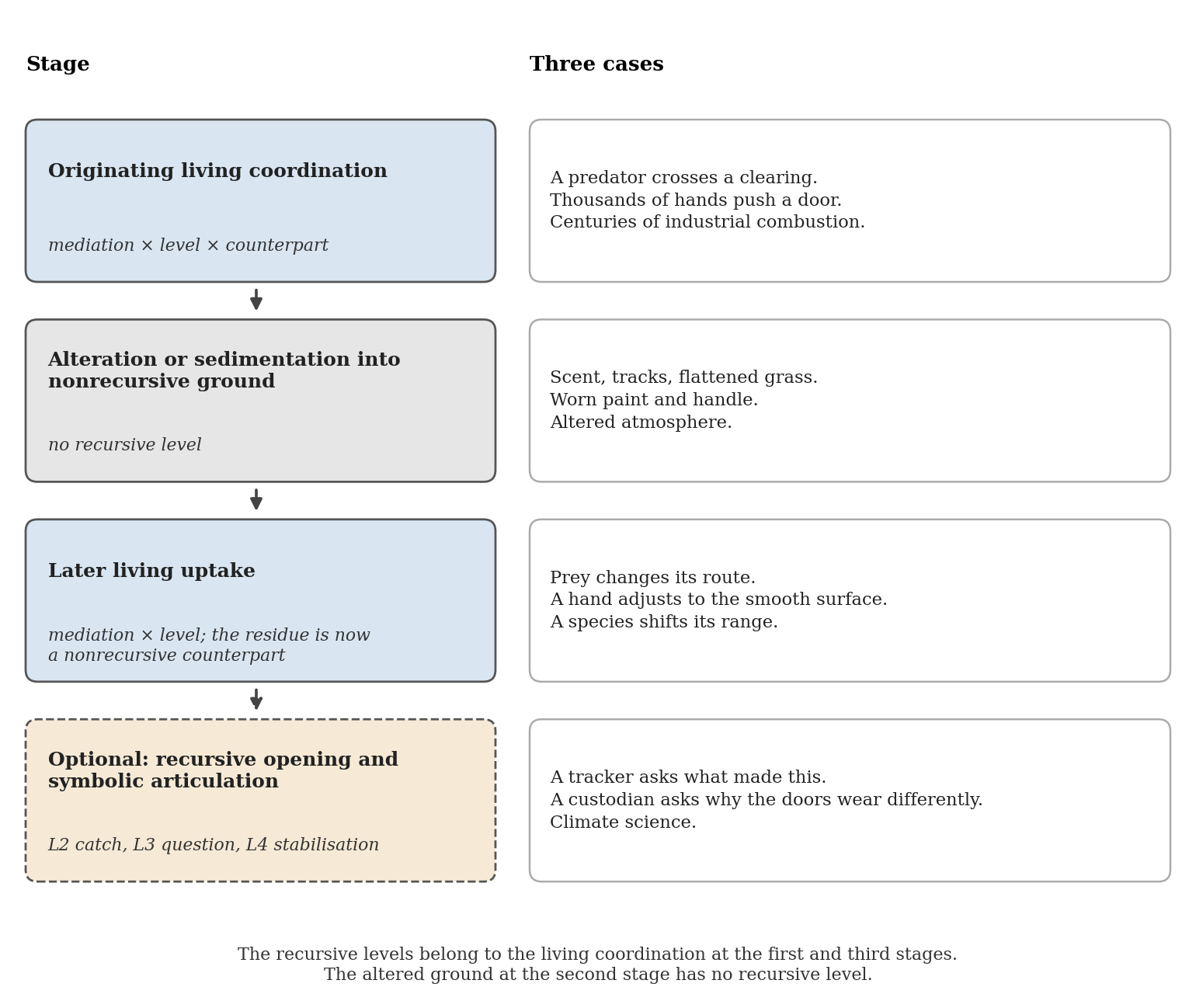
Rather than occupying another box beside the five mediations, immedial coordination describes a passage through the existing architecture across time, and the architecture is best applied by asking three questions of each phase of the passage (see What Is the Mesocosm? and What Is Recursivity?). Which mediations are involved? At which recursive level does the coordination run? Which counterpart is engaged? Figure 1 sets out the passage, and the three axes can then be taken in turn.
The mediation axis
Immedial coordination can proceed through embodiment, being-with, dwelling and multimateriality without multisymbolization constituting the operative relation. Its deepest evolutionary basis lies in the three zoetic mediations of multisensorial embodiment, multispecies being-with and multiversal dwelling, which were in place long before anything symbolic (see Zoetic and Poietic Mediations). Multimateriality enormously expands the possibility of durable nonsymbolic alteration, because made things can hold a modification of the world far longer than a scent or a track (see Things Carry Us Because They Don't Talk Back). Multisymbolization is not excluded from the whole coordination in which a residue is met, and human embodiment, being-with, dwelling and multimateriality can all be densely coupled with it. It is excluded from what makes the residue immedially efficacious. A person can coordinate with a worn door immedially and with the sign on the door symbolically in the same moment. Once the operative difference is functioning as a symbolically articulated distinction, the symbolic sequence takes over for that difference.
The mediational trajectory is not linear, and what produces an alteration need not be what later encounters it. An animal's embodied movement deposits a scent, and a later animal orients by it in embodied fashion. A being-with encounter disturbs terrain, and a later organism coordinates with the altered ground. Repeated movement forms a path, and later dwelling is channelled by the path. Industrial activity alters the atmosphere through its multimaterial emissions, and later organisms meet the change as altered multiversal dwelling. Repeated human handling wears a surface, and later embodied handling changes. In each case one mediation produces and another receives, or the same mediation does both across a gap of time.
Climate change is an exemplary case because it shows that immedial coordination is not limited to small material residues. Centuries of industrial, technological and economic activity alter the dwelling conditions that later organisms encounter. This is a mediational trajectory across time, and no mediation turns into another. Industrial coordination was itself multisymbolic, institutional and interrecursive throughout, and it is not reduced here to multimateriality. What matters is the causal pathway into later dwelling. Emissions are multimaterial, they alter conditions that are subsequently encountered as multiversal dwelling, and later organisms need not engage the symbolic organisation that helped produce industrial activity in order to meet altered temperature, rainfall, seasonality and atmosphere. The case also shows that the line between found and made ground runs through aspects of configurations and not through classes of things. The atmosphere is found for every organism that breathes it, and it is also a deposit of earlier living, as the oxygen released by ancient microbes shows (see From Secretions to Silicon Chips and From Shellmounds to Microplastics).
The counterpart axis
The originating coordination can involve any of the three counterpart configurations. A living being coordinating with nonrecursive matter may leave wear or deformation. A selfrecursive process may leave bodily residues and alterations of its surroundings. An interrecursive encounter may leave disturbed terrain, damaged material, tracks, blood or rearranged space.
Once the originating living process is gone, however, what it left as ground, as distinct from what it left as a living counterpart, is itself nonrecursive. The absent animal no longer answers. The worn door does not answer. The altered atmosphere does not answer. This yields the central proposition of the section: an interrecursive history can sediment into nonrecursive ground. The ground does not respond, and later life coordinates differently because the earlier coordination happened. The same transformation has been described for human life, as the continuous conversion of responsive, effortful living into stable traces that no longer answer back (see "A Very Pretty Home"), and for civilisation, as the intergenerational accumulation of made anchors (see The Ground We Made, the Ground We Found).
A boundary must be drawn here. Not every persisting consequence of prior living coordination becomes nonrecursive. One organism can alter another living organism, and the altered being remains recursive. A parasite, an injured animal, a cultivated plant or a modified microbial community can transmit effects while alive. Where the persisting consequence is itself a recursively living counterpart, the sequence does not yet meet the strict definition developed here. Immedial coordination concerns the sedimentation of prior coordination into nonrecursive conditions.
The recursive-level axis
The strongest clarification concerns the levels. Immedial conditions themselves have no recursive level, because recursive levels belong to living coordination.
A footprint is not at L1. A stain is not at L2. A worn stair is not at L3. Uptake has a recursive level.
The same alteration may be encountered at L1 by thousands of organisms, catch at L2 for one of them, become an L3 question for another, enter an L4 scientific classification and eventually become the subject of L5 theoretical repositioning (see The Wonder of What Works Well and Recursive Openings). Residues differ enormously in how long they hold and how reliably they can be counted on, and these differences belong to the nonrecursive ground and to the mediation through which it is met. A scent is stable for minutes, a track for a season, a worn step for decades and a changed atmosphere for centuries. Recursivity, stability, predictability and controllability are distinct properties, and the stability landscapes of the five mediations are not alike (see The Ground We Made, the Ground We Found). The immedial passage is therefore uneven in its temporal bandwidth at each phase, which is one reason it cannot be read as a single scale or clock.
The five-by-five-by-three therefore classifies no traces as objects. It tracks the living processes that produce residues and the living processes that later recruit them. A residue is neither an L1 object nor an L2 object, and for this reason immedial conditions cannot be construed as the L1 or L2 counterpart of symbols. It would be a category mistake to say that the footprint is the nonsymbolic counterpart of a spoken word at the same level. Symbols can themselves be taken up at L1, and fluent reading proceeds without separate salience. The difference between the two lies in the mediation through which a difference has been stabilised, and the level at which it is taken up can be the same.
IV. The Normal Condition: Immedial Coordination at L1
Most immedial coordination is probably never noticed. Living beings continuously coordinate through worlds that earlier lives have modified. Worn paths, changed surfaces, smells, residues, altered vegetation, compacted soil, habitual routes, depleted resources, modified microclimates and accumulated arrangements of material become part of the practical ground. Normally nothing needs to become salient. A hand encounters a polished handle. A foot adjusts to a worn step. An animal follows an established route. A bird uses a structure altered by earlier occupants. Someone walks past marks on a wall for ten years without asking why they are there.
This is L1 uptake, which means absorbed coordination without separate salience. It is no unconscious representation and no tacit interpretation, because nothing is represented and nothing is interpreted. The symbol article insists that L1 coordination precedes separate salience and that L2 is questionability and no unspoken proposition (see What Do Symbols Do?). Immedial coordination supplies perhaps the clearest environmental demonstration of that principle. The condition is simply ground, and the success with which it supports coordination is the reason it is not noticed (see The Wonder of What Works Well).
Immedial coordination can also run in loops. A hand shapes a handle by use, and the handle shapes the hand's later use. Walkers wear a path that then guides walkers, so that an early deviation across a field becomes the route that most later walkers take without ever having chosen it. The loop passes through nonrecursive ground and across a gap of time, and neither party need be aware of it. Many forms of skill are of this kind. A craftsperson's tool, a regular's chair and a cook's worn surface are both made by and making of the coordination that uses them.
An articulation asymmetry follows, and it can be stated as a hypothesis. The volume of prior living activity that remains consequential in present coordination vastly exceeds the fraction that ever becomes symbolically articulated. This is an empirical hypothesis, and it is difficult to quantify. Most immedial history may never reach L3. The word trace therefore needs care. Analytically a causal residue of earlier coordination may be identifiable, and for the organism that meets it the residue may be nothing more than ground. Nothing is being read.
The toilet doors illustrate the point. Thousands of interactions produce differential wear, thousands more users accommodate themselves to the worn surfaces without noticing them, and the accumulated pattern is a history of living coordination that is nobody's history of that coordination. Immedial conditions carry history without narrating history. A more rigorous formulation is that immedial conditions are historically produced without being historically articulate. The pattern encodes no account of who pushed which door. It would not exist had they not done so, and it channels what later hands do.
The consequence for method is considerable. Research disproportionately harvests L3 and L4, because people can say, write, classify, answer interviews and leave archives at those levels, and the great sedimented bulk of L1 coordination is correspondingly underdescribed (see The Wonder of What Works Well). Population statistics offer a parallel case at the symbolic end. Statistical datasets consist of symbolic deposits made after selected aspects of living processes had been observed, classified and recorded (see How Life Became Another Statistic), so that regularities appear among the sediments and say little about the lives that left them. The deeper claim is that the apparent symbolic richness of human history partly reflects an archive bias in favour of what became recursively available. The articulated historical world is a small selection from the consequential historical world, and the history that is symbolically recoverable is only a small subset of the history that remains causally and coordinationally present. Human beings live amid enormous quantities of prior coordination that remain active without ever having been narrated, classified, remembered or even noticed, and the sense of living in a world of meanings is in part a consequence of the sample that records and testimony provide.
V. Recursive Opening: When Ground Becomes Trace
Recursive opening is the transformation that brings an immedial condition into view. What Do Symbols Do? already treats recursive opening as broader than symbolic reopening: something not presently available to recursive engagement can become available through any mediation, and a previously unnoticed pain becoming salient is already an opening with nothing symbolic yet reopened (see What Do Symbols Do? and Recursive Openings). The present article extends the point to sedimented environmental history.
Most immedial conditions were not produced to be read. They have to become relevant, and the path by which they do so has levels. At L1 coordination simply proceeds through the altered ground. At L2 something catches: a surface feels unusually smooth, a smell interrupts movement, two adjacent doors somehow look different, a migration pattern no longer fits expectation. At L3 the catch becomes askable: why is this worn here, what passed through, why has this species moved, why does this wall keep staining. At L4 inquiry stabilises methods, classifications and explanations, and practices such as wear analysis, tracking, archaeology, forensic science, climate science and ethology establish reproducible procedures for making residues evidential. At L5 the stabilised framing itself becomes an object. Revising an explanation inside a framing remains an L4 matter, as when natural climatic variability gives way to anthropogenic cause as the better account. L5 asks about the architecture of the framing: why natural variability and anthropogenic influence became the governing terms at all, whose purposes that pair serves, and what it leaves out.
The two doors can be taken through the whole path. At L1 thousands of users push, pull and kick as they hurry. At L2 one of them, waiting, registers that the paint beside one handle is rubbed through while the other door is barely marked. At L3 the registration becomes a question about why. At L4 a facilities manager, a conservator or a researcher stabilises a method for reading wear, with photographs, counts, controls and a classification of kinds of damage. A revision follows within that classification, at L4: what the cleaning contractor had logged as vandalism is reclassified as the ordinary accumulation of ordinary hands. At L5 someone asks why damage, wear, misuse and normal use organise the evidence in the first place, whose interests those classifications serve, and why a facilities-management ontology was taken as the appropriate frame.
This is a possible trajectory and no normal progression. A very large proportion may remain at L1 throughout the period in which it affects subsequent coordination, although this is empirically difficult to quantify. The path from L1 to L5 is rare, costly and dependent on institutions that make questions legitimate (see Askability), and many residues that could have become evidence never do.
The key conceptual transformation is that recursive opening turns a condition that merely participated in coordination into something available as a trace of prior coordination. Before opening, the worn handle is part of what the hand coordinates with. After opening, it is also a record of what hands have done. This yields a theory of evidence. Evidence does not lie about in the world already labelled as evidence. An immedial difference enters an evidential practice when it is recursively opened and a warranted relation is established between its present form and a process hypothesised to have produced it. The sequence runs from immedial condition through recursive opening to evidential trace.
Warrant matters here. A difference made askable is still far from evidence. A worn surface can have several causes, and the relation between its present form and the processes that produced it has to be argued, with controls, comparisons, instruments and procedures that others can check. The warrant is largely a symbolic achievement, stabilised at L4 and answerable at L5, and the instruments and measurement procedures that support it are multimaterial as well as symbolic. Evidential practice therefore couples a nonrecursive residue to recursive practices of observation, comparison and warrant. The residue supplies the difference, and the practice supplies the claim that the difference is the consequence of this and not that. A theory of evidence that forgot the residue would make evidence a matter of assertion alone, and one that forgot the practices of observation and warrant would suppose that the world arrives pre-labelled.
Science can accordingly be redescribed, in part, as the institutionalised recursive opening of historically silent differences. Tree rings, sediment deposits, wear patterns, spoor, chemical residues, archaeological strata and atmospheric carbon concentrations do not speak. Scientific practices make selected differences askable, comparable and inferentially consequential. The shellmounds of San Francisco Bay, misread as refuse, and Monte Testaccio in Rome, the hill of discarded amphorae that became terrain and the archive of the system that produced it, show how much such opening can recover and how much it can fail to recover (see From Shellmounds to Microplastics). Opening also has a distribution. The symbol article observes that the ability to reopen a symbolic closure is unevenly distributed, because standing, access, time and money are unequally held (see What Do Symbols Do?). The same holds for evidence. Local people may know very well what a change in the river or a path across a hillside shows, and still lack the instruments, institutions and credentials that would make their knowledge count as an opening. Other changes can be opened only by those with satellites, cores and laboratories. Who is able to make a residue evidential, and who bears the cost of what is left unopened, are questions of power as much as of method.
The metaphor of decoding nature's messages should be resisted, since it reinstates universal semiotics by the back door. Science often succeeds precisely by turning what was never a message into evidence.
VI. From Footprint to Climate: The Scales of Immedial Coordination
The concept must not shrink into a theory of small marks on surfaces. Its scales run from seconds to centuries and from a single body to a planet.
At the shortest scale are ephemeral embodied residues: scent, heat, blood, saliva, tracks, disturbed water and crushed vegetation. These can alter later animal coordination minutes or hours afterwards. At a longer scale repeated activity produces cumulative alteration: worn paths, compressed ground, nests, burrows, territorial modifications, rubbed surfaces, doors and staircases. No individual act produces the whole pattern, and the immedial condition is generated through repeated coordination by many who never coordinated with one another directly.
Multimateriality can increase persistence enormously, although made things can also be deliberately temporary. A nest, dam, pathway, shelter, irrigation system, building or machine can alter the coordinational possibilities of beings who never encountered its maker (see From Secretions to Silicon Chips and Things Carry Us Because They Don't Talk Back). A building channels bodies through its doors, corridors and thresholds, and the channelling continues long after its builders have died (see Beyond the Panopticon). The contrast with durable notation is sharp here. Notation requires recoverable invariance, with a carrier, a retrievable form, a route of encounter and competent uptake (see On the Origins of Writing). Immedial coordination requires no recoverable invariant. A surface can simply become smoother. A river can change course. A building can channel bodies. Later beings coordinate with the changed condition whether or not they can recover its history.
Climate change is immedial coordination at planetary scale. Human industrial coordination has altered atmospheric composition and with it the future patterns of temperature, precipitation, seasonality, fire, ice, ocean conditions and ecological range. Later organisms meet these changes as altered dwelling and not as messages from industrial civilisation. Three points follow. First, immediality is not local. Second, it can be cumulative across millions or billions of actions whose agents never coordinated directly with one another. Third, it can outlast the actors who produced it.
Life has been doing this for a very long time. The oxygen released by ancient microbes and the carbon buried by ancient forests are among the deposits of earlier living that later organisms inherited as found conditions (see From Shellmounds to Microplastics). What an organism meets as entirely found ground may itself be the accumulated product of past life. Found and made are positions within present coordination and no eternal ontological properties of environments, since the same configuration can be found in some respects and made in others (see From Secretions to Silicon Chips). Dwelling is in part the accumulated residue of life before humans.
Most residues vanish, and persistence is selective. Matter that has fallen out of the coordination for which it was formed can decay, persist, disperse or be found again (see From Shellmounds to Microplastics), and which of these happens depends on the properties of the ground it enters. What later organisms meet is therefore a sample of what earlier ones left, filtered by the conditions of survival of residues. A related point concerns how such deposits are encountered. A landscape long shaped by management, or a trail laid down by generations of passage, can be met by a later arrival as simply natural, as found ground with no history of making. A historied world often presents itself as nature, and recursive opening is what turns it back into a world that someone made.
The scales connect to differential temporality (see A Process Ontology of Differential Temporalities). A momentary act of combustion can participate in a planetary alteration lasting centuries. The original recursive event is extremely brief, and its consequences enter later nonrecursive ground on entirely different temporal scales. The past is present as causal residue before it is present as anything else (see Mixed Time). The world is not simply inhabited by living processes. It is deeply historied by them, and human multimaterial activity has massively accelerated and extended some forms of that historising.
Neighbouring concepts
Two literatures will occur to any reader. Niche construction theory is concerned with organism-environment modification and with ecological inheritance, the passing of modified environments from one generation of organisms to the next (Odling-Smee, Laland and Feldman 2003). The ethology of stigmergy is concerned with coordination among agents through modifications of a shared environment, as in the building of insect nests (Grassé 1959). Both are close relatives of the present proposal and both are useful to it.
Immedial coordination asks a different question. It asks how previous recursive coordination sediments into nonrecursive ground, how subsequent life recruits that ground through different mediations and counterpart configurations, and how a residue that was transparent to those who used it can undergo recursive opening, from L1 through evidential articulation at L3 and L4. The first literature supplies an account of inheritance, and the second an account of environmentally mediated coordination among agents. The proposal here adds an account of what happens when the inherited ground is itself opened and becomes a question, which neither of them addresses. It is an addition and no renaming, and it is also what allows the concept to say where symbols enter, how a residue becomes evidence, and why the symbolically recoverable part of history is small.
VII. Residue, Cue, Communication, Sign: Drawing the Boundary
The concept has to be protected from collapse into semiotics, and four terms need definition for the purpose. A residue is a persistent consequence of prior coordination, whether or not anything later recruits it. An immedial cue is such a difference insofar as later living coordination recruits it without symbolic mediation. Communication adds a relation in which the producing activity is organised toward affecting another's uptake, and it need not be symbolic. A symbol requires multisymbolic uptake of an articulated distinction. The four form a graded series and no evolutionary ladder. The series also shows why intention cannot be the boundary: communication can be intended without being symbolic, and a symbolic act can have effects that nobody intended.
At one end lies purely incidental residue: a footprint left while moving, polish left by repeated touching, heat remaining in a nest. Next come cues, where the later uptake of a residue is biologically recurrent without any symbolic stabilisation, such as the reliable use by one animal of the marks left by another. Then come deliberate nonsymbolic alterations, such as building a nest or a dam or arranging material conditions, and communicative alterations in which production is organised toward another's uptake without being symbolic, such as perhaps the depositing of a scent whose later uptake by others appears to be directed. At the far end are symbolic deposits whose functioning depends on multisymbolic uptake.
The boundary is drawn by asking whether the later coordination depends upon the difference functioning as a symbolically articulated distinction, or whether the altered condition can reorganise coordination without symbolic uptake. Durability, intention, convention and recoverability are secondary properties and no part of the boundary itself. Durable notation is one achievement among others, and a spoken warning, a gesture, a command or a name is symbolic without it (see What Do Symbols Do?). Cases in the middle of the series, such as scent marking, are empirical questions and cannot be settled by the form of the residue alone.
The category of the index is especially relevant. A footprint is conventionally described as an index of the animal that made it, and Living Value Theory asks whether the word already says too much (see The Embodied Limits of Peircean Semiotics). The footprint can affect later coordination before anyone treats it as standing for an absent animal. Its causal relation to prior life does not make it a sign. Once a tracker recursively opens it and asks what made it, it can enter symbolic inference, but that is an achievement of later uptake and should not be projected backward into the ontological status of the footprint. Causal inheritance is not yet reference. Being informative to an observer is likewise different from being symbolically constituted: a physician can read illness in a gait that nobody produced as a message.
The section must also prevent immedial coordination from becoming a master category. Symbols remain irreducible. They coordinate directly in the situation they name, as a shout of warning does, and they can be taken up at L1 as well as at L3 and L4 (see What Do Symbols Do?). Immedial coordination therefore cannot be defined as low-level symbolisation. Symbols and immedial conditions can both enter coordination at L1, and what differs is the mediation through which the operative difference has been stabilised and taken up. The danger runs in both directions. Treating every residue as a sign annexes nonhuman life to language. Treating every symbol as a residue flattens what notation, law and diagnosis do.
The two kinds of deposit also interact in ordinary life, and the interaction shows why they need to be kept apart. A path across a hill and a signpost marking the footpath coordinate walkers together. The path persists when the sign has gone, and the sign can persist after the path has gone. A map can fix what walkers have worn into the hillside, and a court can treat wear as evidence in a dispute about a right of way. In each case a symbolic deposit stabilises a distinction that an immedial condition made available, or an immedial condition is recruited as evidence in a symbolic institution. Naming can also compress. A residue classified as damage, waste or vandalism acquires the authority of the classification, and the history it carries is read through a form that did not make it. This is the vertical overreach that the symbol article describes, in which a stabilised category appears as though it were simply the thing (see What Do Symbols Do?).
Living Value Theory can thus describe how life coordinates through traces without declaring all life semiotic. The description needs no hidden sentence in the predator's scent and no symbolic competence in the animal that avoids it, and it leaves full room for the point at which a person asks what made the tracks and starts to read.
VIII. An Anthropology of What Nobody Said
The conceptual argument becomes a method. Anthropology is systematically drawn toward articulated materials: interviews produce sentences, archives contain documents, ritual specialists give interpretations, institutions produce categories, and ethnographers produce notes. Immedial coordination calls for a complementary attention to what nobody thought worth saying.
The ethnographer can ask what has been worn down and what has accumulated. What smells different? What paths have appeared? Which surfaces show repeated handling? What has been quietly repaired? Which environmental conditions have been altered by repeated use? Which bodily routines have sedimented into material differences? What previous living coordination is now encountered merely as ground? These questions belong to the descriptive practice of mesocosmography (see What Is Mesocosmography?), and they sit alongside the questions that disclose stakes (see Whose Problem Is This?).
The two toilet doors become an exemplary miniature ethnography. The first methodological act is to notice that they have aged differently, and interpretation of what they mean comes later, if at all. Recursive opening then supplies the question: why? Opening depends on what catches attention and on what does not (see What Catches Our Attention, and What Does Not).
Methodological restraint is required. Immedial conditions do not contain their causal histories transparently, and a worn surface can have several causes. Recursive opening creates a question and cannot supply its answer. The method therefore calls for reconstruction. It asks what sequence of living coordinations could have produced the present condition, and how that condition now enters further coordination. Interpretive habits that assume the residue carries a latent message look for a speaker, and the reconstructive question looks for a history.
In a household the ethnographer can attend to which chairs are worn and which are spared, where the floor has been scrubbed hardest, where paint has darkened around a switch, which stair treads are polished and which untouched, and where the kitchen shows a lifetime of standing. In a village the equivalents are the worn lanes, the rubbed thresholds, the places where the ground is bare under a tree where people wait, and the mended walls. None of these needs an informant to be of use, and each can be photographed, counted and compared across households and across years. Nobody has to say anything for the pattern to exist, and the pattern may show a division of labour, a hierarchy of seating, a rhythm of the day or an anxiety about a door that no interview mentions.
The method has limits that should be stated. Residues can be over-read, and wear can be taken for destiny. Reconstruction produces hypotheses that must be tested against other evidence, including what people say, and it has ethical dimensions of its own, because the traces of intimate use can reveal what the users did not choose to disclose. A residue must also be read in company with accounts and not in place of them.
The approach gives mesocosmography a way of reaching below articulate accounts without claiming privileged access to a hidden truth. A person's account of how a door is used and the pattern of wear on the door can differ, and the difference is data about the relation between L3 and L1 coordination. Neither is the real one. The residue can become evidence about what was done, and the account is evidence about what was said, and a description that has both is better than a description with one.
IX. Conclusion: The Silent Historical Depth of the Mesocosm
Return to the three opening cases. None requires a symbol for the past to remain consequential. The predator's scent matters to the animal that avoids it, the pattern of wear channels the hands that use the doors, and the altered atmosphere shapes the lives of organisms that have never heard of industry.
The architecture can now be restated. Prior living coordination alters nonrecursive ground, and subsequent living coordination proceeds through the altered ground. The original coordination can involve different mediations, recursive levels and counterpart configurations. The resulting alteration has no recursive level, and its later uptake does. Most uptake remains at L1. Occasionally an L2 catch opens it. More rarely L3 articulation turns it into a question, and L4 may stabilise it as knowledge. The relation is a temporal passage through the five-by-five-by-three and no sixth entity beside the five mediations.
Five points deserve to be kept from the argument. Immedial coordination is a temporal process in which prior recursion alters nonrecursive conditions and later recursion coordinates through them, and it names no object. Absence was consequential before reference to absence existed. Recursive levels belong to living uptake, and the residues themselves have none. The ordinary state of immedial coordination is invisibility, and recursive opening is what makes a previously unremarkable difference relevant, so that the question of origins can then arise. And the history that is symbolically recoverable is only a small subset of the history that remains causally and coordinationally present, which gives Living Value Theory a way to theorise historical depth without reducing history either to symbolic memory or to material causation.
Placed beside What Do Symbols Do?, the present article completes a pair. That article concluded that symbols make distinctions travel, allow absence to matter, institutions to form and prior coordination to become portable (see What Do Symbols Do?). This article establishes the other side of the human and animal world. Absence mattered long before it could be represented, and a predator could matter after leaving because the world retains the consequences of its having been there.
Life does not inherit only genes, bodies, relations or symbols. It inherits worlds already altered by previous living. Most of those alterations are never read because they were never written. They enter coordination as ground, occasionally become salient, and only rarely become questions. Immedial coordination names this silent historical depth of the mesocosm.
Selected References
Grassé, Pierre-Paul. 1959. "La reconstruction du nid et les coordinations interindividuelles chez Bellicositermes natalensis et Cubitermes sp." Insectes Sociaux 6: 41–83.
Odling-Smee, F. John, Kevin N. Laland, and Marcus W. Feldman. 2003. Niche Construction: The Neglected Process in Evolution. Princeton: Princeton University Press.
Living Value Theory corpus references
Askability: Toward a New Method for the History of Ideas
Beyond the Panopticon: Architecture as the Multimaterial Mediation of Recursivity
The Embodied Limits of Peircean Semiotics
From Secretions to Silicon Chips: The Evolutionary Emergence of Multimateriality (Made Things 1/7)
From Shellmounds to Microplastics: Multimaterial Afterlives (Made Things 7/7)
How Life Became Another Statistic: Symbolic Sedimentation and the Ontology of Population Statistics
Mixed Time: Pastness, Futurity, and the Differential Temporalities of Living Value
On the Origins of Writing: Notation Systems as Recoverable Invariance (Series: You Are My Rock)
A Process Ontology of Differential Temporalities (It’s Time 1/6)
Recursive Openings: From Ground to Question and Back to Ground
What Are the Five Mediations? (Core LVT 3/4)
What Catches Our Attention, and What Does Not: An Introductory Lecture to Anthropology
What Is Mesocosmography? (Core LVT 4/4)
What Is Recursivity? (Core LVT 2/4)
What Is the Mesocosm? (Core LVT 1/4)
The Wonder of What Works Well: How Living Value Theory Discovers Questions
Zoetic and Poietic Mediations and the Evolutionary Threshold of Homo sapiens