Abstract
British WWII reenactments are routinely analysed as performances of collective memory, as ritualised reproductions of a heroic national narrative. This article argues that such analyses mistake the most durable mediation for the most important one. In Britain the symbolic history of the war is already massively stabilised by schools, museums, television, commemorative rituals, monuments and archives, so reenactment is not needed to transmit it. What reenactment distinctively provides is a multimaterially enabled re-entry into embodied and relational coordination. Drawing on ethnography at three UK events, we show that wool uniforms, rifles, vehicles and pyrotechnics make bodies hot, constrained and attentive, and that hierarchy, discipline and shared timing turn those bodily states into a new being-with among living reenactors. Multimateriality does most of the enabling work, embodiment and being-with are the principal lived achievements, and multiversal dwelling and multisymbolization carry comparatively little of the distinctive coordinational load. We call this unequal mediational loading. The men whose war is reenacted do not return, and what the events exclude (injury, terror, ruination, dependence for survival) marks the limits of controlled re-entry. The persistence involved is neither memory stored in matter nor resurrection. It is the material afterlife of a past coordination.
I. Inside a Stuffy Ambulance Car
On a baking August afternoon in 2024, with the sun still high in the sky, the first author sat in the back of an ambulance made in the 1940s, with a man he had only just met. Flushed in the face, with droplets gathering on his forehead, he could see the man's discomfort sweating through his tunic. The ethnographer had been able to choose what to wear: shorts and a baggy t-shirt. The reenactor was not so fortunate. As they sat and conversed they were periodically interrupted by explosions that shook the ground and made the metal cab of the ambulance vibrate. It was at this seemingly surreal point, when the ethnographer's ears began to ring and the reenactor appeared to swelter more than ever, that the question was asked: 'What is the point of all this?' The answer, like the answers given by the reenactors he spoke to that summer, was immediate and rehearsed: 'to educate and commemorate.'
This answer is not wrong, though it is formulated at a level that does not exhaust what is happening. In that ambulance there is heat, vibration, acoustic shock, bodily constraint, shared disorientation and the impossibility of maintaining a normal conversational register. These are not merely the background conditions of a symbolic event. They are constitutive parts of the event. The reenactor's sweat does not stand for wartime hardship; it is sweat, produced by wool against skin in August and enforced by a disciplinary code that requires uniforms to be worn to a high standard of presentation, on pain of holding one's rifle above one's head for a prolonged period. Ten press-ups for leaving a safety catch off. The body is held inside a particular configuration of constraint, sensation and shared attention, and it performs a message only in part.
The scene poses an empirical puzzle. Why would anyone need to reenact this if the aim were to know or to transmit what happened? Books, documentaries, museums, archives, schools and memorial ceremonies do that far more efficiently, and in Britain they do it on an enormous scale. What reenactment offers that they cannot is the opportunity to undergo something. The question is what exactly is undergone. What reenactors undergo is a carefully selected set of embodied and relational coordinations that resemble aspects of military life: heat, discipline, physical constraint, weapon handling, coordinated movement, acoustic intensity, hierarchical interaction, temporary comradeship and collective attention. That falls well short of the war itself, and of wartime experience in any strong historical sense.
Drawing on Living Value Theory (see Core Principles (August 2026)) and ethnography at three events, we argue that British WWII reenactment shows unequal mediational loading. The five mediations are irreducible to one another, and they do not carry equal weight in every practice. Here multimateriality enables the event, embodiment and being-with are what participants principally undergo through it, and multiversal dwelling and multisymbolization carry comparatively little of what the events uniquely provide. The men whose war is reenacted are dead, and their bodies, comradeship and fear cannot return. Their uniforms, weapons and vehicles can be collected, restored and recruited into new living coordinations, which makes reenactment a limit case for a question about multimateriality: how can made matter preserve, constrain or reactivate forms of coordination after the original living actors have disappeared? We call the selective and partial reassembly of a coordination re-entry.
Section II describes the events. Section III examines the symbolic bias of cultural memory theory, and Section IV sets out the mediational architecture. Sections V and VI analyse what reenactment assembles and what it produces. Section VII asks why such events take this form in Britain, and Section VIII returns to the ambulance.
II. What Reenactment Actually Assembles
The first author attended three WWII reenactment events in one summer: a small gathering of approximately one hundred people at the Dumfries and Galloway Aviation Museum in Scotland, a mid-sized event of around three thousand near Bradford in West Yorkshire (the Yorkshire Wartime Experience), and the Victory Show near Leicester, the largest reenactment event in the UK, drawing upwards of five thousand attendees, where organisers build a grass runway each year for WWII-era aircraft. The two English events were held on repurposed farmland, and the Scottish site was attached to a permanent aviation museum with displays of WWII scenes and militaria. All three were in rural settings, and none lasted longer than three days. Crowd composition is described from field observation and no systematic demographic data were collected.
What follows describes what these events are like to be inside, which is to say what they do to bodies, attention and coordination as well as what they mean. The theoretical work of the article depends on the density of this account.
The soundscape is the first thing to register. At the Yorkshire Wartime Experience a sonic constant haunted every waking hour: the music of Paul Fenoulhet and The Skyrockets, a typical English jazz orchestra of the 1940s, playing over the Tannoy system. To the ethnographer the songs sounded largely similar from one to the next, but to regular attendees they established something specific: a cultural atmosphere associated with slow dancing, the home front wireless and the intervals between battle. Peaceful music, for an inherently unpeaceful time. If the organisers had chosen to play gunshots or screams of dying soldiers, noises equally associated with the period, the atmosphere would have collapsed. The selection is a careful calibration of which sensory conditions will be assembled and which will not, and it is far from arbitrary.
Against this background the battles erupt with disorienting force. Pyrotechnics are buried in the ground before each engagement and detonated in planned sequence. Some explosions are large enough to feel the heat from at a considerable distance. Blank rounds are fired from rifles and machine guns at ranges far closer than any historical engagement would have involved, a point acknowledged by reenactors themselves. One participant explained that 'there are serious limitations as battles would have occurred at much longer distances … but to not do these would be revisionist.' The sound of constant, close-range gunfire is historically inaccurate and materially productive. It generates an acoustic pressure and a disruption of attention that long-range fire, however realistic, would not.
The material infrastructure of these events is elaborate. Stalls sell objects unearthed from battlefields: soldiers' helmets, fragments from Luftwaffe aircraft accompanied by corresponding photographs, and landmines displayed on tables next to garden ornaments and memorial crosses marketed as temporary headstones. Deactivated firearms are handled by spectators who flock to touch them. The first reenactor the ethnographer interviewed said that what initially drew him to the hobby was 'the guns.' He described them as 'really nice' and 'cool,' and could recite the worth, rarity, calibre and serial number of each weapon in his collection. He did not mention that many of these firearms, of both Allied and Axis origin, were designed and used to end lives. At one event a large tarpaulin banner depicting the film Fury was on sale, bearing the tagline 'BEST JOB I EVER HAD': merchandise sold at an event ostensibly dedicated to commemorating those who died in the war it fictionalises.
The spatial staging is constrained by a structural fact. Britain fought no land battles on its own soil during WWII, so all reenacted engagements must depict foreign places on English farmland. Battles therefore cannot portray the ruination of war, and before and after an engagement the field looks largely the same. At one event the Battle of Monte Cassino was reenacted, a battle that levelled the town of Cassino and that some historians have counted among the war's most difficult urban destructions to justify (Murray and Millett 2000). In the reenactment the destruction amounted to a few pyrotechnic explosions, and there was no acknowledgement of the ruination caused by British artillery and bombing. What was spatially valued was British soldiers falling. What was spatially absent was Italian homes destroyed.
By visible impression, almost all the reenactors the first author met were men, and almost all appeared to be white. Many attendees came as families, and some displays were run by families who reenact together. Among the reenactors is a group of six men who represent a division of the Lancashire Fusiliers, 'the forgotten army,' which served in India and Burma during WWII and has been, as one member put it, 'lost in the grander narratives of history.' They place their small display in woodland to emulate a jungle, and report that spectators engage with them more deeply than with larger, more spectacular set-ups. All six have kin who served in that division. They use family stories to shape how they reenact, though they insist they are 'not trying to be those men.' One described how a veteran he had befriended through reenacting the veteran's old regiment was moved by the fact that reenactors were 'so interested in displaying what it was like to live in war and not just kill.' These family stories, veterans' accounts and kin connections are among the conduits through which a general historical frame is particularised into individual commitment, and they are far from incidental colour.
The feeling of these events is comparable to any large festival: wristbands, barriers, marshals in high-visibility clothing, cadets handing out leaflets. A man was overheard saying to his friend, 'I don't know what John would think of this … he's either Scottish or Northern Irish,' revealing in passing that even within a seemingly unified frame of British remembrance, differences of national identity remain active. These events produce shared conditions of experience within which individual positions continue to diverge, and they produce no consensus.
Each day follows the same temporal arc. Morning is given over to browsing, food stalls and interactive activities: BB gun shooting ranges, fortune tellers and a British Army recruitment trailer. Intensity builds through the afternoon with skirmishes, vehicle demonstrations and the day's main battle. Then, abruptly, the register shifts. The Ode to Remembrance is recited. The Last Post is played on the bugle. Two minutes of silence are observed by everyone present, one or two thousand people who, minutes earlier, were watching explosions advertised on the event's website as an 'ACTION PACKED & FUN DAY OUT FOR ALL THE FAMILY.'
III. The Symbolisation Bias in Cultural Memory Theory
The study of collective memory, running from Halbwachs through the Assmanns to Nora, is not uniform, and its members differ in what they notice. Halbwachs (1992) established that memory is socially constructed and sustained within shared frameworks, which are largely narrative and institutional. Aleida Assmann (2021: 26) defines cultural memory as a system of values, artifacts, institutions and practices that retain the past for the present and the future, and Jan Assmann (2011) develops the framework through monumental case studies in which structures such as pyramids figure chiefly as media of retention and transmission. Nora (1989) recognises that memory is anchored in places, buildings and objects. Connerton (1989) theorises incorporating practices and bodily memory explicitly. Durkheim (1912) gave collective effervescence a central place, and with it bodily synchronisation and affective intensity. Work on sound and the senses (Damousi and Hamilton 2017), on haptic knowledge (Paterson 2009) and on reenactment as an affective practice (Gapps 2009; McCalman and Pickering 2010) has moved further in the same direction. We build on all of it.
A diagnosis nevertheless holds across these differences. Even when cultural memory theory attends to bodies, places and things, it does so under the gravitational pull of multisymbolization. Bodies embody memory. Objects carry memory. Places signify memory. Rituals transmit memory. The other mediations are treated as supports, vehicles or repositories of symbolic continuity, and they are rarely treated as irreducible forms of coordination in their own right. Nora tells us where memory is condensed in places and objects, and he asks what a site encodes and what identity it stabilises. Connerton's interest lies largely in how social forms are transmitted and sustained, so that the body appears chiefly as the site where social memory is incorporated. Later representational readings of Durkheim reabsorb his effervescence into solidarity and symbolism.
The pull has an obvious source. Symbols leave records, and scholarship is drawn toward forms of memory that leave durable deposits and are therefore the most accessible to it. The tradition takes symbolic survivability as evidence of symbolic primacy. It mistakes the most durable mediation for the most important one, and it confuses what leaves the clearest archive with what does the most work in an event. Life is recursive coordination across irreducible mediations, much of which never becomes separately available in symbolic form, and a practice whose distinctive work lies in that unarchived part will be seen only through its symbolic residue.
Reenactment exposes the distortion. A deactivated rifle is not important merely because it signifies the past. It weighs something. It constrains the hand, it makes noise when fired, it requires maintenance, and it reorganises posture and movement. These operations do not need to pass through symbolic interpretation before they matter. The same holds for being-with. A reenactor does not first have to interpret another reenactor as symbolising wartime comradeship before adjusting pace, responding to a command or synchronising action with others. Cultural memory theory has described with great sophistication the symbolic stabilisation that frames such events. That framing is the condition of the events, and it is where the theory stops.
IV. Living Value Theory and Unequal Mediational Loading
Living Value Theory holds that life is continuous recursive mediation in a mesocosm (see What Is the Mesocosm? and What Is Recursivity?). There are five irreducible mediations: multisensorial embodiment, multispecies being-with, multiversal dwelling, multimateriality and multisymbolization (see What Are the Five Mediations?). The first three are zoetic, shared in graded forms with other animals, and the last two are poietic and enormously elaborated in humans. Dwelling concerns found nonrecursive conditions such as terrain, weather and climate. Multimateriality coordinates made nonrecursive material ground: things carry coordinative weight because they do not answer back, so that a uniform keeps its form and a rifle keeps its weight and balance from one handling to the next (see Things Carry Us Because They Don't Talk Back). A material difference becomes multimaterial mediation when a living being recruits it into its further coordination (see From Secretions to Silicon Chips). Two further analytic questions can be put to any coordination. The first concerns recursive level. At L1 coordination is absorbed and proceeds without becoming separately salient. L2 is felt misalignment, the minimal threshold at which something catches. L3 articulates the catch as a question or a name, L4 is stabilised classification and institutional reflexivity, and L5 repositions or reopens such stabilisations (see The Wonder of What Works Well). Symbols do not belong to the higher levels by nature: fluent reading, habitual naming and familiar ritual words coordinate at L1, and a symbolic misfit can register at L2 (see What Do Symbols Do?). The second concerns the counterpart with which a living being coordinates, which may be nonrecursive, selfrecursive or interrecursive.
The five mediations cannot be reduced to one another, but they need not carry equal coordinational load in any particular practice. WWII reenactment is a particularly asymmetric case. Multimateriality supplies the enabling architecture of the event. Embodiment and being-with are the principal dimensions of what participants undergo through it. Multiversal dwelling contributes comparatively little, because the events take place on contemporary British farmland and not in reconstructed wartime environments. Multisymbolization is indispensable as framing and legitimation, but much of its historical work has already been done elsewhere. Reenactment therefore concentrates its distinctive activity in multimateriality, embodiment and being-with. This is a case-specific finding about differential mediational loading, and it implies no hierarchy of mediations. The mediations remain irreducible and share no common scale. Dwelling is necessary because the event must happen somewhere, and which somewhere is remarkably replaceable. Symbolisation is necessary because participants must know what is being reenacted, and its historical content is available from other sources. Multimateriality is much less replaceable, embodied consequences are the experiential point, and being-with makes them collectively lived.
V. Multimaterial Reassembly
Made things make the coordination possible
The causal architecture of the events can be stated simply: multimaterial reconstruction produces changed embodied coordination and changed being-with. A wool uniform produces heat, restriction, altered posture and fatigue. A rifle produces a grip, a posture, a vigilance and a set of handling practices. A vehicle produces vibration, sound and a constrained bodily position. Pyrotechnics produce acoustic shock, flinch and disruption of attention. Military kit alters movement and the practical sequencing of tasks. Collective activity in units produces synchronisation, hierarchy, watching and responding, and the disciplinary code produces interrecursive enforcement through material consequences: a rifle held overhead, ten press-ups, a body held to a standard of dress in August.
The made things make the embodied and relational coordination possible, and no description of the events as symbolic reenactment with sensory decoration added can capture this. Without the wool there is no thermal stress, and without the vehicle there is no vibration. Without the shared kit, the shared constraints and the shared sound there is little for collective attention to organise itself around. The spectators who flock to touch deactivated firearms show the principle in miniature: when a spectator lifts a rifle, adjusts the grip and registers the weight, an object with a history has entered a coordination.
Originals, replicas and functional equivalents
The matter that reenactment recruits stands in several different relations to the past. A helmet unearthed from a battlefield is the same matter that was once worn. A restored vehicle preserves much of the original and has been rebuilt in other respects. A replica uniform reproduces a form without any continuity of material. A pyrotechnic charge produces some effects of a shell, heat and pressure and sound, without being anything like one. These relations differ radically in historical continuity, and their material efficacy in the present may overlap almost completely. An original tunic and a replica tunic can both make a body hot. An original rifle and an accurate reproduction can impose similar posture. A charge can produce a sensory consequence without resembling the shell that supposedly caused it.
Reenactment is therefore not organised simply by representational fidelity. Sometimes material effectiveness is more important than historical identity, and the events make a distinction that the stalls themselves draw. Fragments from Luftwaffe aircraft are sold with photographs documenting where they came from, so that provenance is made explicit exactly where it carries value that the matter alone does not. Provenance can organise relations among the living, as when a collector recites the rarity and serial number of each weapon, or when a veteran's own item carries a relation to its former owner. Material efficacy and symbolic provenance can come apart in analysis and be bound together in practice, and a full account of re-entry has to follow both.
Inaccuracy as evidence
The close-range blank fire is the exemplary case. It is less historically accurate and more experientially effective than fire at historical distances, and participants know it. If reenactment were primarily symbolic representation, greater accuracy would generally be preferable. Participants instead deliberately sacrifice representational accuracy to produce the right bodily effect, and they justify the sacrifice in symbolic terms: to omit the battles would be 'revisionist.' The symbolic frame legitimates what the material choice has already decided.
The same pattern runs through the events. English farmland becomes Italy. Woodland becomes Burma. Harmless pyrotechnics become shelling, and blank rounds replace lethal ammunition. Heat and discomfort are retained, and mutilation and death are excluded. The events select for mediational effects and do not simply reproduce historical reality. This is probably the most convincing empirical finding of the study, because representational fidelity would predict the opposite choices.
Years of material labour
The reenactment visible on a summer weekend is the culmination of a much longer process. Participants have spent years, sometimes decades, acquiring specific weapons, training their bodies to handle them correctly, studying the details of battles and units, and cultivating the embodied competencies that allow them to operate within the event's constraints. The Lancashire Fusiliers group consists of men whose kin served in the division. This slow, costly alignment of body, material, knowledge and social relation is constitutive of the event and no preparation for it. The reenactment activates capacities that have been built over months and years of embodied, material and social work distributed far beyond the event, and it creates none on the day.
VI. What Reenactment Produces
What is undergone
What reenactors undergo is first of all embodied: sweating inside wool, ringing ears, vibration through the floor of a vehicle, the weight of a rifle held for a long time, the flinch at a detonation, fatigue in the heat. These states are felt at L1 and L2, in the course of handling kit and keeping pace, long before anyone names them. The ethnographer in the ambulance registered some of these states in his own body, in shorts and a t-shirt, without being subject to the discipline that produced them in the reenactor. Participants return for such experiences year after year, investing thousands of pounds and hundreds of hours.
A new being-with
Being-with is the second principal outcome, and it is what turns individual sensory experience into coordinated collective experience. Reenactors act as units, and a unit supplies military hierarchy, correction and discipline, mutual timing, shared attention and the handling of objects together. Group identities are built over years. Whole families reenact together, and the Lancashire Fusiliers group pursues its reenactment through family stories and through relations with veterans. At the end of the day crowds of one or two thousand people stand in collective silence in the same sensory field they have just shared.
The original being-with of the war cannot return. The comradeship, the hierarchy and the existential interdependence of the soldiers were lived with counterparts who were dead before most reenactors were born. Reenactment does not restore the being-with of wartime comrades. Multimaterial reconstruction generates a new being-with among living reenactors, shaped by selected constraints modelled on military coordination. What returns is neither the dead men nor their relationships. New relationships are organised through matter left by their former lives, copied from it or attributed to it, and the Fusiliers say as much when they insist that they are 'not trying to be those men.' They orient toward deceased counterparts, using family stories and objects to do so, and they take up positions of their own within a present coordination.
What can and cannot return
Re-entry is selective and normatively bounded, and what is left out is as informative as what is assembled. The events allow, in embodiment, heat, fatigue, noise and minor discomfort, and they exclude injury, mutilation, terror, starvation, permanent disability and death. They allow, in being-with, hierarchy, cooperation and a comradeship-like synchrony, and they exclude real dependence for survival, grief at the deaths of comrades, coercion, desertion and betrayal. They allow, in multimateriality, weapons, uniforms, vehicles and camps, and they exclude live explosives, destroyed homes, corpses and ruined infrastructure. There is no friendly fire in any observed reenactment. There is no shrapnel. The Monte Cassino reenactment brought pyrotechnic detonations and British soldiers falling onto English farmland and left out the destruction of the town.
This is what controlled re-entry means. The events recreate stakes without allowing them to become terminal stakes. Heat is experienced without lethal heat, explosions without wounds, weapons without bullets, hierarchy without court martial and battlefield coordination without battle. We can call this a metabolically buffered re-entry, in which the stakes that make living coordination vital remain registered at L2 and are held below the threshold of harm (see What's Vital?). Buffering helps to explain why war can become leisure, because the experience becomes enjoyable precisely because the metabolic stakes are buffered. The absences also map the boundary of what can be reassembled in public without the event ceasing to be an acceptable one, and they are no oversight.
Why the contradictions dissolve
A persistent puzzle in the study of reenactment is ambiguity. How can family fun, spectacle, solemn commemoration and commercial trade coexist within one event, and how can an 'ACTION PACKED & FUN DAY OUT FOR ALL THE FAMILY' end with two minutes of silence? The literature treats ambiguity as a problem to be resolved or as a productive tension (Eco 1989; McCalman and Pickering 2010). Part of the puzzle disappears once the unequal loading of the mediations is recognised. Read as statements, entertainment and commemoration belong to different normative registers and appear incoherent. Read as coordination regimes, they are different configurations of sensory intensity, bodily constraint, collective attention and temporal pacing, sequenced across a day, each locally coherent and none requiring integration into a single meaning.
The 'cool' gun shows the principle most clearly. A rifle is simultaneously multimaterially interesting, embodiedly satisfying to handle and symbolically morally charged. Nothing requires these three evaluations to coincide, because they arise through irreducible mediations that carry different loads in the encounter. The contradiction appears when an analyst expects a single symbolic attitude to organise the whole encounter. Not every ambiguity dissolves in this way. Whether a banner reading 'BEST JOB I EVER HAD' is compatible with commemoration is a live moral question at L3 and L4, and participants and observers can answer it differently. Separating the mediations does not settle that question, though it helps to show where it lies.
VII. Why Britain? Symbolic Saturation and Material Freedom
The symbolic work around British WWII is institutionally outsourced. Participants enter events that already sit inside an enormous symbolic infrastructure: school history, Remembrance Sunday, the Poppy Appeal, television documentaries, feature films, museums, memorials, family histories, anniversaries, political rhetoric, books, archives and heritage institutions. That infrastructure tells them which war this is, who fought, which side Britain was on, what counts as sacrifice, what remembrance requires, why the dead deserve commemoration, what uniforms and insignia refer to and why the event is morally legitimate. Reenactors do not have to manufacture this interpretive framework anew, and their time and money can go instead to buying kit, restoring vehicles, maintaining weapons, training bodily competencies, coordinating groups and producing sensory intensity.
The recursive relation is the interesting one. The institutional stabilisation of multisymbolization at L4 is the condition for its relative withdrawal within the event itself. We can ask what symbolic work would fail if the reenactments disappeared tomorrow, and the answer is very little. The symbol 'British WWII soldier' can function at L1 as settled background, and it need not be attended to for the event to proceed. Symbolic saturation therefore frees reenactment from performing symbolic transmission as its distinctive function, and reenactment can do something else. This is a stronger claim than the claim that symbolic stability permits such events. It also accounts for the substitutability of dwelling: the events can happen on English farmland because the distinctive experiential work is carried elsewhere. The Fusiliers' choice of woodland to suggest jungle shows the minimal adjustment of dwelling that is needed, since the trees need only provide enough environmental affordance to support the material and embodied coordination.
The stabilisation is powerful and it is contestable. It is a form of heroic memory that, as Chakrabarty (2007) observes, becomes possible because Britain emerged on the winning side (see also Ecks 2023), and it supports what Sontag (2003) calls an illusion of consensus. The ethnography itself records differences of national identity that survive within the frame, the selective absence of destruction from the staged battles, and a division of the army 'lost in the grander narratives' that has to defend its place within the heroic story. A dominant heroic stabilisation is institutionally available and strong enough to frame these events, and it does not make the whole symbolic order settled.
Germany offers a theoretical contrast, and a qualified one, since we have no ethnography of German events. The hypothesis is that where WWII remains more recursively open at the symbolic and institutional level, an event cannot so easily allow multisymbolization to recede into background framing. Symbols themselves demand attention. Certain uniforms, insignia and military formations may immediately become L2, L3 or L4 problems, so that the material assembly is repeatedly pulled back into symbolic scrutiny, and legal restrictions on some symbols would add their own force. Opening, in this sense, is a recoordination through which a sedimented ground becomes newly available to engagement (see Recursive Openings). Germany is useful as a contrast and no evidence of an absence. It suggests that multimaterial freedom depends on symbolic settlement elsewhere.
VIII. The Dead Do Not Return
Re-entry and material afterlife
We use remembering for a present recursive re-coordination conditioned by traces left by prior coordination. Re-entry constructs a present coordination that resembles selected aspects of a past one. In reenactment, re-entry depends disproportionately on multimaterial reconstruction, because the symbolic past is already available through other channels.
Re-entry is never literal. Recursive processes have already changed the conditions of the present, so the same coordination cannot recur. What can be done is to make selected relations similar enough to be recognisable again, which is a matter of selective invariance recoverable by a later party (see On the Origins of Writing). The traces available are uneven, because the mediations run on unequal temporal bandwidths (see A Process Ontology of Differential Temporalities). The soldiers' bodies are gone and the veterans are few, whereas uniforms and weapons survive in large numbers, as nonrecursive traces that no longer answer back (see "A Very Pretty Home" and Mixed Time). Made matter that has fallen out of the coordination for which it was formed can be stored, sold, found, collected and recruited again, and this is its material afterlife (see From Shellmounds to Microplastics).
Symbolic stabilisation, material opening, embodied and relational coordination, symbolic reclosing
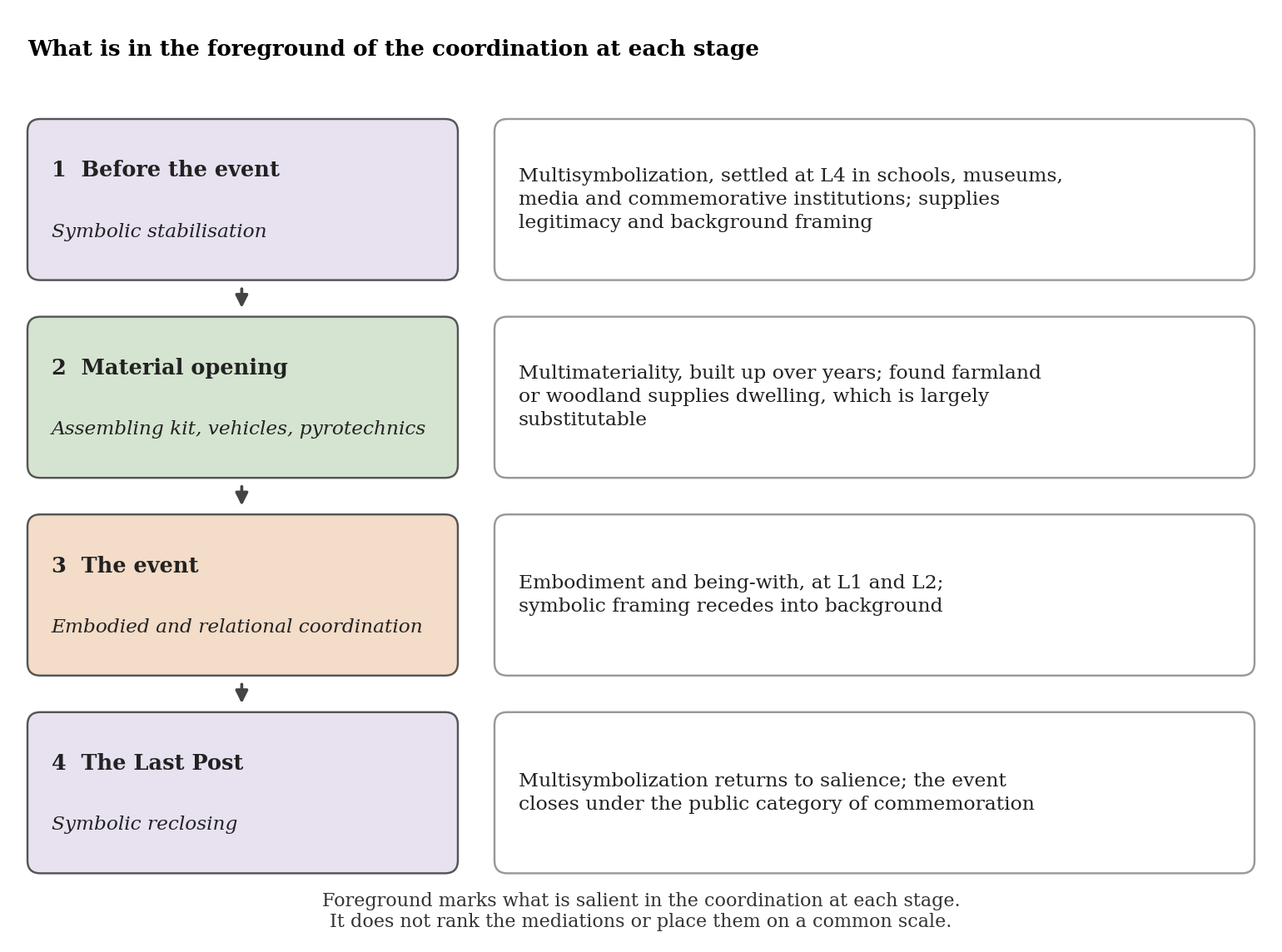
The temporal structure of a reenactment day can be set out in five steps, and Figure 1 summarises them. First, symbolic institutions establish the legitimacy of the event before it begins. Second, during the reenactment symbols largely recede into background. Third, multimateriality organises embodiment and being-with. Fourth, the Last Post brings symbolic framing back into salience. Fifth, the event closes under the publicly recognised category of commemoration. The structure is recursive: symbolic stabilisation, then material opening, then embodied and relational coordination, then symbolic reclosing.
Conclusion
British WWII reenactment is organised primarily through a triad. Multimateriality makes the event possible, embodiment supplies much of what participants seek, and being-with turns individual sensory experience into coordinated collective experience. Dwelling matters comparatively little because the original places are largely absent and substitutable. Multisymbolization remains indispensable and is largely backgrounded, because its central historical and moral work is performed by institutions elsewhere. Cultural memory theory has described that institutional work with great sophistication. It has mistaken symbolic durability for mediational primacy, and so it has missed what reenactment distinctively does.
The dead do not return. The original battles do not return, and neither do the comradeship and fear of the men who fought them. What persists are uneven traces: objects, techniques, stories, places and descendants. Reenactors recruit these into a new living coordination that is theirs. Multimateriality can outlast the lives that formed it and can organise new bodies into partial resemblance with past coordinations. That persistence is neither memory stored in matter nor resurrection. It is the material afterlife of a dead coordination.
Return, finally, to the ambulance. The man sweating through his tunic does not need the ambulance to know that WWII happened. He does not need it to know what British soldiers wore, and he does not need it to learn the national narrative. When the Last Post sounds at the end of the day it will bring symbolic framing back into salience and close the event under the category of commemoration. Before it sounds, he needs the ambulance, the tunic, the heat, the explosions and the other reenactors in order to enter a coordination that a documentary cannot give him.
References
Assmann, Aleida. 2021. Cultural Memory and Western Civilization: Functions, Media, Archives. Cambridge: Cambridge University Press.
Assmann, Jan. 2011. Cultural Memory and Early Civilization: Writing, Remembrance, and Political Imagination. Cambridge: Cambridge University Press.
Chakrabarty, Dipesh. 2007. "History and the Politics of Recognition." In Manifestos for History, edited by Keith Jenkins, Sue Morgan and Alun Munslow. London: Routledge.
Connerton, Paul. 1989. How Societies Remember. Cambridge: Cambridge University Press.
Damousi, Joy, and Paula Hamilton, eds. 2017. A Cultural History of Sound, Memory, and the Senses. London: Routledge.
Durkheim, Émile. 1912 [1995]. The Elementary Forms of Religious Life. Translated by Karen E. Fields. New York: Free Press.
Eco, Umberto. 1989. The Open Work. Translated by Anna Cancogni. Cambridge, MA: Harvard University Press.
Ecks, Stefan. 2023. "Heroic Memory, Wounded Memory: Why Some Monuments Work and Others Fail." Lecture delivered at the University of Edinburgh.
Gapps, Stephen. 2009. "Mobile Monuments: A View of Historical Reenactment and Authenticity from Inside the Costume Cupboard of History." Rethinking History 13 (3): 395–409.
Halbwachs, Maurice, with Lewis A. Coser. 1992. On Collective Memory. Chicago: University of Chicago Press.
McCalman, Iain, and Paul Pickering, eds. 2010. Historical Reenactment: From Realism to the Affective Turn. London: Palgrave Macmillan.
Murray, Williamson, and Allan R. Millett. 2000. A War to Be Won: Fighting the Second World War. Cambridge, MA: Harvard University Press.
Nora, Pierre. 1989. "Between Memory and History: Les Lieux de Mémoire." Representations 26: 7–24.
Paterson, Mark. 2009. "Haptic Geographies: Ethnography, Haptic Knowledges and Sensuous Dispositions." Progress in Human Geography 33 (6): 766–88.
Sontag, Susan. 2003. Regarding the Pain of Others. New York: Farrar, Straus and Giroux.
LVT corpus articles
From Secretions to Silicon Chips: The Evolutionary Emergence of Multimateriality (Made Things 1/7)
From Shellmounds to Microplastics: Multimaterial Afterlives (Made Things 7/7)
Living Value Theory: Core Principles (August 2026 v2)
Mixed Time: Pastness, Futurity, and the Differential Temporalities of Living Value
On the Origins of Writing: Notation Systems as Recoverable Invariance (Series: You Are My Rock)
A Process Ontology of Differential Temporalities (It’s Time 1/6)
Recursive Openings: From Ground to Question and Back to Ground
What Are the Five Mediations? (Core LVT 3/4)
What Is Recursivity? (Core LVT 2/4)
What Is the Mesocosm? (Core LVT 1/4)
What’s Vital? Stakes, Coordination, and the Ground of Living Value Theory
The Wonder of What Works Well: How Living Value Theory Discovers Questions