Abstract
A person wakes, eats, goes about the day, eats again and goes to sleep, and the next morning a day much like it begins. No academic discipline has this sequence as its object, although every discipline can claim a part of it. This article argues that Living Value Theory makes radical comparison possible because it changes what is compared. Its primary unit is mesocosmic living coordination, where other approaches begin from organisms, individuals, societies, cultures, institutions, beliefs or practices. LVT also distinguishes two kinds of tertium comparationis. The first is invariant and process-ontological: every human living coordination proceeds through the five mediations, at recursive levels, and through nonrecursive, selfrecursive or interrecursive counterpart relations. The second consists of recognizable types of coordination, such as eating, sleeping, reproducing, caring, or fighting, whose distribution ranges from features of living almost everywhere to highly specific human formations. The invariant tertium is guaranteed by the process ontology, whereas a typed tertium is a comparative hypothesis that has to be earned. Three tests show how deep a proposed type goes. The animal test asks whether it survives the loss of the exclusively human, the food test whether it survives contact with metabolism, and the sleep test whether it survives the loss of waking symbolic sovereignty. Eating and sleeping, examined through cases from the LVT corpus, prove to be unusually deep typed tertia, and they disclose the five irreducible mediations that pass these tests where conventional disciplinary objects do not. The third word of the title is a playful shorthand, since technically nothing repeats. What the title names is recursivity: all life is recursive mediation in the mesocosm, whether or not any round recurs. That recursivity extends the comparison across development, evolution, suspension, death and the question of what the dead might do next. Typed coordination proposes a comparison, and recursive-mediational analysis disciplines it.
I. Eat, Sleep, Repeat: What Are We Actually Comparing?
A woman wakes at half past six. She drinks a glass of water, makes tea, and eats toast standing at the kitchen counter while her son eats cereal at the table. She goes to work, eats a sandwich at one, comes home, cooks, eats again with two other people, clears up, and some time after eleven lies down and goes to sleep. The next morning she wakes and a day much like it begins.
What academic domain was that? Breakfast was economics, since the bread and tea were bought. It was culture, since toast and tea at that hour is a convention and other places breakfast otherwise. It was kinship, since she ate with her son. It was nutrition, since calories were metabolised. It was politics, since the wheat was subsidised, the tea was taxed and the water was regulated. It might have been religion, had the day been a fast or the food forbidden. It was material culture, since there was a toaster, a plate and a table. Each of these descriptions is correct, each belongs to a different department, and none of them is what she was doing. She was eating breakfast.
And what academic domain was the sleep? For some seven hours she exchanged nothing, voted for nothing, argued for nothing, worshipped nothing, produced nothing and said nothing. The question of which domain her night belonged to begins to look absurd, because by the usual classifications she had stopped doing anything at all. Yet she did not stop living when she stopped doing whatever counts as politics, economics, philosophy, art or religion. Her body kept its temperature and cleared the day's fatigue. Someone lay beside her. The night was dark and cool enough. The bed held, the door stayed shut, and an alarm had been set.
The opening observation of this article follows from that ordinary day. The continuity belongs to life. The discontinuities belong largely to our classifications. Between the toast and the sandwich, the dinner and the sleep, nothing in her living was interrupted, while the scholarly description of it would have had to change hands half a dozen times and fall silent for a third of the day.
Eating and sleeping show this more clearly than almost anything else, because they cut straight across the boundaries by which scholarship has partitioned life. No one can suspend either for long. Both are done by every human being who has ever lived and, in some form, by every animal. Both are coordinated through bodies, companions, places, made things and words at once. And both have been strangely homeless in the human sciences, the one distributed across nutrition, economics and the anthropology of food, the other left until recently to physiology and medicine.
The claim to be defended is about comparison. Comparative work in the human sciences usually begins by settling what kind of thing each case is, a culture, a religion, an economy, a species, and then compares within the kind. Living Value Theory begins somewhere else. It takes living coordination as its object of study (Discipline of Attention). Comparison can then proceed in two ways: through the invariant architecture of living coordination itself, or through recognizable types of coordination such as eating and sleeping. Eating and sleeping therefore stand at a different logical level from living coordination. They are typed coordinations within it, and the argument of this article is not only that they make good comparisons but that they reveal how comparison itself has to be constructed.
The argument proceeds in the order of the title. Eating stands for metabolic continuation. Sleeping stands for the periodic contraction of waking availability while living coordination goes on. Repeating is the playful word. Meals and nights seem to come round again, yet technically nothing repeats, and the word stands for something larger: recursivity, the continuous mediation in which every moment is conditioned by what came before. Section VI corrects the slogan and follows recursivity from the next breath to evolution, and at the far end to the question of whether living coordination can resume once it has stopped. Two kinds of tertium comparationis and three tests, introduced in the third section, turn the methodological claim into something that can be tried on any theory of human life, including this one.
II. The Wrong Units
Scholarship has carved life up for comparison in at least three ways, and each carving can be seen at work on eating and sleeping.
The first carving is by entities: animal and human, individual and society, organism and environment. Its effect is plain in Notes and Queries on Anthropology, the handbook that the British Association for the Advancement of Science issued in 1874 and recast in 1892 to tell travellers what to observe (Garson and Read 1892). The handbook divided the human being into two objects before observation began, an animal to be measured and a social and intellectual being to be described. Eating and sleeping fell into the gap between them. Diet appears among the medical sections of the first part and food among the ethnographic sections of the second, while sleep receives no heading at all and surfaces only as a privation to be endured and a posture to be noted (Notes and Queries in Mesocosmography). The two processes that no human can suspend for long had no place of their own, because the unit of observation had been settled as either an organism or a member of society, and a sleeper is awkwardly both.
The second carving is by institutions: politics, religion, economics, law, medicine, art. Malinowski's account of the Kula shows what it costs. His description of canoes, crossings, partners and valuables is faithful enough to be reopened a century later. When he made it portable for comparison, he sorted it by the domains of his own society, economic against ceremonial, useful against useless, and the Kula has been described ever since as a hybrid of categories that were not cut to fit it (Malinowski 1922; From Lived Worlds to Portable Classifications). Ethnographic adequacy did not confer comparative authority.
The third carving is by stabilised symbolic products: philosophies, literatures, doctrines, ideologies, belief systems. The comparative study of religion is the clearest case. Belief, ritual, myth, doctrine, symbol and cosmology have each been proposed as the object that religions share, and each has privileged the profile of one tradition and measured the others against it. The elevation of belief, understood as private propositional assent, generalised a specifically Protestant settlement of what religion is (Recursive Discernment and the Comparative Study of Religions).
All three carvings are useful, and specialist work within each has produced knowledge that could be had no other way. What none of them supplies is the primary unit of comparison for living. An organism, an institution and a doctrine are each something that living beings are classified as, make or hold in the course of living, and each therefore presupposes the coordination from which it was cut.
It is tempting to diagnose the difficulty as a shortage of abstraction, as though economy and ritual were merely too narrow and broader concepts would gather more cases. That diagnosis mistakes the problem, since a broader concept of the same kind is a wider container cut from the same material. The mistake lay in the choice of units. What Living Value Theory offers is a different object of comparison rather than a more abstract set of categories: it compares mesocosmic living coordinations, such as sleeping, eating, mourning, healing, waiting and returning, as they are actually carried on by living beings in the middle-sized worlds they inhabit.
The attempt to repair the carvings from within shows why a change of unit is needed. Critical studies of sleep have rightly objected that physiology treats sleep as a biological process without history or society. Their correction has been to add culture, showing that sleep is also constructed, scheduled and moralised. The result keeps the original division of the world into a natural half and a cultural half, each with its own way of knowing, and assigns sleep to both (A Living Value Theory of Sleep). A sleeper is then a body described by one discipline plus a set of meanings described by another, and the sleeping itself, the single coordination in which fatigue, a companion, the night, a bed and an alarm clock are all at work at once, still has no description.
That single coordination is what has to be described first. Cultures, institutions, doctrines and species then return as conditions under which coordinations take particular shapes and as stabilisations that coordinations have produced. They remain legitimate objects of study. They become secondary units of comparison, entitled to whatever relevance the coordination under study shows them to have.
The exact error of conventional comparison can now be named. It repeatedly confuses historically stabilised classifications with tertia comparationis, the third terms in the light of which two cases are said to be alike or unlike. Politics is not universally present in living coordination, and neither is an economy. Kinship already presupposes a human classificatory operation, since it sorts relatives by categories that someone has had to name. Religion, as a comparative category, has a spectacularly specific history, and even society carries a particular symbolic carving of living beings and their relations. Offered as third terms, each of these promotes a local stabilisation into a universal. The architecture of living coordination offers something else. The mediational and recursive structure through which any human coordination proceeds does not disappear when the case moves from parliament to breakfast, from Edinburgh to Bengal, or from waking to sleep. It can be called the process-ontological tertium comparationis, and the next section distinguishes it from a second kind of third term, which has to be earned.
III. Two Tertia Comparationis and Three Tests of Comparison
Every comparison needs a third term, the respect in which two cases are set side by side. Living Value Theory supplies two, and they are logically different. Living coordination is the object. The recursive-mediational architecture supplies the invariant tertium comparationis. Recognizable types of living coordination supply a second, conditional tertium comparationis.
The invariant tertium
For human mesocosms the invariant tertium is five mediations, five recursive levels and three counterpart configurations, which can be written as five by five by three. It is always available in principle, because every human living coordination has to occur somewhere in this architecture. It runs through the five mediations, it proceeds at one or more recursive levels, and it engages nonrecursive, selfrecursive or interrecursive counterparts, each of which is defined in Section IX.
The notation can mislead. Five by five by three is no grid of seventy-five boxes, and no checklist whose cells are to be filled in. It is an analytic coordinate system, in the sense in which latitude and longitude are one, since it locates a case without telling anyone what the case is. One does not begin by filling cells. One begins by asking what living coordination is happening here, and then asks through which mediations it runs, at which recursive levels, in what counterpart relations and over what temporalities. Those questions can be put to any case whatever, a meal, a night, a funeral or a parliament, and that makes the architecture the deepest safe common ground of comparison.
Typed tertia
Eating and sleeping belong to a second logical kind. Sleeping is not an invariant dimension of analysis in the way embodiment is. It is a recognizable configuration of coordination, with a characteristic mediational profile, a characteristic recursive-level profile, characteristic counterpart relations and characteristic temporalities. Because sleeping occurs across many species and in every human society, it is an unusually deep typed tertium. Eating is another. Ritual, play, care, mating, fighting and reading are further candidates, each with its own scope.
The two kinds answer different questions. The invariant tertium answers: along what process-ontological dimensions can these cases always be compared? The typed tertium answers: in respect of what recognizable coordination are these cases being compared? The first is a coordinate system and the second names a region within it. A comparison of a Bengali and a Scottish night draws on both. Sleeping tells the comparer which coordination is in view, and the mediations, levels, counterparts and temporalities tell the comparer where the two nights differ.
Three tests
How can one tell how deep a proposed typed tertium goes, or whether an analysis has reached living coordination at all? Three tests help. Each removes something that theories of human life tend to treat as fundamental and asks what is left.
The animal test asks whether the claimed unit of comparison still makes sense when the living being is not human. Replace the human with another animal. What remains? Animals have no politics in the institutional sense, yet they have conflict, alliance, dominance, avoidance and cooperation. They have no economics, yet they forage, compete over food, conserve effort and adjust their living to what a place affords. They hold no doctrines, yet they continuously discern what kind of world they are in and what matters within it. Gulls on a rooftop space themselves with great regularity without any gull needing to model what another gull thinks of it, so that coordination among living beings turns out not to depend on reading minds (Being With Others Doesn't Mean Having to Think about Others). A chimpanzee that chews bitter pith when it is unwell recruits matter in response to felt disturbance and has no concept of medicine (Mobile Remediations). A hamster kept in a family home spends two years running, sleeping, eating and ignoring the humans around it, and lacks nothing that a hamster's life requires (Of Hamsters, Dogs, and Peccaries).
The test has to be formulated with care, because it is easily heard as the claim that animals have politics, religion or philosophy in miniature. Its point is the opposite. Comparative psychology has repeatedly gone wrong by asking whether other animals possess human faculties such as planning, representation or a theory of mind, as though cognition were a portable capacity that species hold in different amounts, when what evolves is a way of living within a particular world (Easy Does It). The same holds for comparison across species generally. What is worth comparing depends on what is relevant in each animal's world, and a bat's life is poorly approached by asking how far it resembles ours (What Is Relevant About Being a Bat?). What the animal test shows is that coordination with a body, with other living beings and with the found conditions of a place remains when the human classifications have disappeared.
The food test asks whether the analysis still describes what matters when the being is eating. Feed it. What remains? A state banquet is politics, a Eucharist is religion, a restaurant meal is economics, a family dinner is kinship and a tasting menu is art. Every one of them still has to pass through mouths and stomachs, and none of them could happen at all unless the guests were beings that must eat. The institutional descriptions are true, and they are partial elaborations of a metabolic coordination that they cannot replace. An analysis that can say what a banquet signifies and cannot say what would happen if the food failed to arrive has not yet reached what the banquet is coordinating.
The sleep test asks whether the purported theory of human life still works while the human being is asleep. Put the object to bed. What remains? For several hours political participation stops, exchange stops, explicit moral reasoning stops, philosophising stops, artistic production stops, and nearly all deliberate symbolic articulation stops. Living goes on. Sleep has been called an ontological pressure test for any theory of living coordination (A Living Value Theory of Sleep), and the phrase is exact. If a theory of human beings can describe only humans who are awake, speaking, choosing, representing, exchanging and taking part in institutions, then its object is a subset of waking human activity, and human life lies outside it.
The three tests can be put briefly. The animal test asks whether an analysis survives the loss of the exclusively human. The food test asks whether it survives contact with metabolism. The sleep test asks whether it survives the loss of waking symbolic sovereignty.
What it means to fail needs to be stated precisely, or the tests will be caricatured as a demand that political science explain the sleep of bats. A comparison of parliamentary systems is under no obligation to account for sleeping dogs. Its claim is deliberately restricted, and within that restriction the tests have nothing to say. A theory fails only if it presents itself as an account of life, human life, society, action or value at a fundamental level while its supposedly fundamental categories vanish as soon as the subject eats, sleeps or turns out to be another animal. The tests become legitimate when politics, culture, symbolism, rational action, practice, society or meaning is raised from a field of study into an ontology of human existence. At that point it is fair to ask where the ontology goes at night.
The tests are also ordered. The animal test strips away human exceptionalism, the food test strips away the self-sufficiency of institutional classification, and the sleep test strips away the assumption that human beings are fundamentally what they are when awake and articulate. Life continues through all three removals.
The tests have a second function, which the discussion so far has not needed. They locate a proposed typed coordination within the distribution of living coordination. A coordination that survives the animal test is deeper than a specifically human formation. One that survives the food test reaches metabolic living and does not merely describe institutions. One that survives the sleep test does not depend on waking symbolic performance. Not every coordination occupies the same range, and a layered topology of comparative scope follows. The word layered is chosen over higher and lower because the order is one of breadth of comparison and ranks nothing by worth. What follows is a methodological hypothesis, and no finished biological taxonomy of coordinations is claimed.
At the broadest level lies the process architecture itself, the mediations, recursive levels and counterpart possibilities. Next come minimal or near-universal zoetic coordinations, such as metabolic regulation, maintenance, orientation to the environment and repair, together with reproduction at the level of life, if not of every individual organism. Third come widely distributed organismic coordinations: eating, sleeping or some other cycling between rest and activity, mating, locomotion, predation, care, avoidance and cooperation. Fourth come recursively demanding coordinations, among them play, reciprocal antagonism, tactical alliance, complex care and other forms of interrecursive negotiation. Fifth come human poietic coordinations: ritual, politics, markets, law, art, theology and mathematics. Sixth come historically specific institutionalisations, such as Westminster parliamentary procedure, the Eucharist, the Kula, peer review, derivatives trading or a Bengali puja.
Comparison becomes progressively less universal from the first layer to the sixth. A Eucharist and a Kula expedition can be compared only in the respects that survive their separate histories, whereas a gull's night and a person's night can be compared in respect of sleeping. The invariant architecture remains analytically available throughout. Figure 1 sets the two structures side by side. The layers describe what kinds of coordination occur, and the coordinate systems describe how living coordination can always be analysed.
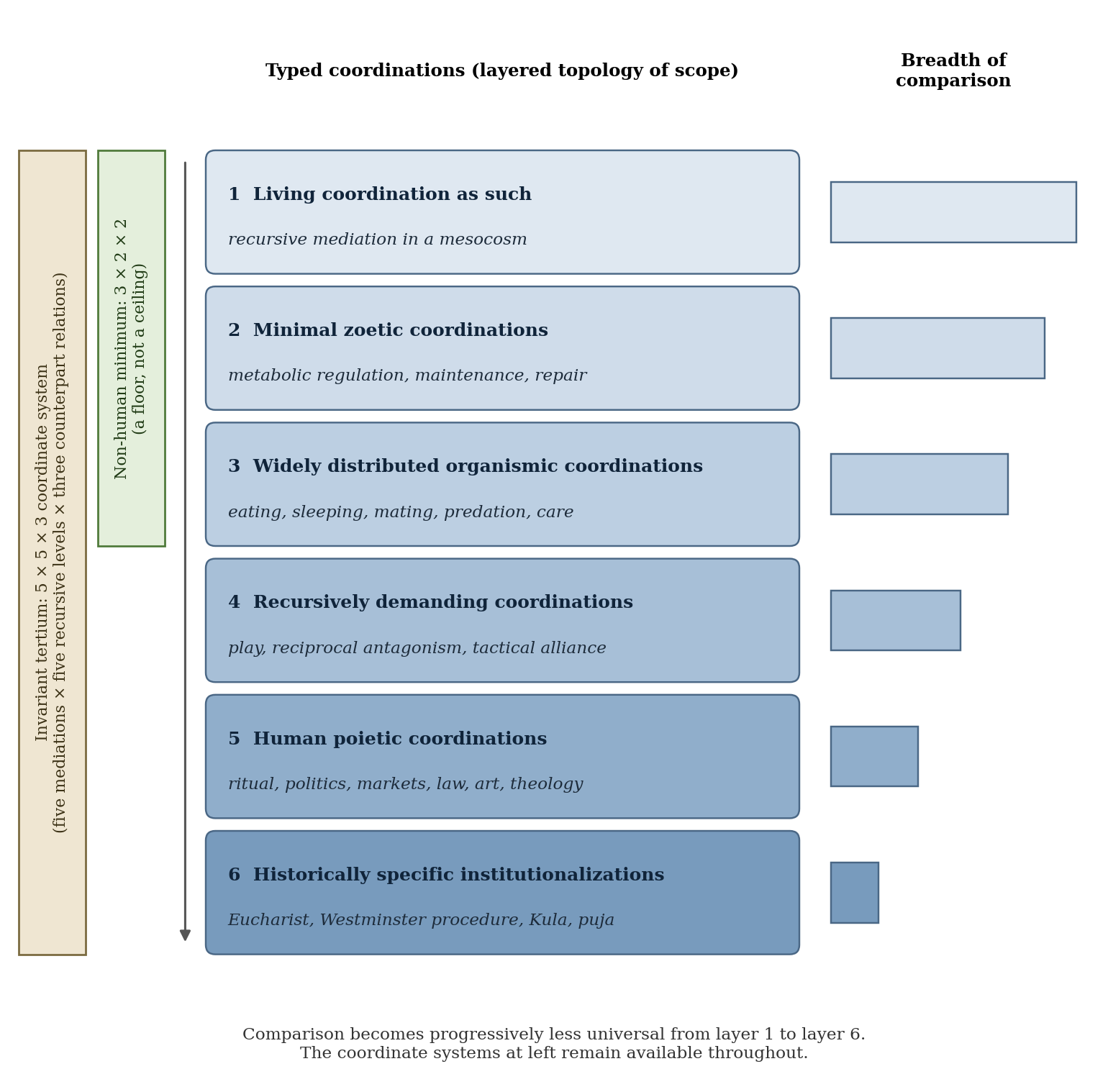
Figure 1. Two structures. The layers describe what kinds of coordination occur and how far comparison across them can reach. The coordinate systems describe how living coordination can always be analysed. The three by two by two baseline is a minimum for non-human life and sets no ceiling on what non-human beings can do.
The next two sections take the two typed coordinations that survive the removals best, eating and sleeping, and ask what, exactly, continues in each.
IV. Eat: Metabolic Stakes Before Institutional Classification
Start, then, with eating, and ask what has to keep coordinating for a meal to occur. The mediations are best arrived at this way, from the coordination, since that is how they were first found.
There has to be a body that hungers, tastes, chews, swallows and digests, and whose hunger returns within hours. There have to be other living beings: the plants and animals that are eaten, and almost always the people with whom food is grown, cooked, shared or withheld. There has to be a somewhere whose found conditions supply and limit what can be eaten: soil, water, climate, season, the monsoon that arrives or fails. There has to be made matter, since human beings eat almost nothing that has not been cut, ground, cooked or stored with tools, and they eat it from vessels, at hearths and tables. And there are symbolic arrangements: names for dishes, hours for meals, rules about who eats first and what may not be eaten, prices, recipes, blessings.
Take away any one of these and human eating either ceases or changes in kind. None can do the work of another: a recipe feeds no one, a companion is no substitute for a harvest, and a full granary is of little use to a body that cannot swallow. Living Value Theory calls these five irreducible conditions mediations and names them multisensorial embodiment, multispecies being-with, multiversal dwelling, multimateriality and multisymbolization. They are what the question of what must keep coordinating turns up, without any scheme having been brought to the meal, and the same five will turn up again when the question is put to sleep.
Eating has good claims to be a privileged entry point into any human world. It is urgent enough to force coordination and slow enough to permit it, and its coordination leaves dense deposits in fields, pots, kitchens, markets and cookery books (Notes and Queries in Mesocosmography). It also shows something that the institutional vocabulary obscures, which is that recognition of another's metabolic condition comes before most of what is called understanding. A visitor to a household in Calcutta or in Edinburgh is offered tea. The manner of offering differs between the two cities, and in both the offer first of all acknowledges that a living being has arrived who may be thirsty, tired, hot or cold (Metabolic Recognition as the Ground of All Understanding). Economics, etiquette and kinship can each describe the cup. The recognition that precedes them is metabolic.
Eating is also an exemplary typed tertium. It is extremely old phylogenetically, metabolically unavoidable for the beings concerned, and massively elaborated in humans, who have made it carry religion, economics, kinship, hierarchy, aesthetics and politics without its becoming reducible to any of them. A Eucharist and a family breakfast can therefore be compared as eating, while the invariant architecture shows exactly where their coordinations diverge: which mediations carry the load, at which recursive level the meal is being run, what kind of counterpart is being fed or addressed, and over what span. This yields a principle that conventional comparison cannot state. Two cases need not belong to the same institution to share a typed coordination. Conversely, two cases may belong to the same named institution and nevertheless instantiate quite different living coordinations, as a weekly village market where everyone knows everyone and a derivatives exchange both count as markets while sharing very little of what their participants are actually coordinating.
The food test does its most instructive work on religion, where the temptation to begin from belief is strongest. Early in fieldwork on Bengali Hindu worship it seemed natural to ask devotees whether Ma Kali actually eats the food that is offered to her. The question produced divergent and sometimes irritated answers. It imported an ontology organised around matter and spirit, the literal and the symbolic, and transactions between separate realms, and none of these distinctions captured what was at stake for worshippers. They disagreed about divine consumption. They agreed on the sequence through which food was offered, protected, transformed and redistributed (Whose Problem Is This?).
The lesson is general. To insist on deciding first whether Kali's eating is literally real or symbolically imagined is to replace a living coordination with an imported epistemological binary. Feed it, and see what remains. People buy and prepare food, keep it from being tasted beforehand, place it before the goddess, wait, take it back as prasad, distribute it and eat it. Bodies are fed, relations among worshippers and between worshippers and the deity are renewed, the heat of the day and the season's produce shape what is offered, vessels and images are handled, and words are spoken. Whatever one's judgement about what the goddess does with the offering, every part of this coordination is real, and it can be compared, step by step, with a Eucharist, a state banquet or a family dinner.
This is no relativism. Living Value Theory distinguishes mesocosmic fit, the adequacy of a coordination to the lives conducted through it, from cosmic fit, the adequacy of a claim to how things are independently of anyone's living. Whether a deity consumes food is a question of the second kind, and it stays open or gets answered on its own terms. Comparison does not have to settle it before describing how living beings coordinate through the offering. The division of cases into real practices and imagined worlds fails the food test just as the division into economy and religion does.
The Hindu temple tradition presses the point further than any other. The temple feeds the deity, bathes the deity, dresses the deity, cools the deity in the hot season, gives medicine and a period of convalescence, and at night puts the deity to bed. Vedic religion had built a ritual economy on gods who needed to be fed, and the later service of images extended this metabolic recognition far beyond food. Yet across some two and a half millennia the tradition never asserts that the deity requires any of it. The recognition is total at the level of practice and permanently unsettled at the level of claim (Does the Hindu Goddess Sleep?). A method that begins from belief has nothing to hold here, because the belief is exactly what the tradition declines to fix. A method that begins from coordination finds an entire divine life modelled on the necessities of a metabolising body. It also finds that where a tradition feeds its god, the question of the god's sleep must arise as well, which leads from the first word of the title to the second.
V. Sleep: What Remains When Waking Human Life Withdraws?
Sleeping is a typed tertium comparationis, and it is the clearest worked demonstration of how one functions. Put the same question to it that was put to eating: what has to keep coordinating for a human being to lie down at night and get up in the morning?
A body has to keep breathing, hold its temperature, turn, clear its fatigue and remain rousable by a cry or a smell of smoke. Embodiment continues massively through sleep, while the sleeper's own monitoring of it contracts. Other living beings matter as much as by day: the companion whose breathing is registered all night, the infant who will wake, the dog at the door, the mosquito, and above all whoever stays alert so that the sleeper need not. Sleep makes a map of recursive burden, showing who is permitted to stop watching because someone else has been arranged to keep watch (Sleep in Mesocosmography). The found conditions of night become indispensable: darkness, temperature, humidity, season, the length of the night at a given latitude. Made things take on more of the load than they carry by day. Bed, bedding, walls, roof, lock and fire do for the sleeper what the sleeper cannot do, and a history of the house can be written as the history of where human beings put themselves when they can no longer keep watch (The House at Night). Symbolic arrangements are present too, as clocks, bedtimes, shifts and rules about who may sleep where, although they are attenuated and reorganised during sleep itself and are the thinnest part of it.
The same five mediations have appeared, and their relative weights have shifted. In eating, symbols and made things are conspicuous and the deposits are dense. In sleeping, the three mediations that human beings share with other animals carry nearly everything, made things serve them, and words fall almost silent. Sleep is zoetically necessary, engages all five mediations, proceeds overwhelmingly at L1, the level at which coordination runs without becoming separately salient, and leaves almost no trace of itself, which is why it serves as a master key for the description of any human world (Sleep in Mesocosmography). It is also why sleep went unnoticed for so long. Successful coordination effaces itself, and a night in which nothing happened leaves nothing for an archive to keep (The Wonder of What Works Well).
This is what makes sleeping a typed tertium. It has a recognizable configuration: strong embodiment, continued being-with, indispensable dwelling, often heavy delegation to multimaterial supports, attenuated multisymbolization during the sleeping itself, overwhelmingly L1 recursion, restricted responsiveness, little of the strong interrecursivity that waking company can demand, and a characteristic temporal organisation. That configuration licenses comparisons that no institutional carving would allow: human and dog sleep, Bengali and Scottish sleep, solitary and shared sleep, sleep in a house and sleep outdoors, ordinary sleep and medically altered states. What makes these comparisons legitimate is not that the cases are the same culturally. They are recognizably the same type of coordination, and each is analysed against the invariant process architecture.
Now run the sleep test on the institutional objects one by one. Put politics to bed. A government exists at night, police patrol, wars go on, and the hours at which a population may sleep are shaped by law and by power. The sleeper is subject to all of this and is not, while asleep, doing politics. What remains is a living body in a place, dependent on a bed, perhaps beside another person, kept safe by arrangements made in advance. Politics is a configuration within that life, and the life is no configuration within politics.
Put economics to bed. The sleeper owns or rents the bed, owes money, will work tomorrow, and may be short of sleep because of a shift pattern. Exchange nonetheless plays no part in what keeps the heart beating through the night, and the quality of a night's sleep is a felt aftermath that measurement can correlate with and cannot reach, let alone price (Sleep Medicine). Put law to bed, and the result is the same from the other side. Law can protect the conditions of sleep, regulate work that depends on it and compensate its loss, yet it can see sleep only after converting it into something else: a disorder, a period of required rest, a risk or a harm (Why Law Can't See Sleep). Put philosophy to bed, and a philosopher asleep is still alive, which is more than can be said for the proposition that human existence consists in thinking. Put religion to bed. A Christian asleep remains a Christian by baptism, membership and intention, and the sleeping itself is no part of Christianity. Put culture to bed. A sleeper whose night is arranged in a recognizably Bengali or Scottish way remains metabolically continuous with every other human sleeper and with the dog on the floor.
In each case the institutional object stays consequential and ceases to be exhaustive. It shapes the conditions of the night without being what the night consists of. This is the precise sense in which these objects fail the test when they are offered as ontologies, and pass it without difficulty when they are offered as fields.
The animal test can now be added to the other two. A dog, a gull and a bat also eat and sleep. They do so through a body, among other living beings and under found conditions, which are the three zoetic mediations: embodiment, being-with and dwelling. Rudiments of the two poietic mediations, multimateriality and multisymbolization, occur widely among animals, as nests and calls attest. What distinguishes human mesocosms is that the two became recursively coupled, each continually reshaping what the other can do and thereby reshaping the zoetic three as well (Zoetic and Poietic Mediations). The animal test therefore takes the analysis down to three mediations, and human eating and sleeping disclose all five.
At the deepest level that Living Value Theory has so far established, non-human living coordination can be compared through three zoetic mediations, two recursive levels, L1 and L2, and two counterpart relations, nonrecursive and selfrecursive. This is a three by two by two architecture, and it needs a qualification. It is a minimal baseline. It sets out what need not be exceeded for living coordination to be present, and it sets no upper ceiling on non-human complexity. More complex animals can reach higher recursive levels and interrecursivity. The baseline says where comparison across life can always begin, and it leaves open how far a given species goes beyond it.
The result can be stated in one sentence: the five mediations survive these tests better than the conventional disciplinary objects do. Feed a human being, put a human being to bed, or replace the human being with another animal, and politics, economy, religion, culture and philosophy each lose their grip at some point, while coordination through body, companions, place, made things and symbols goes on, or goes on in its zoetic part. The mediations were found by asking what remains, and they are what remains.
VI. Repeat: A Playful Word and a Serious Recursion
The third word of the title is playful, and it has to be corrected before anything is built on it. It suggests that life is what comes round again, meal after meal and night after night. Living Value Theory says something stronger and different. Life is continuous recursive mediation in a mesocosm, and recursivity is the whole of it: in every body, in every place, at every span, in the animal and the human, awake and asleep. None of it depends on anything repeating.
Technically, nothing does repeat. Breakfast today is not yesterday's breakfast. The body that eats it is a day older, its appetite has been shaped by yesterday's food and last night's sleep, the slice of bread is another slice, the boy across the table has grown a little, and the light in the kitchen is not yesterday's light. A meal or a night is recognised as the same again by overlooking the respects in which successive rounds differ and attending to those in which they match. That is selective invariance, sameness for a purpose (Mobile Remediations), and it is a stabilisation carried out at the higher levels, since someone has to classify a round as a meal, a night or a Tuesday before it can be said to recur. The human sciences are no different from the kitchen in this. A survey of how often people eat or how long they sleep counts rounds that its own categories have declared equivalent.
Recurrence does exist, as something people arrange. Bells, calendars, shift patterns, mealtimes and recipes are made things and symbols built to hold some respects of a coordination steady from one round to the next. Recurrence is also one temporal relation among others in the structure of living, alongside order, phase, rate, nesting, anticipation and interruption (A Process Ontology of Differential Temporalities). It is often an achievement, and it is not what living consists of.
Selective invariance also explains where typed tertia come from. Yesterday's sleep and tonight's are not identical events, yet they are sufficiently alike in the respects that matter to count as instances of sleeping, and a being or an observer can pick out a recurrent organisation of coordination across instances. Typed tertia are therefore no Platonic kinds waiting in the nature of things, and they are not arbitrary classifications either. They are recognizable recurrent organisations of living coordination, and how far each reaches depends on how widely that organisation actually recurs, among species, across places and over periods.
What living consists of is recursion, which is not repetition. In recursive mediation each moment of coordination takes place under conditions altered by what the previous moment did, so that the process changes itself through its own ongoing activity (The Wonder of What Works Well). Yesterday's meal is part of today's hunger, a bad night is part of the next day's temper, and a household that has slept one way for a year has become a household that sleeps that way. Nothing needs to come round again for this to hold. A being that ate once and slept once would still have lived through recursive mediation, with a body adjusting to what it ate, to the companions beside it and to the ground beneath it. Eating and sleeping serve as entry points in this article because they are urgent and densely multimediated, and the three tests removed classifications without ever needing a cycle. The cycle is the form in which these two coordinations happen to present themselves to a human observer.
It is also why they present themselves so well. Eating and sleeping expose at once that the processes being coordinated do not run at the same rate. Chewing, swallowing and turning over in bed take seconds. Digestion and the stages of sleep take hours. Hunger and fatigue return daily. Food supply, heat and the length of the night change with the seasons. Habits and household arrangements hold for years. Appetite and sleep change over a lifetime, from the infant who feeds every few hours to the old person who wakes before dawn. Cuisines, house plans and inherited schedules last for generations. Metabolic and circadian organisation were shaped over evolutionary time. Beyond any individual death there remain hearths, middens, recipes, and rites for feeding the dead.
Life goes on by coordinating processes that do not run at the same rate. Continuity in this sense is an achievement of workable relations among unequal rhythms, and no metronome sets the pace (A Process Ontology of Differential Temporalities). The mediations differ greatly in the spans they can hold. The three zoetic mediations are bounded above by a lifetime, the found conditions of a place outlast them by orders of magnitude, and made things and symbols carry coordination beyond the limits of any single body's enactment.
Once recursivity is seen as the whole, the unit of comparison opens onto far more than the daily round, and the word repeat can stay in the title as a playful pointer to it. Recursion shows itself at every span. It asks how new human beings come to eat and sleep as their elders do. Development, on this account, is the gradual and sequenced integration of a child into the human mesocosm, the coordinated field of bodies, others, places, materials and symbols on which every human life depends, and the fragmentary findings of developmental psychology describe stages of that integration (A Living Value Theory of Developmental Psychology). The infant who cannot yet sleep through the night and the child who must be taught to eat at table are being drawn into coordinations that will later run without notice.
It asks how the relations within which eating and sleeping are shared come about. Sexual partner formation has a peculiar structure, since the one being evaluated is another evaluator, and each party's regard for the other can transform the evaluation under way. The durable arrangement in which two people come to share a table and a bed is generated through recursive encounters whose outcome no prior information could have specified (Die Liebe fällt, wohin sie will). Between partner formation and child development lies biological reproduction itself, on which the corpus of Living Value Theory has so far published no dedicated study. The gap is worth stating plainly. The inquiry has followed living coordination from its evolutionary emergence through sexual pairing and into development, and reproduction, which is the most literal case of one recursive mediation giving rise to another, remains an obvious place for further comparative work.
It asks, at the longest span, how living coordination of the human kind emerged at all. The evolutionary account runs from the zoetic mediations, which are continuous in graded forms with a wide range of animal life, to the threshold at which multimateriality and multisymbolization entered a sustained feedback loop in one species. That coupling enabled the recursive reconstruction of inhabitable worlds without ever operating independently of the older three (The Genesis of the Five Mediations; Zoetic and Poietic Mediations). Kitchens and bedrooms are late products of that reconstruction, and the hunger and fatigue they serve are very old.
At every span the question has the same form: how does recursive mediation go on, given what it has already done to its own conditions? Put like this, the question has an edge. Mediation that is continuous can be interrupted, and a breath can be the last. So the sequence that began with breakfast arrives, by its own logic, at the far end of the title's third word. Can living coordination, once it has stopped, resume at all? What resumed would not be a repetition of what stopped, since a coordination that comes back comes back under altered conditions.
VII. Can Life Stop and Start Again?
The question is usually handed to two unrelated literatures, the science of sleep and dormancy on one side and the philosophy and theology of death on the other. With living coordination as the unit, it becomes one graded comparison. Take five conditions in order: ordinary wakefulness, sleep, hibernation, the anhydrobiosis of a tardigrade, and death. Instead of asking to which category each belongs, the comparison asks four things of each: what living coordination is presently realised, what is suspended, what remains organised for possible return, and what has irreversibly disappeared.
In wakefulness, coordination is realised across the board, and the living being is available to what goes on around it. In sleep, nothing essential is suspended. Recursive organisation continues, the body regulates and repairs itself, and what contracts is the sleeper's availability: monitoring is reduced, responsiveness is selective, and return is a matter of hours and of a sufficient noise. Sleep is a periodic reconfiguration of living coordination, and the sleeper never leaves it. In hibernation, the contraction goes much further. Body temperature falls towards that of the surroundings, heart rate and metabolism drop to a small fraction of their active levels, and the state lasts for months, though it remains a regulated condition that the animal itself maintains and periodically interrupts.
The tardigrade takes the series to its limit. Under desiccation it draws in its legs, loses almost all its water and enters a state in which no metabolism can be detected. It can remain so for years and resume when water returns. By any ordinary criterion it has left the condition of being alive, and yet it comes back. A classification into alive and dead cannot place it, and the case forces a distinction among three states where the binary allowed two: realised recursive mediation, an organised suspension that preserves the capacity for its return, and the irreversible loss of that capacity (What Is the Difference Between Life and Death?). Death is the third. What defines it is neither stillness nor the absence of measurable activity, both of which the dried tardigrade exhibits, but the loss of an organisation from which living coordination could be remediated.
Laid side by side, the five conditions show what the comparison has done. Sleep is no small death, since in sleep the coordination is realised throughout. Anhydrobiosis is no deep sleep, since in it realisation has ceased and only organisation persists. Death is no deeper suspension, since what is gone is the capacity to return. The conditions differ in what is realised, in what is returnable, and in the temporalities of return: hours for the sleeper, months for the hibernator, years for the tardigrade, never for the dead. None of these returns is a repetition. The sleeper who wakes, the hibernator who emerges and the tardigrade that rehydrates are living coordinations resumed under altered conditions, and none is in every respect the one that stopped. The distance between sleep research and the philosophy of death has closed without either becoming the other, because both turn out to be asking about the organisation and returnability of living coordination.
The sequence also shows that typed tertia can be nested and graded. Sleep is one typed coordination. Beyond it lies a broader type, reduced availability, which takes in sleep and hibernation, and a broader one still, organised suspension, which also takes in anhydrobiosis and compares the three in respect of how much realisation remains and how return is secured. Broader again is the interruption and returnability of living coordination, under which death can be set in the same series as the dried tardigrade and the sleeper. The broadest term is living coordination itself. Each step in breadth loses detail and gains range, from sleep to reduced availability, to organised suspension, to interruption and returnability, and finally to living coordination. The layers of Figure 1 are therefore no mere list of kinds, since the kinds have different degrees of comparative breadth and can be placed inside one another.
Human beings have never left returnability to itself. Medicine can be described, across its whole history, as the recruitment of matter and skill to remediate embodied processes that are felt or judged to need it, a relation that begins with animal self-medication and runs to the modern pharmaceutical (Mobile Remediations). At its far edge medicine works on the boundary between the second and third states. Resuscitation restarts a heart that has stopped. Anaesthesia induces a contraction of availability deeper than sleep and reverses it on schedule. Organs are cooled so that their organisation outlasts the body they came from. Each of these is an intervention in what can still come back, and each has moved the practical line between suspension and loss without abolishing it.
The line itself remains. For every organism there comes a point at which no remediation is possible, by its own processes or by anyone else's means. Other animals meet that point without, so far as anyone can tell, making it into a question. Human beings, who can refer to what is absent and build things that outlast them, have made it into one of the most elaborated questions they possess. The biological comparison ends at irreversible loss. The human comparison begins there, by asking what people have done with the possibility that the loss might not be final.
VIII. Where Do the Dead Go?
The usual comparative question about death is what different religions believe happens afterwards. It has the defects already noted: it turns each tradition into a list of propositions and measures all of them by a notion of belief drawn from one. The comparative study of religion lacks a stable unit, and the missing third term is better understood as a task than as an object, the task of discerning how reality is recursively organised and how living beings should coordinate with it (Recursive Discernment and the Comparative Study of Religions). Death sets that task at its hardest. The questions it forces can be stated without reference to belief. What kind of interruption has occurred? What persists? Where are the dead? Can they return, and should they? How long is the interval? What must the living do while it lasts?
Traditions differ in which of these questions they elaborate. Purgatory, in its historically specific Latin Christian form, elaborates the interval. It gives the time between a death and the final state of the dead person a place and a duration, and it assigns the living work to do during it, in prayers, masses and alms that are held to shorten it (Le Goff 1984). Used precisely, the concept describes a coordination among the living and the dead that runs through bodies at prayer, obligations between kin, altars and coins, calendars and reckonings of days and years. Used loosely, as a name for any lingering attachment to the dead, it loses the features that make it comparable with anything (Pay for Our Souls?).
Resurrection elaborates return. No dedicated study of it exists in the corpus drawn on here, and it is introduced as a question that the preceding comparison has made askable. If death is the irreversible loss of the capacity to return, the teaching that the dead will rise asserts that the loss is reversible after all, by a power outside the order of living things. The theologians who worked the teaching out were pressed into exactly the questions that the tardigrade poses in small: what has to persist for it to be the same one that comes back, and whether a body eaten, burned or scattered retains any organisation from which it could be restored (Bynum 1995). Traditions of rebirth, for their part, take return to be the ordinary fate of beings and treat release from it as the goal, so that the question of whether the dead should return receives the opposite answer. These are different configurations of interruption and continuation, and calling them rival beliefs about the afterlife names the least of what distinguishes them.
The movement of this section is the reverse of the one before it. Section VII went toward the broadest typed terms, and this section goes toward spectacular human specificity. The underlying coordination problems remain recognizable: interruption, persistence, location, return, interval, metabolic necessity and irreversible loss. Humans elaborate them through poietic coordination into Purgatory, doctrines of resurrection and rebirth, immortal gods, ritual feeding and eschatology. This is continuity without reduction. Purgatory is not really metabolism or dwelling in disguise, and resurrection is not really anhydrobiosis. Yet both can be compared with more elementary processes, because their human elaboration still concerns recognizable problems of living coordination, and the invariant architecture can be run on them as on a night's sleep.
Eternity elaborates the removal of the round of eating and sleeping altogether, and here the two words that opened this article come back. Human life must eat and must sleep. Divine life has repeatedly been imagined by subtracting those necessities, and the manner of subtraction differs. The God of the Hebrew Bible makes the night and institutes a day of rest from labour, and never institutes or takes a night of sleep. He is named, in the same breath, as keeper and as the one who neither slumbers nor sleeps (Why Abraham's God Never Sleeps). This is a living being specified by metabolic negation: immense in what he makes and says, without a body that tires or a place that conditions him. The Hindu temple proceeds the other way. It supplies the deity with a complete metabolic day of waking, bathing, eating, resting and sleeping, and leaves open whether any of it is needed (Does the Hindu Goddess Sleep?).
What is compared here is two configurations of attributed living coordination, one in which the divine is recognised through the whole round of eating and sleeping and one in which the divine is defined by exemption from that round, rather than Hinduism and Abrahamic religion as two cultural systems. The comparison is exact because the respect of comparison is exact, and it is possible because eating and sleeping are available as typed terms in both, and the invariant architecture can be run on each.
It also yields a question more pointed than any general discussion of immortality: what would life have to become if it no longer had to eat, sleep, age or die? The traditions that have pursued the question furthest suggest an answer. It would have to shed the zoetic mediations one by one, and the more thoroughly it shed them, the less it would resemble anything that human beings recognise as living. Whether any such life exists is, once more, a matter of cosmic fit. That people have organised their meals, their nights and their dead around it is a matter of record.
IX. Comparison After the Two Tertia and the Three Tests
What the two tertia and the tests leave standing can be gathered into a procedure. It has six steps, and they apply to any comparison whatever, between two households or between a hospital and a temple.
Specify the object. Say what living coordination is happening: what living beings are carrying on, losing, repairing, suspending or resuming. The institutional noun for the setting can wait.
Specify the tertium. Decide whether the comparison runs through the invariant architecture alone, through a typed coordination, or through both. If a type is claimed, say which it is: eating, sleeping, keeping watch, feeding a god, waiting for the dead. The tests locate how deep it goes, and the claim that two cases instantiate the same type has to be defended, as discussed below.
Trace the mediations. Draw the mediational profile, a qualitative account of how the coordination runs through body, companions, found conditions, made things and symbols, where the load sits and what has been handed from one mediation to another. A profile assigns no scores, since the mediations share no scale.
Locate the recursive levels. Ask whether the coordination is running unnoticed at L1, has been felt as disturbed at L2, has been put into words at L3, has been stabilised in categories and institutions at L4, or has had those stabilisations reopened at L5. Doctrines, statutes and protocols are L4 products, and comparison that begins from them begins late.
Identify the counterpart configurations. A nonrecursive counterpart does not answer back. A selfrecursive counterpart alters in relation to its own ongoing state. An interrecursive counterpart is one whose recursively responsive capacity enters into the focal being's own coordination, such that what the focal being does depends partly on what it anticipates the counterpart may do in response. That is narrower than the commonplace that others respond to us. A goddess who is fed and a God who never sleeps differ, among other things, in what kind of counterpart each is taken to be.
The narrower definition is easiest to see in traffic. Other drivers are living, responsive beings, and yet much traffic coordination is not interrecursive in the strong sense. Road markings, lanes, lights and priority rules deliberately let drivers treat one another largely as predictably moving features of the environment, so that each can act without anticipating the other's anticipations. Interrecursivity becomes salient when the institutional stabilisation runs out: at an ambiguous junction, on a road too narrow for two cars, in eye contact and gesture, in uncertain yielding, in the questions has she seen me and does he know that I am waiting. This suggests something that is easily missed. Higher human organisation often reduces interrecursive burden rather than increasing it. Rules, roles, queues, contracts and architecture are poietic means of converting would-be interrecursive counterparts into something closer to nonrecursive ground, and the relief they provide is much of what they are for. It bears on comparison too, since two cases that look alike in their institutions may place very different interrecursive demands on those who live in them.
Map the temporalities. Ask how long the coordination, the interruption, the wait or the return lasts, and at what rates its parts run.
The two kinds of third term differ in their standing. The invariant tertium is guaranteed by the process ontology: every human living coordination runs through the architecture, so the question of how it does so can always be asked. A typed tertium is a comparative hypothesis. Calling two things ritual, care, kinship or sleep licenses nothing until it has been shown that the word picks out a sufficiently similar coordination in both cases. Two activities called ritual may, on closer description, coordinate entirely different things, and two phenomena called sleep may cease to be comparable beyond a shallow resemblance. That a proposed type can fail is an advantage, since it makes comparison empirically corrigible.
The two also work together. The typed tertium tells the comparer where to compare, and the invariant architecture tells the comparer how to compare safely. Sleeping licenses setting a prison cell beside a flat in Kolkata, and the mediations, levels, counterparts and temporalities then prevent the comparison from dissolving into vagueness. Ritual may suggest a comparison, and the architecture tests whether it survives close description. Typed coordination proposes the comparison, and recursive-mediational analysis disciplines it.
Two further features of the procedure need emphasis. The first is that the mediations are irreducible to one another, and this is what makes comparison exact. Because no mediation can be converted into another, there is no master variable, be it power, meaning, function or exchange, into which two cases could both be dissolved, and the comparer is obliged to name the respect of comparison and leave everything else about each case standing. The mediations make no two unlike things equivalent; they make it possible to specify exactly in what respect different living coordinations can be compared. The greater the distance between the cases, the more that precision matters, and it is available at any distance because the invariant common term is fixed by the structure of living coordination and does not thin out as the cases move apart. Sleep, anhydrobiosis and death could be set in one series, and a Bengali temple beside the Hebrew Bible, without any of them being reduced to another.
The second is that culture, place and period lose none of their importance and all of their automatic priority. Bengali and Scottish households can still be compared, and so can the nineteenth century and the twenty-first. They enter as dimensions along which a specified coordination varies, and they have to show their bearing on it. Sometimes a difference of culture will explain most of what differs between two nights' sleep. Sometimes heat, age or the number of rooms will explain more. The comparison finds out, where a comparison that began from cultures had already decided.
A comparison run in this way can be wrong, which is its chief merit. The claim that two coordinations are alike in how a night watch is delegated, or in how an interval after death is filled, can be checked against closer description and can fail.
X. Conclusion: Life Is the Comparative Constant
A person eats. Dozens of scholarly classifications can be attached to the meal, and none exhausts what is happening. The person sleeps. Most of those classifications lose their purchase, and living continues. The person wakes, and another day, similar and not the same, begins. Technically nothing repeats. What goes on, in the person and in every other animal, is recursive mediation in the mesocosm, carried on without economics, politics, philosophy, art or any theory of culture.
Human beings have laid extraordinary made and symbolic worlds over these recurrent necessities and have never escaped them. They have built kitchens and temples, beds and hospitals, calendars and doctrines, cuisines and theologies of resurrection. Sooner or later they ask how life began, how it reproduces, whether it can be suspended, when it has ended, where the dead have gone, whether life can return, and whether anything could live for ever. What makes those questions comparable with one another, and with breakfast, is that all of them concern transformations of living coordination. No single discipline owns them, and no single culture.
Comparison becomes possible at two levels. The recursive-mediational architecture supplies a process-ontological common ground that does not disappear across human differences. Within that ground, recognizable coordinations provide more restricted comparative terms, ranging from metabolic and organismic processes shared across much of life to spectacularly human formations such as ritual, politics and theology. Comparison becomes safer not by flattening these differences but by knowing exactly which level of commonality is being claimed. Eating and sleeping are unusually deep terms of the second kind, and they show the first at work beneath the specific classifications with which the human sciences usually begin.
We have compared cultures, societies, species, institutions, beliefs and histories. Living Value Theory asks us to compare living.
Selected References
Bynum, Caroline Walker. 1995. The Resurrection of the Body in Western Christianity, 200–1336. New York: Columbia University Press.
Garson, John George, and Charles Hercules Read, eds. 1892. Notes and Queries on Anthropology. 2nd ed. London: Anthropological Institute.
Le Goff, Jacques. 1984. The Birth of Purgatory. Translated by Arthur Goldhammer. Chicago: University of Chicago Press.
Malinowski, Bronisław. 1922. Argonauts of the Western Pacific. London: George Routledge and Sons.
Living Value Theory references
“Die Liebe fällt, wohin sie will”: An Anthropology of Sexual Partner Choice
Does the Hindu Goddess Sleep? Metabolic Recognition of the Divine
Easy Does It: A Living Value Theory of Cognitive Evolution
The Genesis of the Five Mediations: A Deep Evolutionary Account of the Human Mesocosm
The House at Night: Domestic Architecture as the Coordination of Sleep
Living Value Theory as a Discipline of Attention
A Living Value Theory of Developmental Psychology
A Living Value Theory of Sleep
Metabolic Recognition as the Ground of All Understanding
Mobile Remediations: The Multimaterial Evolution of Medication (Made Things 2/7)
Notes and Queries in Mesocosmography: Eating and Sleeping
Of Hamsters, Dogs, and Peccaries: Recursive Mediational Attributions to Animals
Pay for Our Souls? Towards an Anthropology of Purgatory
A Process Ontology of Differential Temporalities (It’s Time 1/6)
Recursive Discernment and the Comparative Study of Religions
Sleep Medicine: A Living Value History
What Is Relevant About Being a Bat? Living Value Theory after Thomas Nagel
What Is the Difference Between Life and Death?
Why Abraham’s God Never Sleeps
The Wonder of What Works Well: How Living Value Theory Discovers Questions
Zoetic and Poietic Mediations and the Evolutionary Threshold of Homo sapiens