Abstract
Science and technology studies has made witnessing a central category, extending it from Boyle’s gentlemen to readers, instruments, algorithms and ecologies. This article argues that the expansion has followed the function of evidence rather than the processes constituting witnessing. Through readings of Shapin and Schaffer, Haraway, Latour, Richardson and Roth, it shows how observation, testimony, replication, inscription and verification came to share one name. Living Value Theory defines witnessing proper as the consequential interrecursive reopening of an actual firsthand encounter. The distinction reveals how scientific and economic technologies, from the air pump to Bitcoin, increasingly coordinate past occurrences without witnesses.
I. Introduction: Not Everybody Is a Witness
In earlier essay of mine, while working through Bruno Latour's and Donna Haraway's accounts of experimental science, I wrote the following sentences about Robert Boyle's air-pump experiments:
The bird witnesses the truth of the vacuum. The honourable gentlemen witness the truth of the air-pump. Boyle witnesses the fact that the members of the Royal Society are capable of understanding the truth of his hypothesis. The air-pump, being both nothing but a cultural artifact and simultaneously the most trustworthy agent, witnesses the truth of universal laws.
The passage displays a conceptual problem in concentrated form. Consider what each of these supposed witnesses actually does. The bird undergoes the embodied consequences of experimental conditions: it struggles for breath as the air is withdrawn from the glass receiver. The gentlemen observe events and form judgments about them. Boyle interprets the responses of other people. The apparatus produces the conditions whose effects can be examined. These are four different processes, and in the passage each becomes an instance of witnessing. Joseph Wright of Derby's painting An Experiment on a Bird in the Air Pump (1768) already shows how varied the relations around such a demonstration were. A cockatoo lies collapsed in the glass globe; the lecturer looks out of the picture; one man times the experiment with a watch, another gazes at the bird, two young lovers attend only to each other, and a girl hides her eyes. Everyone in the room is present. They are not doing the same thing.
The lines were written not by an opponent of science and technology studies (STS) but enthusiastically, from inside its vocabulary, and they are cited here as evidence rather than as a confession of youthful error: they show how completely the language of witnessing could organise an account of scientific practice without requiring its author to distinguish the phenomena gathered under it.
Since then the STS vocabulary has grown. We now speak of direct witnessing, virtual witnessing, modest witnessing, nonhuman witnessing, machine witnessing and algorithmic witnessing. Are these different forms of one process? Different processes serving similar functions? Or figures whose purposes change from one theoretical project to the next? This article argues that influential accounts have not resolved these questions, and that the reason is instructive. Witnessing has become an expansive category in STS because the literature has often approached it through the epistemological function of establishing credible knowledge, rather than through the constitutive processes of living coordination. Approached by function, observation, testimony, replication, inscription and technological verification all qualify, because all of them help establish what happened.
Two questions must be held apart. The first is what a witness may accomplish: making past occurrences consequentially knowable to others. The second is what constitutes witnessing: a particular process through which an actual firsthand encounter becomes interrecursively reopened. They are not equivalent questions, and answering the first does not answer the second.
Living Value Theory (LVT) offers an independently established process ontology from which an answer to the second question can be derived. It distinguishes witnessing proper, the consequential reopening, at L3 or above, of an actual firsthand encounter through questioning and articulated response, from the many ways in which past occurrences are experienced, recorded, communicated, reconstructed and verified. Far from diminishing the importance of the processes commonly gathered under its name, a narrow definition of witnessing makes them more intelligible, and it shows how scientific and economic technologies can take over evidentiary functions associated with witnessing without themselves becoming witnesses.
II. How Witnessing Became Self-Evident
Everyone seems to know what a witness is: someone was there, saw what happened, and can say what happened. Even this familiar description contains several separate processes. Being present is not necessarily observing. Observing is not necessarily remembering. Remembering is not necessarily telling anyone. Telling someone is not necessarily being questioned about an occurrence. And an account of what happened can be evaluated without anyone involved having firsthand knowledge of it at all.
Three uses of the word have shaped scholarly discussion. In ordinary usage, a witness is a person who sees or experiences something. In legal usage, a witness is someone occupying a recognised position within procedures for establishing evidence, a position that can include expert witnesses who never encountered the disputed events. In STS, witnessing has come to name an increasingly wide set of actors and arrangements through which scientific claims become observable, credible or communicable. None of these uses is erroneous in its own setting. The difficulty arises when an argument moves between them without explaining what remains the same. The most consequential movement runs from describing a person's position, to describing a process, to describing a function performed by a technical system.
A word can be used broadly in ordinary language without harm. A theoretical concept carries further obligations. Four criteria can be used to evaluate one. Can it specify when the phenomenon occurs? Can it distinguish the phenomenon from adjacent processes? Can it identify circumstances in which the phenomenon is absent? And does it enable explanations that would otherwise remain unavailable? The fourth criterion matters most. Rather than an exercise in tidying vocabulary, this article has to show what explanatory gains follow from differentiation.
Applied to the broad vocabulary, the criteria give uncomfortable answers. When does virtual witnessing occur: whenever a report is read, or only when it is read with assent? From what adjacent process is it distinguished: from reading, from learning, from believing a report? In what circumstances is it absent: when a reader disbelieves, or only when no report exists? The same questions can be put to machine witnessing. When does a sensor witness: whenever it registers a change, or only when its output is used? What distinguishes its witnessing from its functioning? Can a working sensor ever fail to witness what passes before it? If the answers are that witnessing occurs whenever evidence is produced, is distinguished from nothing that produces evidence, and is absent only when evidence is absent, then the concept has become a synonym for evidentiary function. It can then explain nothing that the concept of evidence does not already explain.
The 1997 essay offers an internal lesson. One of its section titles was "Witnessing Witnesses Witness". The formulation was playful, but it registered something real: every participant in the experimental process could be called a witness because each contributed to the eventual establishment of a scientific fact. A common function, contributing to fact-making, had been taken to establish a common process. A shared evidentiary consequence cannot establish a shared ontology.
III. Shapin and Schaffer: How Witnesses Were Multiplied
Steven Shapin and Simon Schaffer's Leviathan and the Air-Pump (1985) remains the foundational account of witnessing in the history and sociology of science, and its achievement should be stated accurately. Shapin and Schaffer reconstruct Boyle's experimental programme as a historically organised practice in which material apparatus, literary communication and social conventions jointly established matters of fact. Far from arguing that facts were invented by powerful men, they examine the concrete material difficulties of the experiments, the leaks and failures of the pump, the problems of replication, and the social organisation of assent. Their second chapter distinguishes three technologies explicitly: a material technology embedded in the construction and operation of the air pump; a literary technology by which the phenomena were made known to those who were not direct witnesses; and a social technology incorporating the conventions experimental philosophers were to use in dealing with one another and in considering knowledge-claims (Shapin and Schaffer 1985: 25).
The problem Boyle faced was that a single person's experimental encounter could not secure general acceptance. A matter of fact had to be assented to by many. Shapin and Schaffer show how witnesses were multiplied: through public demonstration before competent observers, through replication elsewhere, and through detailed published reports. Here the decisive distinction is between being present at the original experimental occurrence, performing another experiment, and reading an account of the original occurrence. All three may help establish confidence in Boyle's claims. They do not provide the same kind of access to the past.
The material conditions sharpened the problem. Air pumps were expensive, difficult to build and prone to leak, and in the early 1660s only a handful existed in Europe. Replication was therefore rare and contested, and public demonstration before competent observers could reach only those who came to the room. Boyle's reports did something further that matters for the argument here: they sometimes named the people who had been present at particular trials, distinguished observers of standing whose names could vouch for what had been seen. A named observer is a person who could, if a dispute arose, be asked what he had seen. In LVT's terms, the naming kept open the possibility of witnessing proper, of reopening an actual firsthand encounter, even as the report itself carried the experiment to readers who had no such encounter.
The decisive passage concerns virtual witnessing. In the chapter's discussion of prolixity and iconography, Shapin and Schaffer write that "the technology of virtual witnessing involves the production in a reader's mind of such an image of an experimental scene as obviates the necessity for either its direct witness or its replication", and that "through virtual witnessing the multiplication of witnesses could be, in principle, unlimited" (Shapin and Schaffer 1985: 60; see also Shapin 1984). Boyle's reports were long, circumstantial and illustrated with engravings of the apparatus so that readers could imagine the scene as though they had been present.
The LVT criticism must be precise. The reader did not encounter the original experiment. The reader encountered a report. The report may be exceptionally informative. It may support warranted belief. It may make replication possible. But none of these accomplishments gives the reader firsthand access to an event that occurred before the report was written. Virtual witnessing therefore names an important technical and symbolic achievement through a concept whose literal constitutive conditions are absent. The question this raises is simple: if a published report allows a reader to know something without witnessing it, why should the reader be called a witness?
Replication does not resolve the difficulty. A replication is a new occurrence. A scientist repeating Boyle's experiment has firsthand access to the repeated experiment, not to the original one. The two occurrences may support a common scientific proposition, but common evidentiary relevance does not collapse their temporal distinctness. In LVT's terms, the earlier occurrence has actually happened and cannot be encountered again. Its traces, accounts and consequences can be revisited, and a similar new occurrence can be produced. Neither amounts to recovering the original encounter.
A fair assessment must acknowledge that Shapin and Schaffer do distinguish direct observation, replication and written communication, and that their three technologies are themselves a differentiation. The criticism therefore concerns something other than a failure to distinguish techniques: the concept of witnessing can run across all of those techniques because it is organised around their shared epistemological function, the constitution of matters of fact through the assent of many. The empirical and historical insights of Leviathan and the Air-Pump can be preserved in full while its vocabulary is made more discriminating. The multiplication of scientific credibility is not necessarily the multiplication of witnessing.
IV. Haraway: Who May Be a Witness Is Not the Same as What Witnessing Is
Donna Haraway's Modest_Witness@Second_Millennium.FemaleMan©_Meets_OncoMouse™ (1997) takes the scientific witness as a historical and political figure. Building on Shapin and Schaffer, she argues that the modest witness's apparent neutrality depended on particular embodied, gendered and institutional conditions. The self-effacement on which the experimental gentleman's credibility rested was, in her words, "the specifically modern, European, masculine, scientific form of the virtue of modesty" (Haraway 1997: 23). The modest witness is "the legitimate and authorized ventriloquist for the object world", adding nothing from his opinions or from his "biasing embodiment" (Haraway 1997: 24). Haraway's purpose is to make that invisibility visible and to argue for more situated and accountable scientific practices. She is therefore not oblivious to embodiment, historical contingency or questions of inclusion, and any critique has to begin by acknowledging how much her account achieves.
Three distinctions organise her intervention. The first is between authorised and unauthorised witnesses: who is recognised as entitled to produce credible knowledge? The second is between disembodied and situated knowledge: how does the observer's self-effacement support claims to impartiality? The third is between unaccountable and accountable knowledge practices: what responsibilities should accompany scientific representation? The 1997 essay reconstructed these arguments through gentlemanly modesty, masculine virtue and the exclusion of women from the experimental scene. Haraway, drawing on Elizabeth Potter's work, notes that women attended some of Boyle's demonstrations, and that on one occasion ladies present at an experiment on a bird asked that air be let back into the receiver to spare it (Haraway 1997: 26–31; Potter 2001). The episode is revealing for the present argument. The women were in the room; they had a firsthand encounter with the occurrence; they responded to it. They were not counted among the witnesses whose assent established the matter of fact. Presence and recognition came apart in the experimental scene itself.
Those historical questions need to be kept apart. Exclusion from experimental spaces, exclusion from scientific institutions, exclusion from having one's testimony credited, and exclusion from participation in scientific decision-making do not necessarily coincide, and they did not coincide for every woman in seventeenth-century England.
What Haraway's account leaves undetermined becomes visible when five figures are set side by side: a person who observed an experiment; a person who later gives a firsthand account of it under questioning; a researcher who receives someone else's account; a scientist who studies instrument-generated traces; and a machine that registers experimental outcomes. The discussion of the modest witness, in the passages examined here, does not provide criteria for systematically separating these processes. That matters because her account concerns the authority of scientific witnessing, not its constitutive conditions. Haraway investigates the historical production of the authoritative witness without first establishing an ontology of witnessing. This is a claim about the passages on the modest witness, not about every page of the book.
The instability of the figure across successive interventions is itself telling. Michael Lynch (1998) objected that Haraway turned Shapin and Schaffer's historically specific account of gentlemanly modesty into a generalised figure of scientific authority. Without showing that Haraway is wrong about gender, the objection shows how the figure of the witness changes meaning as it passes from one theoretical project to the next, from a historical role in Restoration England to an emblem of technoscientific power in general.
The LVT alternative separates qualification from recognition. A person can be a witness proper, someone whose actual firsthand encounter is consequentially reopened, and yet be denied credibility or permission to testify. Conversely, someone can possess immense scientific authority without having witnessed the particular occurrence about which they make claims. Separating the two allows exclusion to be analysed more precisely: one can ask whether a person was kept from the encounter, kept from being asked about it, or asked and then disbelieved. Far from diminishing Haraway's political questions, this allows them to be posed more carefully.
V. Latour: When Instruments, Objects and Networks Become Witnesses
Bruno Latour's Science in Action (1987) and We Have Never Been Modern (1993) carry the figure of the witness from human beings to nonhumans. In the latter's treatment of Boyle and Hobbes, the decisive novelty of Boyle's programme is the introduction of new actors: inert bodies, without will or bias, which can nevertheless show, sign and write on laboratory instruments before trustworthy witnesses (Latour 1993: 23). The air pump and its contents become participants in the establishment of matters of fact, alongside the gentlemen who watch.
What happens when the air pump itself is described as a witness? A machine can produce an occurrence. A measuring instrument can respond physically to an occurrence. A recording system can preserve a trace. An inscription device can transform an operation into a diagram. These are consequential material processes, and STS has shown in great detail how much scientific knowledge depends on them. But the claim that they constitute witnessing requires further justification. That something reliably produces evidence does not entail that it has encountered an earlier occurrence, that it can be consequentially questioned about that encounter, or that it can give an articulated firsthand response. Attributing causal efficacy to an apparatus is one thing; attributing witnessing to it is another. A mercury column in a barometer falls as air is withdrawn. It responds to the occurrence with great reliability, and an observer can read the occurrence off it. But the column does not retain the episode as an encounter that can be reopened. Once it has risen again, its earlier fall survives only if someone noted it or if a recording mechanism preserved a trace. The same holds for a self-registering instrument that writes its readings onto a drum: the trace persists, but nothing persists that could be asked what it was like to be there, or that could answer, hesitate, or contradict another account. In LVT's terms the apparatus is a nonrecursive counterpart, and nonrecursive counterparts "do not alter their course because they have been engaged" (Ecks 2026e). The apparatus's contribution to coordination is real and often indispensable, and it is of a different kind from the contribution of a person who was in the room and can be asked.
Latour's own earlier work complicates any simple charge. Laboratory Life (Latour and Woolgar 1986 [1979]) introduced the concept of the inscription device, an item or configuration of apparatus that transforms a material substance into a figure or diagram usable by the members of the laboratory, and it distinguished apparatus according to what it does. The same apparatus could serve as an inscription device in one use and as a machine or a checking device in another. This is a valuable partial convergence with LVT. Latour's work contains resources for distinguishing technical functions even where broader discussions stretch the vocabulary of witnessing, and it should be recognised as such rather than presented as careless about machinery.
The larger point is not that nonhumans matter less than STS has claimed. LVT has elsewhere extended the analysis of what made things do in coordination well beyond the actor-network vocabulary (Ecks 2026a). The question is how nonhumans matter. The five mediations offer a way of answering it without reducing apparatus, organisms, experimental practices, reports and institutional judgments to varieties of one universal category. Whether nonhumans contribute to scientific coordination is not in doubt. Whether their contributions are instances of witnessing is.
VI. From Modest Witnesses to Nonhuman Witnessing
Over the past two decades the vocabulary of witnessing has moved beyond the laboratory into discussions of cameras, sensors, algorithms, environmental traces, surveillance systems and automated evidence. Michael Richardson's Nonhuman Witnessing: War, Data, and Ecology after the End of the World (2024) is the most developed contemporary example. Richardson argues that "a radical rethinking of what counts as witnessing is central" to building frameworks for justice amid war, ecological catastrophe and technological capture, and he proposes that ecological, machinic and algorithmic forms of witnessing can help address them. His motivation is explicit: forms of violence and environmental damage exceed what human perception and human testimony can register, and a concept of witnessing confined to human beings leaves them without a name.
Richardson is well aware of the definitional problem. He acknowledges that witnessing resists a single definition and that it is difficult to distinguish from perception or the mere registration of events, and he nonetheless argues for expanding the category beyond human capacities, for ethical and political reasons. This changes the shape of the disagreement. What is at issue is a disagreement between two explanatory strategies rather than a dispute with conceptual negligence. One extends the term to systems that perform certain epistemic, evidentiary or ethical functions. The other distinguishes those functions from witnessing and studies how they are coordinated with it. LVT takes the second approach. Figurative language can do valuable work; the objection is that a figurative extension needs analytical justification once it becomes an explanatory concept, and that recognising the difficulty of drawing a boundary is not the same as drawing one.
The difference between the strategies is clearest in one of Richardson's own domains, the nuclear tests conducted on First Nations land in Australia. Radioactive contamination persists in soil, plants and bodies long after the explosions, and an expansive concept allows the land itself to be described as bearing witness to what was done to it. LVT describes the same situation differently, without reducing its moral weight. The contamination is a trace, a nonrecursive deposit of extraordinary evidentiary importance that can be measured, mapped and brought before inquiries. The Aboriginal people who were on the land when the tests took place had firsthand encounters with the occurrences, and for decades their accounts were not sought, or not believed, until official inquiries began to hear them. On the LVT account, what was withheld from them for so long was witnessing proper: the consequential reopening of their actual encounters. Describing the soil as a witness risks obscuring precisely that injustice, because it relocates witnessing to the trace at the point where the failure lay in the treatment of persons.
Andrea Roth's "Machine Testimony" (2017) shows that systematic functional differentiation already exists in adjacent scholarship. Roth argues that "some machine evidence, like human testimony, depends on the credibility of a source", distinguishes credibility-dependent machine outputs from those in which a machine is merely a conduit for others' assertions, and identifies "black box dangers", the ways in which a machine's design, input or operation can make its output false or misleading. She then asks how such evidence should be tested, proposing safeguards from design and operation protocols to impeachment and a refocused right of confrontation. Roth's purpose is jurisprudential: she asks what procedural protections the law should provide. LVT's purpose is ontological. Different purposes explain why the definitions diverge, but they do not remove the need to keep them apart. A legal order may reasonably treat a machine as a source to be confronted without thereby showing that the machine witnesses anything.
The literature traced so far makes four moves. Shapin and Schaffer multiply witnesses. Haraway reconstructs the authority of the witness. Latour extends consequential participation to nonhumans. Recent scholarship explicitly enlarges witnessing to machinic and ecological processes. Each move has generated important insights. None thereby establishes that the resulting activities instantiate the same process. What would an account of witnessing look like if it were derived from living coordination rather than from the functions of evidence?
VII. What Witnessing Actually Is: An LVT Derivation
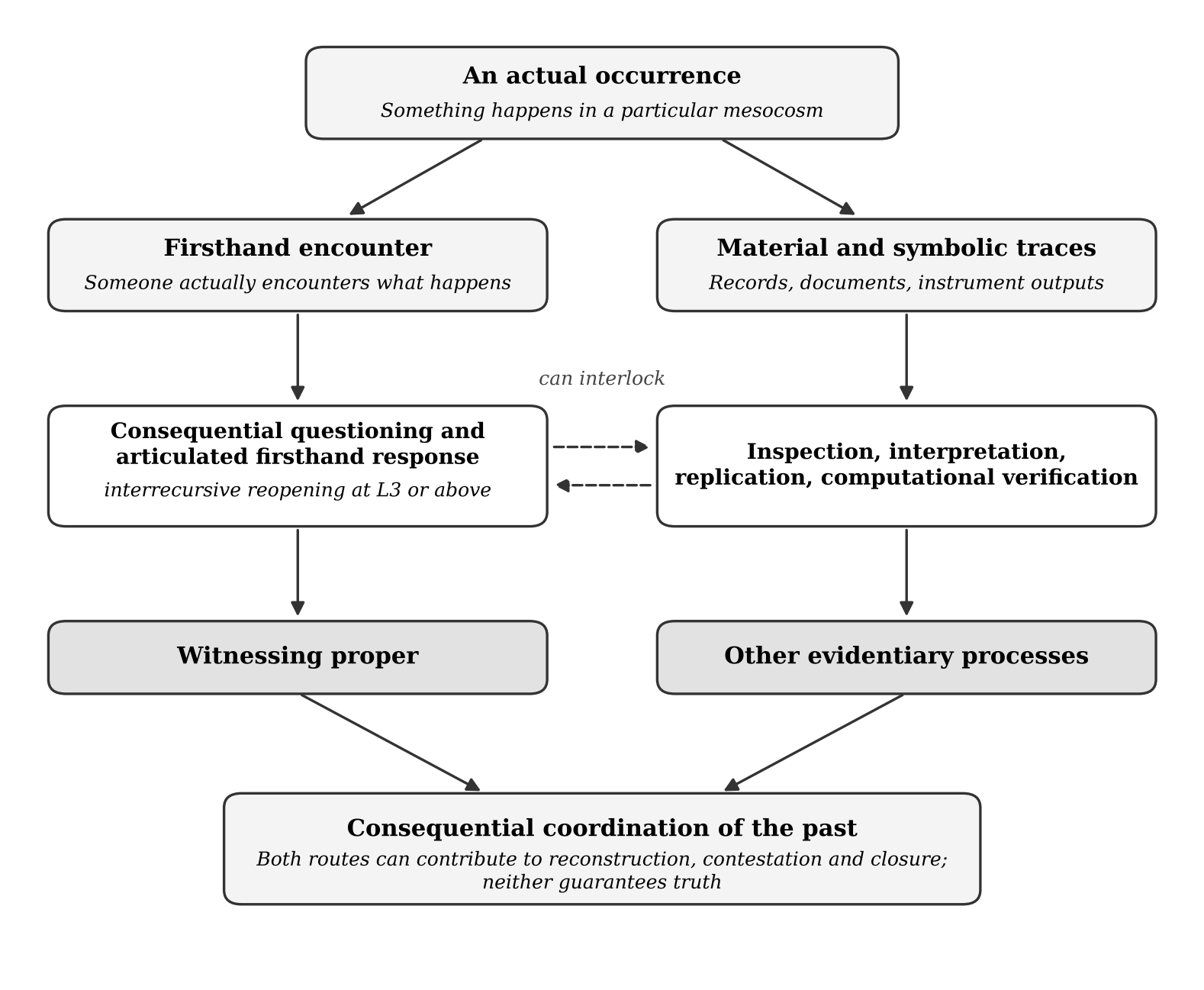
The derivation begins with an ontological problem rather than a word. An occurrence takes place. Living beings may encounter it through multisensorial embodiment, multispecies being-with, multiversal dwelling and multimateriality, and in human life also through multisymbolization (Ecks 2026c). The occurrence passes. Its consequences persist, but the occurrence itself cannot be recovered by returning to the moment in which it happened. Someone remembers aspects of it. Material traces remain. Symbolic accounts may be preserved. Other people hold different memories. Later, what happened may become consequentially questionable. This creates the possibility of a particular kind of recursive opening: someone who actually encountered the occurrence can be asked to articulate what happened, and their response may alter ongoing coordination. Witnessing becomes possible when an actual past encounter is reopened interrecursively and articulated because something consequential depends on what happened. The ontology precedes the definition.
The definition that follows is this (Ecks 2026d). Witnessing proper is the consequential interrecursive reopening, at L3 or above, of a past occurrence through the questioning of someone who actually encountered it and that person's articulated firsthand response, where the determination of what happened bears on vital stakes. Six conditions are jointly necessary. There must be an actual past occurrence: something that happened, not merely something imagined or predicted. There must be a firsthand encounter: the person questioned actually encountered the relevant occurrence. There must be temporal separation: the encounter is already past relative to its reopening, whether seconds or decades have elapsed. There must be interrecursive reopening: another person's questioning, challenge or request makes the encounter consequentially answerable. There must be articulation at L3 or above: the person who was there produces an intelligible account in response. And there must be vital stakes: establishing what happened matters to ongoing living coordination. These conditions specify witnessing proper as an analytical concept, not every ordinary use of the word. The witness may be truthful, mistaken, evasive or deceptive about something they actually encountered, since firsthand access does not guarantee accuracy. Someone who falsely claims to have encountered an occurrence they never experienced is counterfeiting a witness-position.
The definition also implies a set of surrounding processes that are not themselves witnessing. Elicitation is an attempt to reopen someone's actual firsthand access. Obstruction is refusal, intimidation, concealment or denial that prevents its articulation. Counterfeiting is a claim to firsthand access one did not have, or a misrepresentation of what an actual encounter establishes. Contestation challenges the reliability, scope or interpretation of an actual firsthand account. Scientific history contains all four: the request to a named observer to confirm a result, the laboratory member who declines to say what was done to a sample, the fabricated notebook entry, the dispute over whether an observer could have seen what he reported through a poorly ground lens.
The definition has a comparative consequence as well. Many animals encounter occurrences and retain their consequences, and some track what other individuals have previously perceived. None of this amounts to witnessing, which requires that another's past encounter become explicitly questionable and articulable at L3 or above (Ecks 2026d). Witnessing is in this sense a distinctively human achievement, built on capacities humans share with other animals but not reducible to them. That is one reason why extending it to instruments and ecologies is therefore far more than a modest broadening of an existing category: it assigns to nonrecursive counterparts a process that, on the evidence, is not even available to most recursive ones.
Recursive reopening is constitutive, not supplementary. Seeing something is insufficient, because witnessing is not an attribute acquired at the moment of perception. The encounter creates the possibility of later witnessing. A laboratory technician may observe an experiment and never be asked about it. Years later, the technician may be questioned about what happened during a disputed procedure. It is then that a witness-position is constituted. The same encounter can be reopened differently for different stakes: one inquiry may ask whether the apparatus malfunctioned, another whether someone knowingly altered the procedure. The underlying encounter is the same; its consequential questioning changes. LVT's theory of recursive opening describes the general form: a reopening "reactivates a relation that has already been closed or sedimented", and institutions regulate "recursive jurisdiction", who may open, refuse or reclose a matter (Ecks 2026b). Witnessing must therefore be treated as a process, not a personal status.
The definition sorts the processes conventionally grouped together without discounting any of them.
| Process | What occurs | Witnessing proper? |
|---|---|---|
| Observation | Someone encounters an occurrence | Not by itself |
| Remembering | Someone reactivates their own past | Not by itself |
| Routine recounting | A past is narrated without consequential questioning | Not necessarily |
| Firsthand testimony | An actual participant responds to consequential questioning | Yes, if the full conditions are met |
| Hearsay or secondhand reporting | Someone communicates another person's account | No |
| Replication | Another occurrence is produced | Not witnessing of the original event |
| Inscription | A process produces a durable symbolic or material trace | No |
| Automated registration | An instrument records an occurrence | No |
| Technical verification | A system checks whether specified conditions are satisfied | No |
| Forensic reconstruction | Past events are inferred from traces and accounts | May include witnessing, but need not |
The five mediations are not assigned one to each component of witnessing; they operate together in every consequential reopening. Multisensorial embodiment grounds the original encounter and the capacities involved in remembering and responding: what could be seen from where one stood, how a voice holds under questioning. Multispecies being-with makes questioning, disclosure, refusal, uncertainty and trust practically consequential, since it is other people who ask, doubt and act on the answer. Multimateriality sustains traces, instruments, documents and the settings in which both encounter and reopening take place. Multiversal dwelling situates the original occurrence and its reopening in particular conditions of light, weather, time and place. In pneumatics this is no abstraction. The pressure of the air varies with weather and altitude, as the barometric trials carried up the Puy de Dôme in 1648 had shown, so that what an observer of an air-pump trial encountered depended in part on conditions no one in the room had made. Multisymbolization makes articulate retrospective questioning, testimony, comparison and institutional stabilisation possible. All five participate, and their contributions differ from case to case. This also explains why a technical record cannot simply replace the embodied firsthand access of a person, even where the record is better evidence of a particular fact. The record is a multimaterial and multisymbolic deposit; it has no encounter to reopen and cannot answer a question about what it was like to be there.
The recursive architecture can be connected to witnessing without turning each recursivity level into a type of witness. At L1, "living coordination proceeds in operative closure": encounters are retained and used without explicit questioning. At L2, coordination "becomes recursively salient, or questionably available": something is felt to be off. At L3, "salience becomes symbolically articulable": a consequential question about an earlier occurrence can be put and answered. At L4, "articulations become portable stabilisations": procedures determine when testimony is admissible, authoritative, reproducible or open to challenge. At L5, "stabilisations become recursively repositionable": the legitimacy of those procedures and the grounds of inquiry can themselves be reopened (Ecks 2026e). The counterpart types sort the elements of a reopening. A material trace is a nonrecursive counterpart, one of those that "do not alter their course because they have been engaged". A person's remembering is selfrecursive. A consequential question and a firsthand response constitute interrecursive engagement (Ecks 2026e).
Closure matters as much as reopening. Witnessing may resolve an uncertainty, fail to resolve it, provoke further inquiry, or be deliberately obstructed. Its practical result is not necessarily truth or agreement, but a transformation in the coordination of a disputed past.
VIII. What Becomes Visible Once Witnessing Is Defined
The definition earns its place only if it explains something. The clearest test is to return to the laboratory, and then to follow evidentiary technologies beyond it.
Consider again the four supposed witnesses of the opening passage. The bird undergoes the experimental conditions. The air pump produces those conditions. The gentlemen observe and evaluate what happens. Boyle organises, interprets and communicates the results. And the written report, which the passage did not mention, preserves a symbolic account for readers who were absent. These processes are coordinated, but they are not interchangeable. Witnessing proper would arise if one of the gentlemen were later questioned, in a dispute over a contested demonstration, about what he actually saw: whether the bird collapsed before or after the valve was turned, whether the pump was leaking. Alternatively, a reader in Leiden or Paris might reconstruct the experiment from Boyle's account without witnessing the original occurrence at all. The experiment's credibility can increase without the number of witnesses increasing. That is the first concrete payoff: the history of experimental credibility and the history of witnessing come apart, and each can be studied on its own terms.
The second payoff concerns the automation of registration. Self-registering instruments, photography and later electronic recording systems made it possible to register occurrences without a human observer. The distinction between observation and automated inscription was historically important long before digital computing. Daston and Galison (2007) reconstruct the rise of mechanical objectivity in the nineteenth century, the effort to let nature print itself by minimising human intervention in scientific representation. An instrument may run continuously while no one looks at its output, and it may produce an exceptionally accurate record. This is not an automatic witness in the LVT sense. The record enables other forms of evidentiary coordination: inspection, comparison, statistical analysis. It can later become relevant to witnessing proper when the conduct of someone who handled, calibrated, interpreted or manipulated the instrument is questioned. Galison's (1987) account of how experiments end, and Hacking's (1983) insistence on the experimental intervention that produces phenomena, both describe a world in which much of the evidentiary work is done by arrangements no one witnesses, and in which persons are still called upon when the arrangements are disputed.
The third payoff comes from an unexpected direction. Satoshi Nakamoto's white paper of 2008 presents Bitcoin as a way of establishing a verifiable transaction history without a trusted third party to certify each transfer, since otherwise "the main benefits are lost if a trusted third party is still required to prevent double-spending". It even uses the language of witnessing: the longest chain "serves as proof of the sequence of events witnessed" (Nakamoto 2008). The functions involved can be distinguished precisely. Cryptographic signatures authorise spending under the protocol's rules. Network participants validate transactions against those rules. Proof-of-work and the chain of blocks establish a computationally verifiable history of accepted transactions. The resulting ledger is available for retrospective inspection by anyone. The network does not thereby become a witness proper: nothing in it encountered a transaction in the sense required, and nothing can be questioned about such an encounter and answer. Nor does a valid transaction establish the surrounding economic facts: who the parties were, what they intended, what they had agreed, or whether the transaction was lawful. Those questions may require further material evidence, investigation or firsthand testimony. The point of comparing it with the air pump lies less in any shared function than in what both show: why evidentiary arrangements must be examined without assuming that everything contributing to evidence counts as witnessing.
These cases lead to what can be called the paradox of automation. Technologies can greatly expand the ability to establish what happened while reducing the need for anyone to witness it. Yet automated systems also generate new possible objects of witnessing. Someone may later be questioned about how an instrument was calibrated, whether a data file was altered, who controlled a cryptographic key, why an anomalous transaction was authorised, or whether a laboratory procedure was followed. The automation of evidentiary functions redistributes, rather than abolishes, the circumstances in which firsthand encounters become consequentially reopened. It moves witnessing from the occurrence itself to the human handling of the systems that record it.
Investigations of scientific misconduct show the redistribution clearly. When a published result cannot be reproduced and fabrication is suspected, the instruments' outputs, the data files and the laboratory notebooks are examined first, as nonrecursive deposits. But the inquiry almost always turns, sooner or later, to people: the technician who prepared the samples, the postdoctoral researcher who ran the analysis, the colleague who saw the original gel. They are asked what they did, what they saw and when. Their encounters with the laboratory's daily work, which no one had thought of as witnessing at the time, are reopened because a career, a body of literature and sometimes patients depend on what happened. The more evidentiary work is delegated to apparatus, the more decisive these reopened human encounters become when the apparatus is in doubt.
A carefully bounded historical proposition follows. One significant development in modern science and economic life has been the construction of material and symbolic arrangements that make increasing amounts of coordination possible without continuous firsthand attestation. Neither a universal historical law nor a claim that automation always improves evidence, it is a proposition that becomes testable only once witnessing is distinguished from the functions associated with it. As long as instruments, ledgers and readers are all called witnesses, the transformation is invisible, because the number of "witnesses" appears to grow without limit.
IX. Four Objections
The first objection is that LVT is simply redefining an ordinary word. Ordinary language legitimately permits broad usage, and nothing here forbids it. The question is whether a theoretical concept gains or loses explanatory power by grouping distinct processes together. LVT proposes a more restrictive analytical category and has tried to show, in the preceding section, what the restriction explains.
The second objection is the most serious: is this not simply a definition of testimony? The answer lies in the full configuration of conditions. Testimony refers broadly to the provision of information or assertions, including secondhand and expert accounts. Witnessing in the LVT sense additionally requires an actual firsthand encounter, its consequential interrecursive reopening, and an articulated response from the person who had the encounter. Each condition does work. Without firsthand access, the expert and the hearsay reporter would qualify. Without reopening, every memoir and every routine report would qualify. Without articulation, every trace would. The configuration as a whole is what distinguishes witnessing from the larger family of testimony.
The third objection asks about nonhuman and machine witnesses. A legal system may appropriately treat machine evidence as functionally analogous to testimony, as Roth argues. A scholar may deliberately use witnessing expansively for political or ethical purposes, as Richardson does. Such applications need not be prohibited. But functional or normative extension does not establish identity of process, and the theoretical task is to distinguish the different forms of coordination involved. As the case of nuclear testing shows, the distinction can serve the ethical aims of the expansive concept better than the expansion does, by keeping in view whose encounters were never reopened.
The fourth objection is that a restrictive definition diminishes scientific knowledge or excluded testimony. It does neither. Scientific knowledge does not depend on every legitimate evidentiary process being witnessing. And separating access to an occurrence from institutional recognition makes it possible to identify exclusions more precisely: whether someone was kept from the encounter, from being asked, or from being believed. The aim is to enlarge explanatory possibilities by differentiating processes, not to restrict whose experiences matter.
X. Conclusion: After the Witness
In Boyle's laboratory the bird, the gentlemen, Boyle and the air pump were all consequential participants in experimental science. They were not all witnessing, and the conclusion, far from impoverishing the analysis of science, makes the diverse processes involved in experimental knowledge visible and allows each to be investigated in its own terms. Shapin and Schaffer explained the multiplication of experimental credibility. Haraway examined the historical authority of the witness. Latour reconstructed the participation of nonhumans in fact-making. More recent scholarship has extended witnessing to machines and ecologies. LVT offers a prior ontological differentiation: witnessing proper is one particular way in which actual past encounters become consequentially reopened, while many other processes can establish what happened without witnessing at all.
The same differentiation sharpens the politics of witnessing. Exclusion can be located precisely: at the encounter, at the questioning, or at the reception of the answer. The automation of evidence can be studied as a redistribution of witnessing rather than as its replacement. And the expansion of witnessing to nonhumans can be weighed against what it obscures, above all the persons whose actual encounters were never asked about.
The strongest implication is historical. The development of science and economic technology has done more than multiply witnesses: it has transformed how much of the world can be coordinated without them, and when their firsthand accounts must be sought again.
Selected References
Daston, Lorraine, and Peter Galison. 2007. Objectivity. New York: Zone Books.
Galison, Peter. 1987. How Experiments End. Chicago: University of Chicago Press.
Hacking, Ian. 1983. Representing and Intervening: Introductory Topics in the Philosophy of Natural Science. Cambridge: Cambridge University Press.
Haraway, Donna J. 1997. Modest_Witness@Second_Millennium.FemaleMan©_Meets_OncoMouse™: Feminism and Technoscience. New York: Routledge.
Latour, Bruno. 1987. Science in Action: How to Follow Scientists and Engineers through Society. Cambridge, MA: Harvard University Press.
Latour, Bruno. 1993. We Have Never Been Modern. Translated by Catherine Porter. Cambridge, MA: Harvard University Press.
Latour, Bruno, and Steve Woolgar. 1986 [1979]. Laboratory Life: The Construction of Scientific Facts. 2nd ed. Princeton: Princeton University Press.
Lynch, Michael. 1998. "Everything You Ever Wanted to Know about Technicians, and More."
Nakamoto, Satoshi. 2008. "Bitcoin: A Peer-to-Peer Electronic Cash System." bitcoin.org/bitcoin.pdf.
Potter, Elizabeth. 2001. Gender and Boyle's Law of Gases. Bloomington: Indiana University Press.
Richardson, Michael. 2024. Nonhuman Witnessing: War, Data, and Ecology after the End of the World. Durham: Duke University Press.
Roth, Andrea. 2017. "Machine Testimony." Yale Law Journal 126 (7): 1972–2053.
Shapin, Steven. 1984. "Pump and Circumstance: Robert Boyle's Literary Technology." Social Studies of Science 14 (4): 481–520.
Shapin, Steven, and Simon Schaffer. 1985. Leviathan and the Air-Pump: Hobbes, Boyle, and the Experimental Life. Princeton: Princeton University Press.