Abstract. This article pioneers a Living Value Theory (LVT) approach to media influence, rejecting narrative-centric methods that displace political decisions with symbolic correspondences. Focusing on Europe’s 2015 migration crisis, it reconstructs how photographs, movements, executive actions, and anticipated images entered distinct mesocosms through five irreducible mediations and differential temporalities. By centering urgent executive decisions rather than parliamentary discourse, and by distinguishing immedial coordination from recursive attribution of future media effects, the analysis demonstrates that influence often operates through non-published anticipations and practical pressures. The result is a decision-centred research design that replaces narrative coding with mediational and recursive audits capable of discriminating genuine causal pathways.
I. A Photograph, a Train, and a Chancellor
On the morning of 2 September 2015, the body of three-year-old Alan Kurdi was found at the waterline near Bodrum on the Turkish coast. Within hours, photographs taken by the Turkish photojournalist Nilüfer Demir were circulating on social media, and by the following morning they were on the front pages of newspapers across Europe. In the same days, several thousand people who had crossed the Aegean and travelled north through the Balkans were stranded in Budapest, where the Hungarian authorities had closed Keleti station to international departures on 1 September. On 4 September a large group set out on foot along the motorway towards the Austrian border. That night, after the Hungarian government announced that it would provide buses to the border, Chancellor Angela Merkel and the Austrian Chancellor Werner Faymann agreed that the people arriving would be allowed to travel on into Austria and Germany. From 5 September, trains carried them to Munich, where police, municipal staff, and volunteers met them on the platforms with food, water, and handmade signs.
These three developments were closely connected, and they were of different kinds. The photograph was an extraordinarily forceful perceptual encounter, and it reached millions of people who had no other contact with the routes along which the boy’s family had travelled. The march from Budapest was a movement of exhausted bodies through late-summer heat and across a state border, generating immediate needs for water, food, sleep, shelter, transport, and registration. The decision taken during the night of 4–5 September was an exercise of executive authority under legal, diplomatic, administrative, and political constraints, conducted largely by telephone between heads of government. An account organized around narratives is drawn to describe all three as moments in a shift of humanitarian discourse. A Living Value Theory (LVT) account asks instead how the photograph, the movements, the reception arrangements, the executive decisions, and the public responses became involved in one another, through which mediations, at which recursive levels, and over which temporal horizons.
The German decision to permit onward travel from Hungary did not originate in parliament. The Bundestag was not sitting when it was taken and voted on no measure authorizing it. The precise sequence of consultations that night, the legal basis for the decision, and its relationship to subsequent border practice have been disputed ever since, in journalistic reconstructions (Alexander 2017) as well as in legal and political argument, and the common phrase “opening the border” is itself a contested description of an event in which no border was formally opened. The decision was also preceded by developments that the photograph cannot explain. In late August the Federal Office for Migration and Refugees had already signalled that Dublin transfers of Syrian applicants were, in practice, no longer being pursued, and on 31 August Merkel told her summer press conference “Wir schaffen das,” two days before the photograph existed.
This produces the puzzle from which the article starts. If a photograph circulates before a parliamentary debate, and parliament subsequently adopts humanitarian language, what precisely has been influenced? The rhetoric of individual speakers, the positions of parties, a decision already taken, its public justification, or its later implementation? A temporal sequence of two public statements cannot answer this question, because the same sequence is compatible with each of these possibilities and with several others in which reporting did nothing to the decision at all.
The aim of this article is to develop an LVT approach to media influence by examining the mesocosmic conditions under which media reporting becomes relevant to political decisions, particularly under urgent and emotionally charged conditions. Its question is deceptively straightforward: how did media reporting influence the political decisions made in response to Europe’s acute migration crisis in the summer of 2015? Its answer begins by refusing to treat that question as a question about narratives. Media mattered in 2015, and nothing in what follows diminishes that; how far, and through which processes, they mattered to particular decisions is what remains to be established. The argument is for identifying much more precisely how, when, where, and to whom they mattered, including through reporting that had not yet appeared.
II. The Wrong Object: From Political Decisions to Narrative Circulation
What Smellie and Boswell investigate
Saskia Smellie and Christina Boswell’s “The Influence of Media Narratives on Political Debate” (2025) is the most systematic recent attempt to answer a version of this question comparatively. Drawing on the EU-funded BRIDGES project, they examine media coverage and parliamentary debate in France, Germany, Italy, Spain, and the United Kingdom, using 238 newspaper articles from a progressive, a centrist, and a right-leaning title in each country, more than 150 parliamentary transcripts, and 25 semi-structured interviews. Following the Narrative Policy Framework of Michael Jones and Mark McBeth (2010), they code each narrative into four components: a setting, characters (victims, villains, and heroes), a plot, and a moral of the story, usually a policy solution. They then classify the movement of narratives between the two spheres with a fourfold typology of embracing, adapting, rejecting, and ignoring.
Their central finding is that humanitarian reporting appears to have influenced political debate during a particular window of opportunity (compare Kingdon 1984), when parliaments were in recess and the media were less dependent on political sources, and that this influence was strongest over the emotive components of narratives and weakest over proposed remedies, which political actors adapted to their own agendas. They are explicit that their devices for inferring causal direction are not conclusive. The scale of the undertaking deserves credit, and so do observations such as that French editorials quoted French politicians remarkably little and that British coverage divided along ideological lines more than between media and parliament. The question is whether the explanatory framework is adequate to the significance claimed for them.
The displacement of the explanandum
A study of media and politics might investigate at least four objects: how media discourse and parliamentary discourse resembled or differed from each other; how media coverage changed what politicians said in public; how media coverage influenced specific executive or legislative decisions; and how it affected the implementation and consequences of public policy. These objects are related, but a method suited to the first cannot answer the others. Smellie and Boswell’s primary object is the first, and it is a legitimate and deliberately bounded one: correspondences between public discourses are worth mapping, and theirs are carefully mapped. The difficulty arises at the points where those correspondences are read as mechanisms of influence: in the conclusion that humanitarian narratives “exerted influence” on political debate (Smellie and Boswell 2025, 4195), in the use of interviews to infer that politicians took their cue from newspapers, and in the closing call to examine whether the solutions proposed in dominant narratives come to “mirror policy output” (4197). At these points the analysis begins to claim more than narrative comparison can show, and the historical processes through which governments came to decide what they decided are represented by relations among their symbolic traces. This may be called the displacement of the explanandum.
How a coding scheme can produce its findings
Categories such as victim, villain, hero, and plot can organize discourse descriptively, but they risk imposing the shape of a story on forms of political communication that are primarily something else: justifications, procedural interventions, announcements, accusations, or institutional position-taking. A minister answering a question about reception capacity is not obviously telling a story with a villain in it, and the coding scheme must decide that she is before it can report who the villain was.
The four components also differ in their degree of abstraction. “Refugees as victims” is a broad characterization that a great many speakers with very different positions could share. A proposal to relocate 120,000 people, to reintroduce controls at the Austrian border, or to accelerate asylum procedures is highly specific. The finding that characters and plots remained comparatively stable across media and parliament while policy solutions were adapted may therefore partly reflect coding granularity rather than any difference in the durability or causal power of narrative components. Smellie and Boswell connect the finding to Schmidt’s (2010) distinction between deep-seated background ideas and more malleable policy ideas, but the test would be to code every component at the same level of specificity. Characters coded as finely as solutions (Syrian families at Keleti station, young men at Calais, unaccompanied minors landed at Lampedusa) might prove as variable as policies, and solutions coded as coarsely as characters (“European solidarity”) might prove as stable as victims.
The problem of causal inference
The authors deploy three devices to infer causal direction: explicit references in one sphere to communications in the other, the temporal sequence in which narratives appear, and interviewees’ beliefs about media influence. Each is informative and each is insufficient. An explicit reference establishes that a source was invoked without establishing that it changed a preference, since, as the authors acknowledge, a politician may cite a newspaper to validate a position already held. Temporal precedence excludes neither a common cause, such as a shipwreck or a march (Birkland 1997) to which journalists and ministers responded independently, nor communications that leave no public trace, such as briefings, telephone calls between heads of government, and internal guidance to officials. Interview testimony can establish actors’ understandings of influence, but those understandings may themselves be retrospective justifications. With two interviews in Spain, the third device is thinnest where one of the strongest causal claims, the Spanish reversal (Pasetti, Güell, and Garcés Ramos 2023), is made.
What is missing is an account of what would count as evidence against the hypothesis of media influence. A study that can classify every observed relation between media and parliament as embracing, adapting, rejecting, or ignoring has no outcome that the hypothesis forbids. Historical causation remains investigable, but only once the inquiry specifies outcomes, plausible counterfactuals, alternative explanations, and evidence capable of distinguishing among them (Beach and Pedersen 2019).
Symbolic overreach
The underlying problem is symbolic overreach: treating relations between symbolic stabilizations as sufficient explanations of the living processes in which those stabilizations arise and operate. Symbolic overreach requires no grand philosophical commitment. It can be produced by ordinary methodological choices: selecting texts, defining categories for them, standardizing those categories across five countries, and interpreting the order in which the categories appear. The decisive step is the presumption that, because political communication is observable as symbols, the principal mechanism of political influence must be reconstructed as a relation between symbols. Investigating narratives is no error in itself; overreach begins at the point where explanatory claims exceed what the comparison of narratives can establish (Ecks 2026f). Figure 1 sets the two approaches side by side. The question it raises is what would need to be observed if inquiry began with the crisis itself rather than with the language in which it was represented.
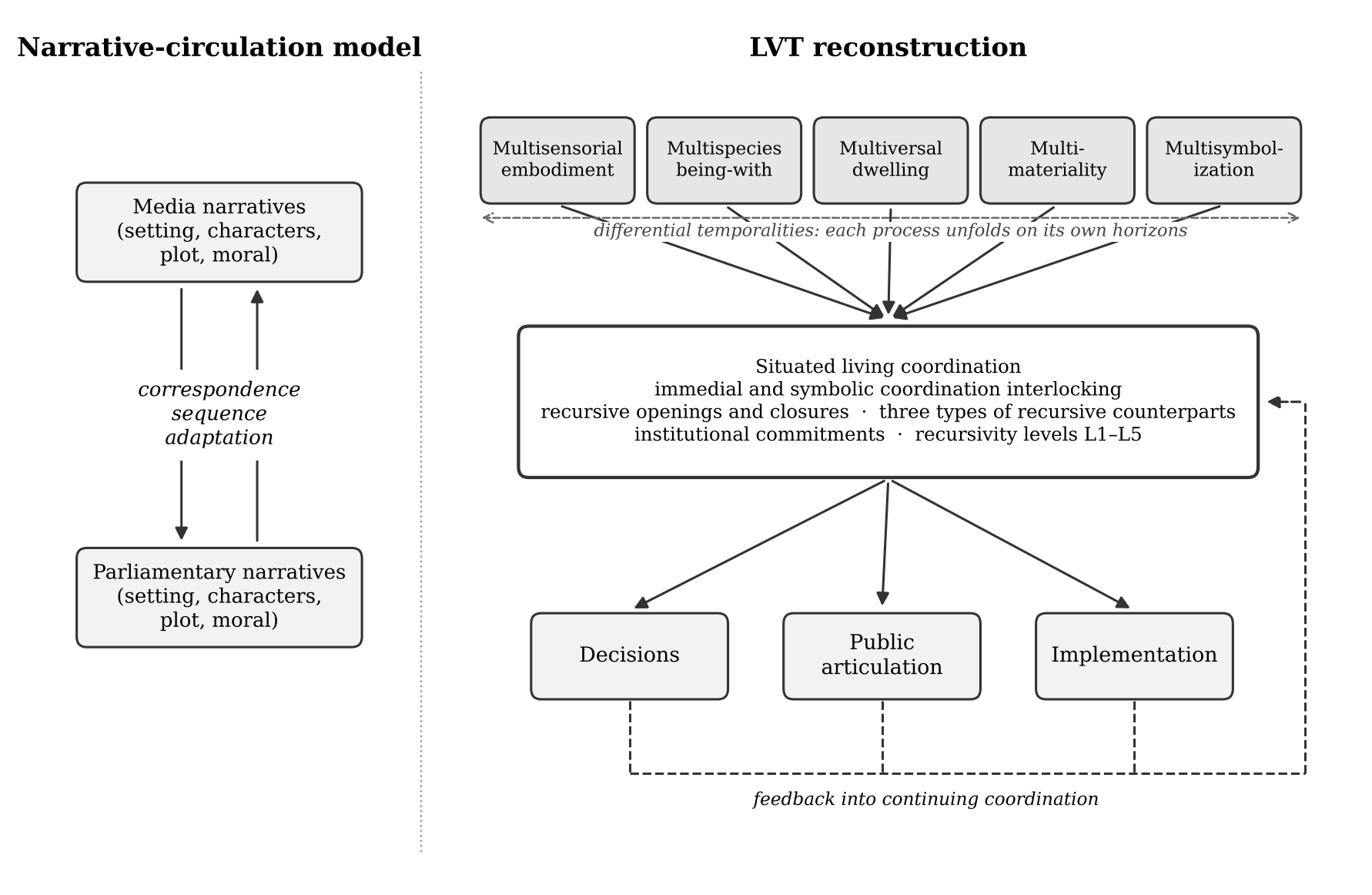
Figure 1. Two approaches to media influence. The figure is a conceptual comparison rather than a one-way causal model. In the LVT reconstruction, the five mediations remain distinct, differential temporalities characterize their ongoing coordination rather than forming a sixth element, and decisions, public articulation, and implementation all feed back into continuing living coordination.
III. Auditing the Crisis: Five Mediations, Different Mesocosms
One name, many mesocosms
“The European migration crisis” is an L4 stabilization (Ecks 2026g). It names a historical episode without establishing that everyone involved encountered the same phenomenon or faced the same stakes. For people crossing the Aegean and walking through the Balkans, the stakes were bodily survival, safety, the ability to keep moving, and the possibility of reaching somewhere to live. For reception workers on a Munich platform or at a Sicilian port, they were beds, sanitation, food, interpreters, staff, and the capacity of facilities designed for smaller numbers. For heads of government, they were decisions under legal, diplomatic, and electoral constraints, often within hours. For residents far from the main routes, the crisis was encountered principally through photographs, broadcasts, and political statements, and through anticipations of what the arrivals might mean for their own futures. The analytical task is to reconstruct these different mesocosms (Ecks 2026h) and the connections among them before deciding what in them could be compared.
An audit through the five mediations
The five mediations (Ecks 2026e) organize such an audit without turning it into five boxes into which every observation must be sorted.
In multisensorial embodiment, the crisis consisted of exhaustion, hunger, thirst, cold at night, blistered feet, seasickness, injury, illness, fear, and the particular vulnerability of small children and the elderly. It also included the dispositions through which onlookers registered strangers and crowds as reassuring or disturbing, and the perceptual force of photographs that reached people through the eye before they reached them as argument.
In multispecies being-with, which in 2015 was overwhelmingly a matter of human relations, the crisis consisted of families travelling together and separated in transit, children carried across borders, strangers forming temporary companies along the route, hospitality offered by volunteers, obligations felt towards people outside one’s own polity, and, in the opposite direction, perceived threat and the withdrawal of trust.
Multiversal dwelling concerns the conditions of a mesocosm that no one has made, such as sea, weather, terrain, distance, daylight, and season, but always as conditions lived within inhabited and historically configured worlds, never as an external environment standing over against them. The Aegean was a different sea for a family in an inflatable boat at night, for a coastguard crew, and for a holidaymaker on Lesbos; the strait is narrow enough to make a crossing thinkable and rough enough to make it lethal. The overland route through the Balkans meant days of walking in late-summer heat and, by October, in cold and rain, and the approach of winter set a horizon for travellers and governments alike. The routes were never only geographical: the passage from Syria to Germany combined seas and mountains with railways, family networks, earlier arrivals, and messages passed between phones about which border was open. Refugees crossing the Aegean, families waiting in Budapest, residents of Munich, and people following events from Britain dwelt differently in the unfolding crisis, and their possibilities for movement, encounter, anticipation, and settlement were not interchangeable. Nor did national borders define the boundaries of their mesocosms.
In multimateriality, the crisis consisted of boats, life jackets, smartphones, railway lines, stations, buses, the fence Hungary was building along its border with Serbia, gymnasiums converted into dormitories, fingerprint databases, and the ferry terminals and tunnel at the Channel: the arrangements through which people were transported, received, or prevented from moving.
In multisymbolization, the crisis consisted of photographs, headlines, editorials, legal categories (refugee, asylum seeker, economic migrant, Dublin case), official announcements, parliamentary statements, quotas, national histories of refuge and of invasion, and the stabilization of “the crisis” itself as a single named object.
The five mediations are irreducible to one another, neither comparable quantities nor independent variables. The train journey from Budapest to Munich cannot be classified as a material event with symbolic consequences. It was at once bodily relief after days on foot, a carriage of families and strangers, a passage across the Pannonian plain in early autumn, a scheduled multimaterial operation of rolling stock and staff, and a journey made possible by a decision and legible, on arrival, as a symbol of welcome. Its significance arose from the involvement of all five.
Different countries, different configurations
Smellie and Boswell select their five countries through a most-similar-systems design: all were EU member states and liberal democracies with pluralist media and long experience of immigration. Their positions in relation to the movements of 2015, however, differed so much that the similarity of their political systems does little to make their crises comparable.
Smellie and Boswell report many of these differences, but treat them chiefly as differences in the narrative “setting” of each national story. Table 1 sets them out instead as differences in what was happening, along seven dimensions. Its entries are a provisional reconstruction for the purposes of research design rather than findings.
Table 1. Five positions in the crisis of 2015: a provisional comparative matrix
Dimension |
Italy |
Germany |
France |
Spain |
United Kingdom |
|---|---|---|---|---|---|
Position in movements |
Principal arrival point on the central Mediterranean route |
Principal destination, reached via the Balkan route |
Partly destination; transit towards Britain at Calais |
External border state, marginal to the 2015 routes |
Distant destination outside Schengen |
Immediate operational pressure |
Coastguard, ports, reception centres, hotspots |
Rail, federal police, asylum office, Länder, municipalities |
Calais and Paris encampments, prefectures |
Limited; chiefly diplomatic |
Limited; Home Office resettlement and Calais cooperation |
Decision-making authority |
Government, Interior Ministry, EU Council |
Chancellor and federal ministries; Länder for reception |
President and government; EU Council |
Government; EU Council |
Prime Minister and Home Office; outside relocation |
Prior commitments |
Mare Nostrum and Triton; demand for Dublin reform |
Constitutional asylum right; late-August handling of Syrian Dublin cases |
Early-summer resistance to quotas |
Opposition to mandatory quotas |
Resettlement scheme since 2014; non-participation in relocation |
Mesocosmic exposure |
Direct in the south, mediated elsewhere |
Direct in Bavaria and at stations, mediated elsewhere until allocation |
Direct at Calais and in Paris, largely mediated elsewhere |
Almost wholly mediated |
Almost wholly mediated |
Decision temporality |
Chronic pressure on an EU timetable |
Hours on 4–5 September, then weeks |
EU negotiating timetable |
EU timetable; rapid shift in early September |
Days, with no operational deadline |
Possible media influence (to be tested) |
Articulating the European burden |
Disclosure, volunteer coordination, anticipated images, stabilization |
Stabilizing a shift on quotas |
Reopening the quota position |
Change in the scale of resettlement |
The analytical payoff is that the same photograph reached all five countries within hours while entering markedly different configurations of living coordination. It coincided with an expansion of resettlement in Britain, with urgent operational decisions in Germany, and with negotiations over European relocation in France, Italy, and Spain. These differences are problems for explanation. The matrix states what an explanation would have to account for without supplying one, and a design that compares national narratives as responses to a common event cannot even pose the problem.
The mesocosm is not the nation-state
The comparison also needs to descend below the national level. Munich in the first week of September and a small town in Lower Saxony that met the crisis first on television belonged to the same jurisdiction and occupied very different mesocosms, as did Lampedusa and Turin, or Calais and Lyon. Different people in the same place may also inhabit different mesocosms: a volunteer at the Munich station, a federal police officer on the platform, and a commuter passing through on the same morning. Mesocosmic variation within national jurisdictions may explain more than aggregate contrasts between national newspaper discourses, and a research design that takes the nation as its unit of comparison cannot see it.
Immedial and symbolic coordination
The audit also has to register how much of the crisis proceeded without anyone articulating it. On the Munich platforms, people stepped down from trains, volunteers handed out water and food, police directed movement, and families looked for somewhere to sleep. Much of this was immedial coordination (Ecks 2026f): bodies, hands, gestures, queues, and glances adjusting to one another without any participant needing to formulate, still less exchange, a narrative about the European migration crisis. A train approaching Munich generated impending practical demands whether or not anyone interpreted it as a humanitarian story. At the same time, signs, announcements, instructions, and media reports organized and transformed that coordination. A television report or a message forwarded between phones could change which volunteers came to the station, what they brought, how officials prepared, and how arrivals were received. Symbolic coordination had concrete consequences here because it entered immedial coordination that was already under way. The question that matters is how immedial and symbolic coordination became involved in one another under conditions of extraordinary urgency, and a corpus of editorials and debates records only one side of that involvement.
Different issues require different audits
The same point applies across political issues. An acute displacement emergency, a pension reform, and a railway investment cannot be presumed to instantiate the same media-politics mechanism. A displacement crisis makes bodily vulnerability immediately pressing for those inside it while remaining heavily mediated for distant observers; a pension reform engages decades of sedimented expectation; a high-speed railway is organized around planning, territorial conflict, and implementation horizons that outlast several governments. None of these is simply emotional or simply rational, and the constitution of each must be investigated before cases are chosen for comparison. The methodological principle is that before comparing representations, one must audit the living processes of which they are representations.
IV. Urgency and Differential Temporalities
More than a topic attracting attention
The movements of the summer of 2015 imposed demands that did not wait for deliberation. People on the road needed water and somewhere to sleep that night, and a crowd walking along a Hungarian motorway would reach the Austrian border within a day or two whether or not anyone had decided what would happen there. Yet the same episode involved many temporalities at once, as Table 2 indicates.
Table 2. Illustrative temporal horizons of the late summer of 2015
Process |
Characteristic temporal horizon |
|---|---|
Embodied survival and immediate assistance |
Minutes to hours |
Travel and reception logistics |
Hours to days |
News publication and circulation |
Minutes to days |
Executive and diplomatic responses |
Hours to weeks |
Parliamentary procedure and party coordination |
Days to months |
Legislative and administrative restructuring |
Months to years |
Settlement, belonging, and institutional memory |
Years to generations |
These horizons are illustrative. The five mediations are not themselves durations and cannot be measured in clock time (Ecks 2026d), but the concrete processes through which they operate unfold across horizons that can be measured, and it is these that the table records. What matters is how the horizons interlocked. A decision reached in a few hours of telephone calls between Berlin, Vienna, and Budapest altered arrangements of asylum and border governance built up over decades. A photograph that circulated in minutes reopened questions that institutions had treated as settled. Legislation passed weeks later closed, in a restrictive direction, some of what that night had opened.
The fallacy of temporal precedence
Newspapers and parliaments have different operational rhythms. A newspaper publishes continuously; a parliament sits according to a calendar, and in August most European parliaments did not sit at all. An executive may decide while parliament is absent, and the parliamentary record of the decision is produced afterwards, when ministers report, opposition parties respond, and backbenchers position themselves. Earlier appearance in the media may therefore reflect the timing of the publication mechanism rather than the origin of political coordination. This matters all the more because Smellie and Boswell deliberately study a summer recess, which they treat as a window in which the media could set the agenda. The same recess made the parliamentary record unusually remote from executive decision-making. In the very period chosen to show media leading parliament, parliament was structurally bound to come second, whatever had led the government.
The British sequence makes the point concrete. As the photograph circulated, the Prime Minister, David Cameron, was still arguing that the answer to the crisis did not lie in taking more refugees. On 4 September, during a visit to Lisbon, he said that Britain would accept thousands more Syrians. On 7 September he told the House of Commons that the United Kingdom would resettle up to 20,000 over the remainder of the Parliament, and on 8 September the House held an emergency debate, granted on an application by the Shadow Home Secretary, Yvette Cooper, in which the opposition attacked the scale and pace of the commitment (House of Commons 2015a; 2015b). Any parliamentary narrative coded from these debates postdates the decision it discusses. Whatever humanitarian language the debate contains is evidence about how a decision was articulated and contested, and only indirectly about how it was made.
When decisions are already being forced
A decision can stand in several temporal states. It may not yet be seriously considered; it may have become possible while remaining open; events may force a choice within a shrinking window; it may have been taken while remaining open to modification; it may be under implementation while public argument continues; and it may be retrospectively justified, criticized, or reclassified. Media influence must be investigated differently in each state. A report that precedes an open choice may contribute to how it is made, while one that follows it may affect its legitimacy or later modification. A parliamentary statement delivered after implementation has begun cannot explain why the original choice was made, though it may help explain why it was later revised.
The German case passed through every one of these states within about seven weeks: from the administrative handling of Dublin cases in late August, through the forced choice of the night of 4–5 September, to the reintroduction of temporary controls at the Austrian border on 13 September and the Asylum Procedure Acceleration Act passed in October. Coding “German political narratives” across this period as a single object flattens sequence into sameness.
Recursive opening and closing under pressure
The crisis reopened, at L4, institutional commitments that European governments had treated as settled: the Dublin system’s allocation of responsibility to the state of first entry, the obligations owed to people who are not members of the polity, the disappearance of internal Schengen borders, and what solidarity among member states requires. Reopening and modifying established regulations is L4 institutional reflexivity. L5 would require something further: a reconsideration of the grounds on which responsibility had been defined, distributed, and made institutionally askable, such as whether responsibility for asylum should follow the point of entry at all. Whether 2015 produced any such L5 repositioning, or chiefly L4 reopening followed by L4 re-closure, is an empirical question, and the persistence of the first-entry principle through subsequent rounds of reform suggests that much of it was the latter. Reporting sometimes intensified these reopenings by making distant suffering difficult to pass over. Yet urgent decisions also required recursive closure. Administrations could not reconsider every alternative indefinitely. They had to establish provisional arrangements, such as a train schedule, a registration point, or an allocation formula for reception places, that allowed coordinated action to proceed while the larger questions remained open.
An acute crisis may thus generate extraordinary recursive opening and extraordinary pressure for rapid closure at the same time, and the two need not occur at the same level or among the same participants. The governments that closed the question of the trains on 5 September did not thereby close the question of European responsibility-sharing. The Justice and Home Affairs Council that adopted the relocation of 120,000 people by qualified majority on 22 September closed a question of procedure while leaving the question of implementation wide open, as the scheme’s subsequent history showed.
Delayed articulation
Some of what appears in a chronology of texts as the movement of a narrative from media to parliament may therefore be the delayed symbolic articulation of multimaterial, executive, and institutional processes that had already changed. The humanitarian language of a September debate may be catching up, at L3 and L4, with what had been done on platforms and at borders in the preceding days. That possibility cannot be identified through a chronology of statements alone, because in a chronology of statements the platforms and the borders do not appear.
V. Who Decided? Executive Action, Parliamentary Speech, and Institutional Authority
Political debate and political decision
Three forms of political activity need to be distinguished. Authorization concerns who had the legal and institutional capacity to make a decision. Articulation concerns who publicly explained, defended, contested, or interpreted it. Implementation concerns who carried it out, and through which practical arrangements. These may involve different actors, institutions, and temporalities, and a newspaper can influence any of them, but evidence of influence on one does not establish influence on the others. The fundamental difficulty with comparing newspapers and parliamentary transcripts lies less in the possibility that parliament misrepresents public opinion than in the possibility that parliament was not the institutional site where the decision under investigation was made. In most of the episodes of September 2015, it was not.
Germany as the pivotal case
The German sequence needs to be reconstructed with care. In August the Federal Interior Ministry raised its forecast of asylum applications for the year to 800,000, and the Federal Office for Migration and Refugees issued internal guidance that Dublin procedures for Syrian nationals would largely not be pursued, guidance that became public on 25 August. On 27 August the bodies of 71 people were found in an abandoned lorry on an Austrian motorway near the Hungarian border. On 31 August came the summer press conference. The photograph of Alan Kurdi circulated from 2 September. On 4 September, after the march from Keleti station and the Hungarian announcement of buses to the border, Merkel and Faymann agreed to let those arriving travel on, and from 5 September trains brought thousands to Munich. On 13 September Germany reintroduced temporary controls at its border with Austria. In October the Bundestag passed the Asylum Procedure Acceleration Act, which extended the list of safe countries of origin and tightened benefit rules.
Smellie and Boswell are right that German reporting took a humanitarian turn before the press conference, and their German material, drawn from Reindorf and Vollmer (2023), suggests that the media’s positioning “pre-dated and likely emboldened” the Chancellor (Smellie and Boswell 2025, 4190). Two features of the sequence complicate the inference. The administrative handling of Dublin cases preceded both the press conference and the photograph, and it was decided by officials whose reasons, among them a mounting backlog and the practical difficulty of transferring people back to Greece and Hungary, may have had little to do with newspapers. And the decisive executive act of 4–5 September answered a situation forced by the movement of people and by a Hungarian government that wanted them out of Budapest. The question is then whether the humanitarian discourse later recorded in parliament reflected media influence on the decision or the political necessity of articulating, defending, and modifying a decision the executive had already taken under pressure from events. These are competing explanations, and the sequence of texts alone cannot discriminate between them. Nor does pressure from events establish that media played no part in the decision: executive actors could have been responding to practical pressures and to anticipated public representations at once, a possibility to which the next subsection turns.
The opposition led by the Bavarian Minister-President Horst Seehofer, which Smellie and Boswell record as a rejection of the government’s narrative, belongs to the same reconstruction. Bavaria was the Land through which most arrivals entered, and according to journalistic reconstructions its leader was not reached during the night of the decision (Alexander 2017). Seehofer’s opposition can be coded as a rejecting narrative. It can also be reconstructed as the articulation, at L3 and L4, of a position whose stakes were multimaterial and federal: platforms, police deployments, accommodation, and a Land government left outside a decision whose consequences it carried.
The images that had not yet been taken
A contemporaneous reconstruction in Die Zeit, published on 17 September, reports that on 4 September the federal government expected the movement towards Austria to peak over the weekend and judged that it could no longer be held back. According to that reconstruction, Merkel feared the images that were about to emerge, of refugees run over on the motorway, of police acting against people in distress, perhaps of Hungarian soldiers, and a cabinet member is reported as saying that Europe could not allow itself to be associated with such pictures (Hildebrandt and Ulrich 2015). Robin Alexander’s later reconstruction makes a comparable argument about 13 September, when the reintroduction of border controls was not followed by the turning back of people at the border, in part, he argues, because no one was prepared to take responsibility for the images that turning them back would produce (Alexander 2017). Both are journalistic reconstructions resting largely on unnamed sources, and neither establishes Merkel’s motives. They do open a line of investigation that a corpus of published narratives cannot reach.
Media influence need not follow publication. Political actors may coordinate their present actions in anticipation of future reporting, including representations of events that their own decisions might bring about or prevent. In the reconstruction of 4 September, people moving along a motorway, the anticipated actions of police, photographs that did not yet exist, expected audience responses, and an executive decision became involved in one another before any anticipated media event occurred. This is a matter of mixed futurity (Ecks 2026b): a present decision partly governed by an unactualized future, in which embodied and multimaterial events would become multisymbolic deposits and those deposits would constrain what could be done next. It is also subject to an archive asymmetry, since misfit leaves symbolic traces and fit leaves none. A decision that succeeded in preventing a confrontation leaves no photograph of the confrontation to be coded, yet the anticipated photograph may have shaped the decision. Such anticipatory coordination cannot be reconstructed from the temporal sequence of published narratives, because the anticipated future may never materialize. The same holds for other actors: editors anticipating how readers will respond, journalists anticipating official reactions, and refugees anticipating how governments will respond to their movements, whose anticipations were in turn anticipated by governments (Ecks 2026a; 2026c).
Party coordination and prior commitments
Parliamentary speakers do not enter debates as uncommitted individuals meeting media narratives for the first time. They occupy party positions, electoral relationships, institutional responsibilities, and established commitments. In Germany these included the CDU, the CSU, the SPD, and the Greens and Die Linke in opposition, each with a prior record on asylum. A humanitarian intervention in the Bundestag could arise from party position, support for an executive decision, opposition to a rival, response to constituents, a change in felt relevance following reporting, or strategic anticipation of reception. Only some of these imply that reporting changed the speaker’s position; others imply at most that it shaped how an existing position was publicly articulated. What appears in a corpus as the borrowing of a narrative is often interrecursive institutional coordination among parties, ministries, and Länder, in which newspapers figure as one counterpart among several.
Britain as an illuminating contrast
The British case permits a different chronology to be examined. Before September, the Syrian Vulnerable Persons Relocation scheme, established in January 2014, had resettled only a little over two hundred people (House of Commons Library 2015). Within roughly seventy-two hours of the photograph’s circulation, a governing party that had resisted expansion committed itself to 20,000 places, through an existing scheme and without any change in the arrival of people at British borders. An e-petition calling on the government to accept more refugees gathered hundreds of thousands of signatures in the same days. The British chronology therefore offers a stronger prima facie case than the German one for media-related change in a decision, as distinct from its articulation, although the close sequence of photograph, public mobilization, and announcement does not itself establish which of these processes changed the government’s position.
The questions an LVT reconstruction would ask are therefore precise. What was newly decided, and what was the scaling of an existing arrangement? What had already been under discussion within government before 2 September? What role did the photograph play relative to the petition, to pressure from within the Conservative Party, to European partners, and to the opposition’s procedural initiative? And what of the government’s prior position did its choice of resettlement from the region, rather than relocation within the EU, preserve? These questions are empirically answerable if sufficiently detailed evidence becomes available, and none of them can be answered by coding the debate of 8 September.
A study of media influence on political decisions must begin by identifying the decisions and reconstructing the processes through which they became possible. Parliamentary discourse is an important source for that reconstruction, and it cannot be presumed to be its principal site.
VI. What Media Actually Do: Recursive Opening, Affect, and Symbolic Coordination
Distance from the arrivals
None of this diminishes the importance of media. For most Europeans in 2015, the crisis was encountered overwhelmingly through mediated representations rather than through contact with people in transit or with reception systems, and this asymmetry is fundamental. Media did more than supply information about a pre-existing public concern: they could make an otherwise distant event enter a person’s mesocosm as something pressing, relevant, or threatening. Direct encounter and symbolic mediation were not alternatives, however. Media also shaped how people lived encounters they were already having, so that the same arrival at a station could be met as welcome or as overwhelm according to what the onlooker had seen the night before.
The photograph as recursive opening
The photograph of Alan Kurdi should not be reduced to a narrative presenting a victim. A photograph is a multimaterial and multisymbolic deposit encountered first through multisensorial embodiment, often before any verbal interpretation has formed. Its force could involve recognition of a small child’s vulnerability, the possibility of imagining one’s own child at the waterline, and a felt disruption of habitual indifference to reports of deaths at sea that had been appearing for years. Not every viewer responded in the same way, and some responded with suspicion or anger.
An LVT analysis would investigate how the image became perceptually salient rather than being passed over among the many images of the crisis; how L2 felt relevance emerged, with or without immediate linguistic articulation; how L3 questions became askable that had not been asked before, such as how this could happen or what one’s own country was doing; how L4 institutions, including editors who chose to publish, parties, NGOs, and petition platforms, took up, amplified, constrained, or redirected the opening; and whether the L4 reopening of established positions that followed ever reached an L5 reconsideration of the assumptions through which responsibility had been framed. The photograph’s political significance may lie partly in its capacity to provoke recursive opening before any coherent narrative had formed, which is precisely what a framework restricted to already articulated narrative components is poorly placed to investigate.
The behavioural evidence on the photograph’s effects is unusually useful. Online searches for refugee-related terms and donations to a Swedish Red Cross fund for Syrian refugees rose steeply in the days after publication and fell back within weeks (Slovic et al. 2017), and social media research documented the speed and international reach of the image’s circulation (Vis and Goriunova 2015). Such a pattern does not demonstrate L2 felt relevance, and it does not exclude symbolic interpretations. What it does is indicate where mediational and recursive processes need to be investigated: a surge and decay in the readiness to act, occurring while the narrative categories of victim and hero, present before the photograph, remained in place after it.
The unarticulated and the publicly unsayable
Political life includes felt responses that remain at L1 or L2, unformulated, hard to put into words, or discouraged by public norms. Responses to migration may include compassion, apprehension, hospitality, and resentment, and many people live several at once. A newspaper corpus cannot establish the absence of concerns that newspapers did not express, and parliamentary statements cannot reveal the whole field of felt relevance among the publics whose support politicians were anticipating.
In the late summer of 2015 a humanitarian vocabulary dominated the leading titles in several countries. The speed with which a security frame displaced it in Germany by the autumn (Vollmer and Karakayali 2018) is compatible with apprehensions that were present throughout but not, for some weeks, publicly sayable in those titles. It is equally compatible with apprehensions produced by later events. The methodological point holds either way. The possibility of politically consequential L2 coordination must be investigated through evidence suited to it, such as panel surveys, local ethnography, letters to representatives, local press, and the conduct of municipal authorities, and can be inferred neither from public discourse nor from its silences.
Six kinds of media consequence
Media may disclose, making previously distant events available for attention. They may intensify, heightening relevance, urgency, or felt stakes. They may articulate, providing a vocabulary for a concern already emerging at L2. They may reopen, challenging settled assumptions or established positions. They may coordinate, as when reports of what was needed at a station brought volunteers carrying exactly those things. And they may stabilize, legitimizing, defending, reinterpreting, or contesting decisions already taken.
These are analytically distinct possibilities that may occur together, separately, or not at all, and they are not stages of a single process. A photograph may intensify public engagement without altering any executive decision; reporting may provide a public rationale for a decision taken on other grounds. Both are media involvement, and their causal significance for political decisions differs profoundly. The question for each episode is which of them actually occurred.
Three types of recursive counterparts
The distinctions among types of recursive counterparts must do explanatory work, so they cannot be used to classify everything dynamic in the crisis as recursive. A newspaper article or a published photograph can function as a nonrecursive counterpart: a deposited symbolic object that does not itself revise its response to the reader, though its consequences may be anything but stable or predictable, as the photograph of Alan Kurdi showed. A living participant can engage selfrecursively, altering their own coordination in relation to their ongoing condition and activity, as when someone who has walked for days reorganizes what they can attempt next around their own exhaustion. Journalists, politicians, refugees, officials, and volunteers coordinate interrecursively, modifying what they do in response to what others do, including what others are anticipated to do. Not every change over time belongs to any of these: an administrative backlog that grows with the number of incoming applications changes by accumulation without engaging its own state.
An editorial can enter an interrecursive political process without itself becoming an interrecursive counterpart, which is why the apparent exchange of narratives between two institutions may conceal long chains of anticipation and response among living participants.
Recursive attribution: acting on responses that have not occurred
The most consequential channel of media influence may run through such chains. Smellie and Boswell record from their interviews that politicians read newspapers as a gauge of public opinion. The politician who does so is doing more than adopting a newspaper’s narrative: she is interpreting a nonrecursive deposit, a run of editorials, as an indication of what an interrecursive counterpart, “the public,” may feel, demand, reward, or punish in future. This is recursive attribution within an anticipatory interrecursive process, and it has three properties that a study of narrative transfer cannot register. First, recursive attribution and recursive relevance vary independently: a newspaper can be attributed great representative weight by a minister and be read by few, or be widely read and attributed none. Second, the attribution may be mistaken and still matter, since people act on the anticipated responses of others, including responses that never occur. Third, the anticipated response need not concern anything already published, which joins recursive attribution to the anticipation of images that had not yet been taken. Attributed relevance and demonstrated influence must therefore be investigated separately: what officials took particular reporting to indicate, what publics in fact did through petitions, donations, volunteering, polling, and votes, and whether either changed a decision. A design that conflates the three will credit newspapers with whatever politicians believed newspapers revealed.
Why symbolization remains indispensable
LVT does not treat media representations as superficial additions to a material reality underneath. Photographs, reports, classifications, and official statements can transform what people notice, which questions become askable, how people coordinate, and which decisions become possible. Its significance becomes causally intelligible, however, only in relation to how it operates within the wider mesocosm, and above all to how it enters immedial coordination already under way. This sets a more demanding standard for claims of media influence than narrative adoption.
VII. A Comparative Method for Investigating Media Influence
A decision-centred design
The unit of analysis should be a specific episode of consequential political coordination rather than a national narrative. For 2015, candidate episodes include Germany’s executive response to the movement from Hungary through Austria in early September; Britain’s expansion of its Syrian resettlement programme; Spain’s change of position on EU relocation; Italy’s negotiation of relocation, hotspots, and reception obligations; and France’s announcement of its participation in relocation. These are not equivalent decisions, and the first finding of an LVT study might well be that they should not all be compared as instances of one mechanism.
A prior audit of each decision
For each episode, the audit addresses six questions, set out in Table 3. Only once the audit has been completed should the researcher formulate an account of possible media influence.
Table 3. A prior audit of each decision
Dimension |
Prior question |
|---|---|
Decision |
What exactly was decided, by whom, and when? |
Possibilities |
What alternatives were available, and which were already closed? |
Vital stakes |
Whose living coordination was at stake, and in what ways? |
Five mediations |
How was the situation constituted through multisensorial embodiment, multispecies being-with, multiversal dwelling, multimateriality, and multisymbolization? |
Recursive organization |
What remained at L1 or L2, what became articulated at L3, what was institutionally reopened or stabilized at L4, and did anything reach L5? |
Temporalities |
Which processes were urgent, which were long-standing, and which could be postponed? |
From narrative coding to mediational and recursive coding
An LVT methodology would not simply relabel the four narrative components. The five mediations organize the investigation, while the empirical codes record what a source contains rather than which mediation it belongs to. The coding architecture has five distinct but interconnected dimensions. The first, mediational content, asks which of the five mediations are explicitly represented in a document and which are absent, marginalized, or presupposed. The second, recursive organization, asks whether a source articulates a felt disruption, an open question, a settled commitment, an institutional reopening, or a retrospective justification, and what evidence supports that reading. The third, counterpart relations, asks which nonrecursive, selfrecursive, or interrecursive counterparts a source engages, who is anticipating whom, and with what practical consequences. The fourth, decision relevance, asks whether a communication is informative, justificatory, deliberative, oppositional, authorizing, or oriented to implementation. The fifth, temporal and mesocosmic position, asks at what point in the decision sequence a communication was produced and how its author was situated within the crisis.
It is essential to keep coding what is present in a document apart from inferring the living processes behind it. The former can be performed on the existing BRIDGES corpus, while the latter requires additional evidence. Keeping the two apart prevents an LVT method from reproducing the symbolic overreach it diagnoses.
Decision chronology before discourse chronology
For each case, the researcher assembles a documented timeline containing significant developments in movements and reception conditions, relevant executive and administrative consultations, decisions and their institutional authorizations, operational instructions and implementation, media publications and changes in reporting, public mobilization, parliamentary statements and debates, and subsequent amendments, reversals, or stabilizations. It must distinguish the date on which a decision was taken from the dates on which it was announced, defended, and implemented, which in September 2015 sometimes fell weeks apart.
Competing explanations and null cases
For any apparent media influence, at least six possibilities must be assessed. In media-induced change, reporting introduced information or relevance that demonstrably altered a decision. In a common-event response, media and policymakers responded independently to the same developments. In the continuation of prior commitments, decisions followed established positions despite changes in reporting. In executive-to-media influence, decisions and announcements shaped subsequent coverage. In symbolic adaptation without decision change, public language changed while policy remained substantially continuous. In combined influence, reporting interacted with administrative pressure, party politics, public mobilization, and the movements themselves in ways that cannot be reduced to one isolated cause.
The research should deliberately seek negative and contrasting cases. The same photograph circulated in Hungary, Slovakia, and the Czech Republic, whose governments voted against the relocation decision of 22 September regardless. These cases are an opportunity for the method, because they show how prior commitments and institutional arrangements can prevent a media event from producing the political change one might otherwise expect: governments whose domestic positions had been staked on refusal, a Hungarian border fence already under construction, and media systems differently related to government all shaped what the photograph could reopen. The German reintroduction of border controls on 13 September followed no comparable shift in reporting. The British government expanded resettlement under pressure while maintaining its refusal of relocation. Earlier shipwrecks, such as the Lampedusa disaster of October 2013, produced executive responses through a different configuration of institutions and reporting, and the many drownings reported between those events produced little.
A study must also have a plausible conception of what the world would look like if the proposed influence had not occurred, because only then can evidence discriminate among explanations. The British case shows what this means in practice. If reporting changed the decision, contemporaneous records should show the expansion of resettlement being raised, costed, or reconsidered between 2 and 4 September, with reference to public reaction. If the decision continued prior commitments, options for scaling up the scheme should have been worked up before the photograph appeared. If the government was responding to the same events as the media, its deliberations should refer to developments in Hungary, Austria, and Germany rather than to coverage. If the expansion was chiefly symbolic adaptation, the numbers and timetable should have changed less than the language. Each explanation predicts different traces, and only records of the deliberation itself can show which traces exist.
Evidential thresholds
Stronger evidence of influence on decisions would include contemporaneous executive records, meeting notes, internal communications, documented reversals, and process-tracing interviews structured around specific decision points rather than general beliefs about the media, especially where actors identified a particular report as having prompted reconsideration before a decision was made. A comparison of two textual corpora can support claims about textual correspondence. A claim that reporting changed a decision demands a different evidential threshold. Where the necessary records remain closed, as British cabinet papers from 2015 will remain for years under the twenty-year rule, the correct finding may be causal uncertainty rather than a confident assertion that media did or did not influence policy.
Acute and slow-burning politics
The method can be extended beyond 2015 by comparing urgent migration decisions with slower-moving issues such as pension reform or railway infrastructure, without assuming that affect governs crisis politics while calculation governs slower politics, to investigate how different temporal constraints, multimaterial commitments, established rights, public encounters, and decision structures alter the possibilities for media involvement. Media influence would then appear as a family of mechanisms afforded differently by different political objects and mesocosmic configurations, rather than as one mechanism varying in strength.
What the comparison might discover
Several hypotheses follow, none of which the present argument establishes. Political actors may have been influenced by representations they anticipated rather than ones already published, and by what they took reporting to indicate about publics rather than by its narrative content. Media may have been especially consequential in disclosing the crisis and intensifying felt relevance among people with little direct experience of arrivals. Immediate movements and reception demands may have played a more direct role in forcing particular executive decisions. Existing political and institutional commitments may explain much of the continuity in policy solutions despite changing public language. The same reporting may have operated differently across mesocosms because of variations in routes, local encounters, administrative responsibilities, and political possibilities. And the subsequent parliamentary record may reveal more about the institutional stabilization and contestation of decisions than about their original formation. A full demonstration of these hypotheses would require a new empirical study. What the present reconstruction provides is the analytical architecture and research design for it, using the published material to identify what that study could discover.
VIII. Conclusion: Beyond Symbolic Overreach
The photograph on the beach near Bodrum, the people walking out of Budapest, the decisions taken by telephone between Berlin and Vienna, and the parliamentary debates that followed belonged to interconnected but different processes of living coordination. None of them can be adequately explained by showing that similar narratives appeared in different places.
Smellie and Boswell’s comparison produces useful descriptions of how selected newspapers and parliamentary speakers represented migration in five countries. Their research design, however, cannot establish whether the similarities they observe reflect media influence, prior institutional commitments, common responses to events, or retrospective justification. More fundamentally, it risks symbolic overreach by letting relations among public representations stand in for the processes through which political action became possible.
LVT offers a different orientation. It begins with vital stakes and mesocosmic coordination, differentiates the five mediations and the five recursivity levels, reconstructs the relevant institutional authorities and temporalities, and only then investigates the contribution of media. Applied to 2015, it suggests that the answer to the question in this article’s title is plural. Reporting disclosed the crisis to the many who were distant from it, intensified felt relevance for a few weeks with unusual force, reopened questions of responsibility that institutions had treated as closed, coordinated practical help at stations and borders, furnished governments with a vocabulary in which to articulate and defend decisions, and served politicians as evidence, accurate or not, of how publics would respond. Whether it also changed those decisions remains open. The British sequence provides a particularly promising case for investigating whether mediated public responses contributed to a discrete change in executive policy. The German sequence foregrounds the immediate pressures of refugee movements, administrative commitments, and executive coordination, while raising the possibility that anticipated media representations also influenced political judgement. Neither sequence permits media influence to be inferred from subsequent parliamentary discourse. LVT does not diminish symbolization; it places it where its significance can be empirically established.
Media did not simply tell Europeans stories about the migration crisis, and politicians did not simply borrow those stories. Media reporting entered living worlds already constituted through movement, vulnerability, anticipation, institutional commitment, multimaterial possibility, and urgent decision. To understand its influence, we must reconstruct those worlds and discover where reporting altered the coordination taking place within them.
Selected References
Alexander, Robin. 2017. Die Getriebenen: Merkel und die Flüchtlingspolitik. Report aus dem Innern der Macht. Munich: Siedler.
Beach, Derek, and Rasmus Brun Pedersen. 2019. Process-Tracing Methods: Foundations and Guidelines. 2nd ed. Ann Arbor: University of Michigan Press.
Birkland, Thomas A. 1997. After Disaster: Agenda Setting, Public Policy, and Focusing Events. Washington, DC: Georgetown University Press.
Garcés-Mascareñas, Blanca, and Ferruccio Pastore. 2025. “The Making of Migration Narratives: Understanding Processes and Gauging Impacts.” Journal of Ethnic and Migration Studies 51 (16): 4119–4137.
Hildebrandt, Tina, and Bernd Ulrich. 2015. “Im Auge des Sturms.” Die Zeit, no. 38, 17 September. Translated excerpt in German History in Documents and Images, “Angela Merkel’s Policy towards Refugees (2015).”
House of Commons. 2015a. “Syria: Refugees and Counter-terrorism.” Prime Minister’s statement. Hansard, House of Commons Debates, 7 September 2015.
House of Commons. 2015b. “Refugee Crisis in Europe.” Emergency debate under Standing Order No. 24. Hansard, House of Commons Debates, 8 September 2015.
House of Commons Library. 2015. Syrian Refugees and the UK. Briefing Paper 06805. London: House of Commons Library.
Jones, Michael D., and Mark K. McBeth. 2010. “A Narrative Policy Framework: Clear Enough to Be Wrong?” Policy Studies Journal 38 (2): 329–353.
Kingdon, John W. 1984. Agendas, Alternatives, and Public Policies. Boston: Little, Brown.
Pasetti, Francesco, Berta Güell, and Lucas Garcés Ramos. 2023. “The Impact of Narratives on Policy-Making at the National Level: The Case of Spain.” BRIDGES Working Paper 24.
Reindorf, Markus, and Bastian Vollmer. 2023. “The Impact of Narratives on Policy-Making at the National Level: The Case of Germany.” BRIDGES Working Paper 21.
Schmidt, Vivien A. 2010. “Taking Ideas and Discourse Seriously: Explaining Change through Discursive Institutionalism as the Fourth ‘New Institutionalism’.” European Political Science Review 2 (1): 1–25.
Slovic, Paul, Daniel Västfjäll, Arvid Erlandsson, and Robin Gregory. 2017. “Iconic Photographs and the Ebb and Flow of Empathic Response to Humanitarian Disasters.” Proceedings of the National Academy of Sciences 114 (4): 640–644.
Smellie, Saskia, and Christina Boswell. 2025. “The Influence of Media Narratives on Political Debate: Narratives on the 2015 Migrant ‘Crisis’ in Five European Countries.” Journal of Ethnic and Migration Studies 51 (16): 4181–4200.
Vis, Farida, and Olga Goriunova, eds. 2015. The Iconic Image on Social Media: A Rapid Research Response to the Death of Aylan Kurdi. Sheffield: Visual Social Media Lab.
Vollmer, Bastian, and Serhat Karakayali. 2018. “The Volatility of the Discourse on Refugees in Germany.” Journal of Immigrant and Refugee Studies 16 (1–2): 118–139.