Abstract
Narrative-component methods in political science code narrative products through categories such as setting, characters, plot, and moral. Whether such categories apply to actual political communication is an empirical question, since much of that communication, from railway instructions to border procedures and executive consultations, is not organised through heroes, villains, or recognisable plots. This article proposes a different basis for coding. Living Value Theory identifies five irreducible mediations through which all living coordination proceeds: multisensorial embodiment, multispecies being-with, multiversal dwelling, multimateriality, and multisymbolization. Ontologically Grounded Theory (OGT) uses this architecture in two ways: to code any narrative, whatever its form, and to reconstruct the living processes that narratives represent, including coordination that was never articulated and events that never occurred because participants acted to prevent them. The European migration crisis of September 2015 shows why both are needed. The photograph of Alan Kurdi that was taken, the photographs of refugees forcibly stopped at borders that may never have been taken, the confrontations that did not happen, and the practical decisions of the German and Austrian executives must be investigated together. Narrative reconstruction becomes scientifically rigorous when it is grounded in the processes that made events consequential, and not only in the representations that survive them.
I. What Happened That Night? Introducing Ontologically Grounded Theory
On the afternoon of 4 September 2015, several thousand people who had been stranded for days around Keleti station in Budapest set out on foot along the M1 motorway towards the Austrian border, some 170 kilometres away. Late that night, after the Hungarian government announced that it would send buses to take them to the border, the Austrian Chancellor Werner Faymann and the German Chancellor Angela Merkel agreed by telephone that those arriving would be allowed to travel on. In the early hours of 5 September the first buses unloaded people at the crossing between Hegyeshalom and Nickelsdorf, and within hours trains were carrying them to Vienna and Munich.
What happened exactly? A minimal answer names the agreement permitting onward travel. A fuller one adds the times of the calls, the numbers travelling, and the announcements that followed. Neither explains anything. Why were people stranded in Budapest? Why did they walk instead of waiting? What had the Hungarian authorities done the day before, and how had it been taken by those to whom it was done? What did each government expect the others to do? How did the approach of thousands of walking people shrink the time available for a decision? None of these questions can be answered by classifying what was later said or written about the night. They require the night to be reconstructed, and reconstruction requires telling what happened in an order that preserves who was responding to whom.
A further question is harder, and more important for method. Two days earlier, on 2 September, a photograph of the body of a small boy, Alan Kurdi, lying at the waterline on a Turkish beach had circulated around the world. That photograph exists, and its effects can be investigated. Other photographs may never have existed: pictures of police using force against exhausted families on a motorway, or of people driven back at the Austrian or German border. If political leaders anticipated such pictures and acted partly to prevent the confrontations they would have shown, then the nonoccurrence of those confrontations was among the most consequential achievements of the night, and it left no image behind. Whether this happened, and how much it mattered beside other considerations, is a historical question that remains open. That it is a question at all poses a methodological problem: how can researchers investigate something that never happened, when its nonoccurrence may have been what participants were working to achieve?
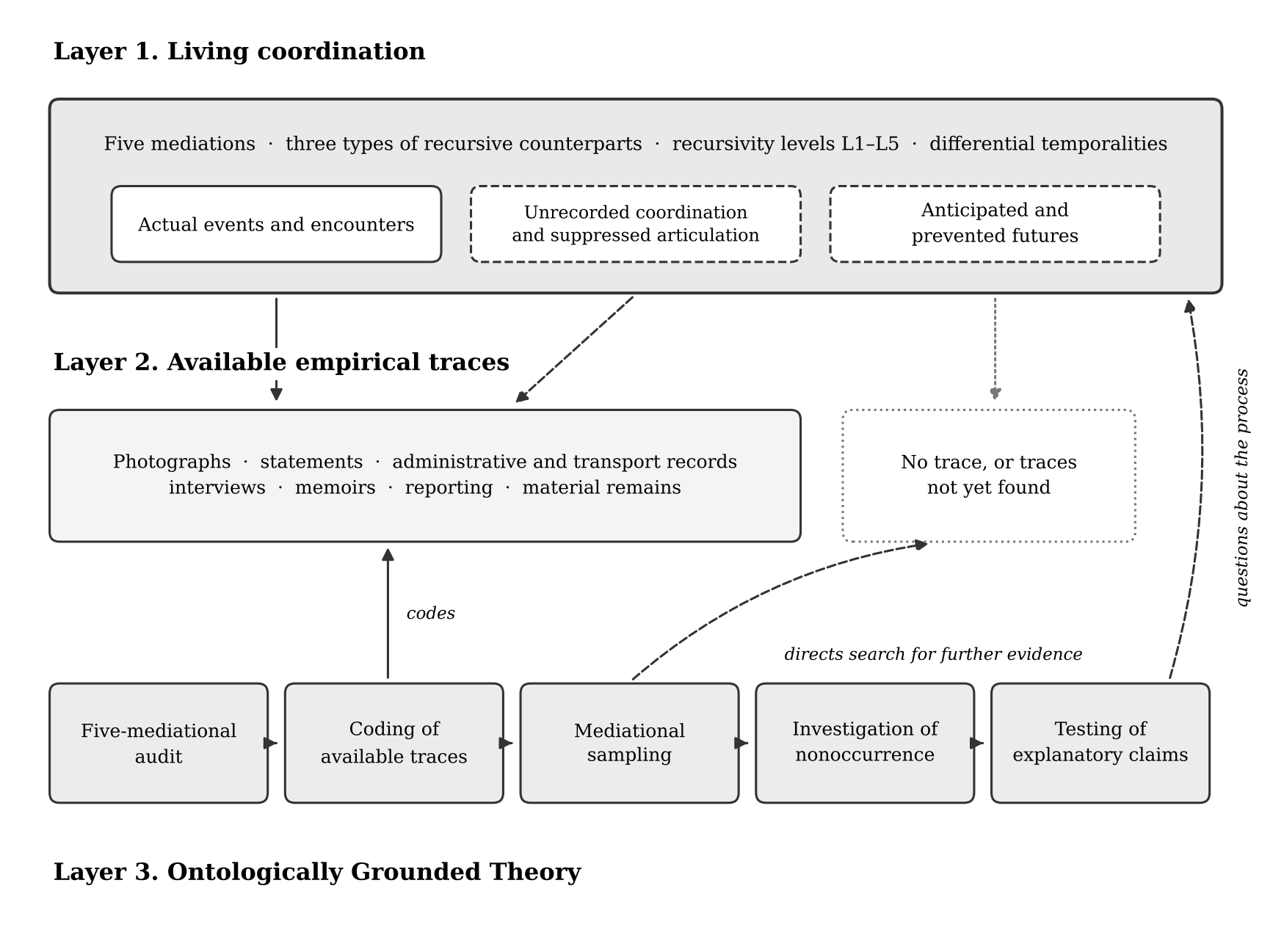
Methods that code what texts contain cannot pose this problem, because what never happened is not in the texts. This article proposes a method that can. It calls the method Ontologically Grounded Theory (OGT). The name deliberately echoes Grounded Theory, which builds its categories from engagement with available evidence. OGT derives its primary categories instead from an ontology of how living coordination takes place: the five mediations of Living Value Theory (LVT). These offer a universally applicable, ontologically grounded architecture for coding, and they make three research operations possible and distinct: coding what narratives contain; reconstructing the living processes that produced the narratives and their subjects; and investigating what those processes prevented from ever becoming narratable.
II. Why Narrative Components Are Too Narrow
What component coding assumes
The Narrative Policy Framework (NPF), developed by Michael Jones and Mark McBeth (2010) to make the study of policy narratives “clear enough to be wrong,” operationalises narrative form through four elements: a setting; characters, classified as heroes, villains, and victims; a plot; and a moral, usually a policy solution (Shanahan, Jones, and McBeth 2018). Robert Entman’s (1993) account of framing divides political texts along similar lines: problem definition, causal diagnosis, moral evaluation, and remedy. Such schemes turn heterogeneous texts into commensurable observations, and they have produced valuable comparative work. Saskia Smellie and Christina Boswell (2025), for example, used the NPF to compare media and parliamentary narratives on the 2015 crisis across five countries, with a carefully assembled corpus and an explicit acknowledgement of the limits of causal inference from it. The question raised here concerns the coding architecture, and none of it is directed against the care of such studies.
That question is simple. Why should political communication be expected to contain identifiable heroes, villains, victims, plots, and morals in the first place? A great deal of political decision-making consists of coordinating administrative procedures, legal responsibilities, institutional commitments, material capacities, and anticipated responses. Many of the most consequential communications of September 2015 concerned railway timetables, the provision of buses, border procedures, registration, police deployments, and telephone consultations among heads of government. Such communications do not organise their subjects into a dramatic narrative, and neither, often, does reporting. A report may describe people arriving at a station, the number of trains available, conditions in a reception centre, and the officials responsible, without casting anyone as hero or villain. The communication that may have mattered most on the night of 4 September, a telephone conversation in which two heads of government agreed that people arriving at a border crossing could travel on, had participants, stakes, and consequences, but it is hard to see what its plot or moral would be, or who in it should be coded as the villain.
Absence and imposition
The NPF does not require every narrative to contain every component, and its authors do not claim that all political communication is narrative. The methodological danger lies elsewhere. When a framework supplies roles such as victim and villain, analysts are encouraged to identify those roles where a text only implies them, and the question becomes whether a role was consequential to the communication or was assigned because the framework invited the analyst to look for it. A scheme can be applied with high consistency while imposing an external organisation on its material. Intercoder reliability shows that coders agree. It does not show that the categories they agree on are appropriate to what is being coded.
Two kinds of universality
Component schemes are sometimes defended as modest, and an ontology of living coordination may look immodest beside them. The comparison runs the other way. The NPF generalises from a particular form of symbolic representation, the dramatic story, towards a broad class of political texts, and its applicability to any given communication depends on whether its components can meaningfully be identified there. LVT generalises from the mediations through which any living coordination takes place, and those mediations do not require a text to have any particular dramatic content. A framework built around story components therefore makes the more restrictive empirical assumption, since it presupposes something about the form of what it codes, while a five-mediational architecture presupposes only that the text concerns living beings.
Narrative without drama
LVT’s own definition of narrative is deliberately thin: a multisymbolic presentation of temporally ordered events in which at least some earlier events are presented as consequential for what follows. It makes no reference to heroes, villains, a prescribed plot arc, or a moral. An account of how an administrative crisis developed over three days satisfies it fully. Aristotle had already distinguished, in the Poetics, between events that merely follow one another and events that happen because of one another, and Paul Ricoeur (1984–1988) made the relation between narrative and lived time the subject of a three-volume inquiry. What makes an account a narrative is the retention of consequential relations among events, and what makes it a good one is that it retains the relations later events depend on.
III. Ontologically Grounded Theory: Beyond Coding What Is Said
The relation to Grounded Theory
Barney Glaser and Anselm Strauss (1967) proposed Grounded Theory as a way of generating theory from data rather than testing theory imported from elsewhere. Its achievements are substantial: constant comparison, theoretical sampling, the iterative development of categories responsive to what researchers find, and a discipline of staying close to empirical material. Later versions extended it in important directions. Kathy Charmaz (2014) reformulated it in constructivist terms, attending to how categories are co-produced by researcher and participants. Adele Clarke’s situational analysis (2003; Clarke, Friese, and Washburn 2018) extended it to the material and nonhuman elements of situations, to discourses, and to what she calls implicated actors and silent positions. Grounded Theory in these forms is far from a technique for counting words in transcripts, and it already investigates tacit practices and absences.
OGT departs from it at one specific point. Grounded Theory, in all its variants, develops its analytical categories through engagement with the empirical material and the unfolding research process. OGT begins from an independently defended ontology of living coordination and uses its mediations to specify what must remain investigable, whether or not the available material has articulated it. Grounded Theory seeks to develop theory grounded in empirical material; Ontologically Grounded Theory investigates empirical material through categories grounded in the ontology of the processes that generated it. This does not license deduction. The ontology specifies what can be asked, and only evidence can say what happened.
A working definition
Ontologically Grounded Theory is a research methodology that uses the irreducible mediations of living coordination as a universal analytical architecture for investigating empirical representations, reconstructing consequential processes, and identifying historically relevant possibilities that available representations may omit, suppress, or never record.
This is no new name for thematic coding. Rather than themes to be discovered inductively in a corpus, multisensorial embodiment, multispecies being-with, multiversal dwelling, multimateriality, and multisymbolization are constitutive of living coordination, and they are irreducible to one another. A researcher does not ask whether a refugee’s journey involved bodies, relations, the sea, boats, and words; it necessarily did. The researcher asks what each consisted of, how they were related, on which temporal horizons they unfolded, and with what consequences. The ontology is universal, while the content is always empirical.
What the ontology adds in practice
The difference shows most clearly when the two approaches meet the same material. Suppose a researcher has collected German press coverage of 4–6 September. A grounded-theory analysis would develop categories from what the coverage contains, and might arrive, entirely properly, at categories such as welcome, loss of control, or European failure. OGT asks the same five questions of every source. Where is the embodiment in this report, and whose? Which relations does it register, and which participants does it omit? What does it say of distances, terrain, and weather? Which trains, buses, phones, and fences appear, and which are presupposed? Which symbolic forms does it use, and which earlier symbols does it answer? The answers form a profile of what each source retains and leaves out, and the profiles of many sources together show which mediations of the event are documented richly, which thinly, and which not at all.
That profile then directs the search for further evidence. Grounded Theory’s theoretical sampling chooses new cases to develop emerging categories. OGT adds what may be called mediational sampling: the deliberate search for sources on whatever the existing corpus leaves silent. If newspapers and speeches say almost nothing about the rolling stock, staffing, and timetabling that made the trains of 5 September possible, the researcher turns to railway and police records. If they say nothing of what people on the motorway knew or feared, the researcher turns to testimony, messages, and photographs taken by those who walked. The ontology does not supply answers. It makes the gaps in a corpus visible as gaps, which is the precondition for filling them.
Two applications
The first application codes narratives as empirical objects. Any human narrative, whether an editorial, a parliamentary speech, a police log, a memoir, or a photograph with its caption, can be investigated for how it renders each mediation available: foregrounded, assumed, marginalised, or absent. The architecture applies where a narrative has no identifiable hero, villain, moral, or conventional plot, which is precisely where component schemes are least secure.
The second application reconstructs the processes to which narratives refer. The same five mediations direct inquiry into the embodied, relational, dwelling-related, material, and symbolic circumstances of the event itself. Three objects must be kept apart here: the narrative, the process it represents, and the circulation and reception of the narrative. A photograph of an event is not the event, and how a photograph was received is a third matter again.
Consequential absences
The decisive advance concerns what available texts systematically lack. At least four forms of consequential absence can be distinguished. Prevented events are anticipated developments that participants act to avert. Avoided encounters are interactions that participants arrange never to have. Suppressed articulations are questions, accusations, demands, or accounts that remain unsaid because saying them would be consequential. Unrecorded coordination is practical activity that took place without ever becoming an explicit statement or surviving document.
These categories must be held apart, and none of them may be presumed. Not everything absent from a document has been suppressed, and not every unrealised possibility was prevented by anyone. The method distinguishes routine omission, documentary loss, absence of evidence, practical avoidance, active suppression, and successful prevention, and it treats each as a finding that needs its own evidence. What the ontology contributes is the ability to ask about these absences systematically. Because every situation involving living beings has all five mediations, a source silent on one of them points to a question; because interrecursive participants anticipate one another, the possibility that something was prevented is always worth asking about when stakes were high.
Beyond politics: stigma
The point is general. Erving Goffman’s (1963) analysis of stigma already recognised that people manage information and contact to avoid discrediting encounters. Read through OGT, stigma cannot be understood by collecting only the interactions in which someone is explicitly stigmatised. Much stigmatising coordination is sedimented into routines, spatial arrangements, institutional classifications, and anticipatory conduct that keep potentially stigmatising encounters from taking place: the route not taken to work, the question never asked at a clinic, the colleague never told. People may expend great effort ensuring that certain encounters never happen. The observable incident is one manifestation of a much larger process, and the same holds for a confrontation that did not occur on a Hungarian motorway.
IV. Interrecursivity and Consequential Nonoccurrence
Three kinds of counterpart, three kinds of past
LVT distinguishes nonrecursive, selfrecursive, and interrecursive counterparts. The sea off Bodrum is a nonrecursive counterpart: it can be engaged with great skill and has a complex history, but it does not take the swimmer’s response as anything. A person’s own exhaustion and earlier decisions are taken up selfrecursively, as she arranges what she can attempt next around them. Interrecursive counterparts are living participants who respond to one another’s responses. In September 2015, people on the move responded to governments’ border practices, governments responded to their movements, journalists responded to both, and political actors anticipated the responses of other governments, of publics, and of journalists. Anticipation ran in every direction. People on the Balkan route followed, through messages passed between phones, which borders were open, which trains were running, and how police at each crossing were behaving, and they chose routes and timings accordingly; governments, in turn, knew that their announcements would be read by those still travelling and would change where people went. Each development altered the field within which the next one occurred.
Interrecursive histories are especially resistant to contextual stripping, the removal of particulars to produce a portable description, because their consequential past consists partly of earlier actions as discerned, interpreted, and answered by others. “Poseidon is angry with Odysseus” is accurate and explains almost nothing; the anger is intelligible only through the cave, the false name, the blinding, the boast, and the prayer, each a response to the last. Remove any link and what follows loses its hold. Context, in such cases, belongs to the causal relationship itself.
Coordination through avoidance
Interrecursive coordination does not always culminate in an observable encounter. One participant may anticipate another’s response and alter course so that the encounter never takes place, and the anticipated response remains consequential even though its object is never realised. An investigation confined to actual interactions misses this. It also misses a related form of coordination concerning recursive opening and closure. A person can keep a difficult question from becoming askable. An institution can maintain a settled arrangement by preventing a challenge from arising. A political actor can prevent a confrontation that would otherwise have reopened a commitment everyone preferred to leave closed. These are positive achievements of coordination, often requiring sustained effort, and they are not empty spaces in a record.
September 2015 was full of such coordination, on every side. The Hungarian government’s buses can be read as avoiding a crowd that would otherwise have walked to the border or remained in Budapest. Many of those at Keleti appear to have avoided trains after the events of 3 September, discussed below. Volunteers in Munich organised themselves so that arrivals would not meet an empty platform. And whatever the German and Austrian executives intended, their decision avoided a confrontation at the Austrian border that night. Each of these avoidances may be well or poorly evidenced, and each may have had several motives; the point is that none of them appears in a corpus that codes only what was said to have happened.
Three temporal structures
Three temporal structures must therefore be distinguished. A consequential past consists of earlier events that continue to shape present possibilities. An anticipated future consists of possible developments that participants discern as consequential before they happen. A prevented future is a possible development that does not occur partly because participants acted to avoid it. A prevented future is no historical event in itself: the historical facts are the anticipation, the action taken, and the subsequent nonoccurrence, and the causal relation among them requires evidence like any other.
The past is historically determinate, even where its traces are uneven and survive through bodies, places, objects, and relations as well as documents, while the future was open to participants at the time; an interrecursive future is open in a way that better observation alone cannot close, because the participants’ anticipations of one another enter the process they anticipate. Living coordination is thus organised both by what participants do in response to what has happened and by what they do to keep particular futures from becoming actual. A method that reconstructs only the first kind of organisation has reconstructed half the process. William Sewell’s (2005) insistence on the eventful temporality of social life, in which outcomes depend on contingent sequences, points in the same direction, and the prevented future extends it to sequences that were cut off before they began.
V. The Photograph Taken and the Photographs Prevented
The photograph that was taken
In the early morning darkness of 2 September 2015, a small, overcrowded rubber boat set out from the Bodrum peninsula for the Greek island of Kos, about four kilometres away, and capsized a few hundred metres from the shore. Alan Kurdi, a boy reported at the time to be three, his five-year-old brother Galib, and their mother Rehanna drowned; their father Abdullah survived, and other passengers on boats that night also died (Khan 2015). Accounts of what happened aboard differ, and they are not needed for the analysis that follows. Hours later the photojournalist Nilüfer Demir photographed Alan’s body lying face down at the waterline. By the next morning the images were on front pages across Europe (Vis and Goriunova 2015).
Much of the photograph’s force cannot be explained by identifying its hero, villain, victim, plot, and moral. A five-mediational reading shows why.
In multisensorial embodiment, the photograph presents the motionless body of a small child, and its force derives in part from immediately recognisable conditions: smallness, vulnerability, stillness, death, a posture that might have been sleep. A viewer need not formulate any proposition about the value of human life for the image to become consequential. Responses differed, and some viewers responded with suspicion or anger. The theoretical point concerns the possibility of embodied salience preceding explicit articulation, not a uniform reaction.
In multispecies being-with, a child is encountered as someone who lives through relations of care and dependence. The image can evoke parents, a family destroyed, and the failure of protective relationships without depicting any of them. These are viewers’ inferences. The family’s actual history, which reporting soon supplied, including an aunt in Canada and a refused sponsorship application (Khan 2015), must be reconstructed from evidence and is not contained in the photograph.
In multiversal dwelling, the photograph places the child at the edge of the sea. The sea here is less a setting than the four kilometres between the Bodrum peninsula and Kos, crossed at night to avoid the coastguard, within a much longer movement from Kobani through Turkey towards hoped-for dwelling elsewhere. Distances, weather, and the season’s seas entered the family’s possibilities only as conditions of an inhabited and politically organised world in which safer routes had been closed to them.
In multimateriality, the death was generated by a particular configuration that the photograph does not show: a small boat carrying far more people than it was built for, the life jackets the passengers had or lacked, the smugglers’ promised vessel that did not arrive, and the absence of any legal crossing.
In multisymbolization, the photograph is itself a symbolic deposit, produced by a camera and distributed through agency wires, social media, and newspapers. This is the theoretically most important dimension, because multisymbolization is broader than verbal articulation. The image brought immediately recognisable living stakes into engagement without requiring an articulated political narrative. Captions, headlines, parliamentary statements, and debates then stabilised it into more specific interpretations: humanitarian, legal, accusatory, defensive. Those later articulations were consequential, but they should not be confused with the encounter that preceded them. The behavioural traces of that encounter, such as surges in online searches and donations that decayed within weeks (Slovic et al. 2017), indicate where it should be investigated without themselves demonstrating what it was.
What the photograph does not show
The image does not document the journey, the boat, the family’s deliberations, the policies that shaped which routes were open, or the war that displaced them. Yet a five-mediational analysis identifies each of these systematically as a question for further investigation, because each mediation it registers in the image points to a process beyond it. That is the difference between coding a representation and reconstructing the process from which it emerged. The photograph should not be made to contain everything researchers later discover. Its power lies partly in how it made an otherwise absent history pressing.
The photographs that were never taken
The photograph that existed may help explain why other photographs became consequential before they existed. Two days after it circulated, political leaders faced decisions about thousands of people moving towards their borders. They could anticipate further images: of suffering on the motorway, of coercion, of people forcibly stopped. Such anticipated images may have affected how the available alternatives were weighed, and if leaders acted to prevent the confrontations, the feared images would never exist. The political consequences of a possible image can enter a decision before the image exists, and action taken because of those consequences can ensure that the image never comes into existence.
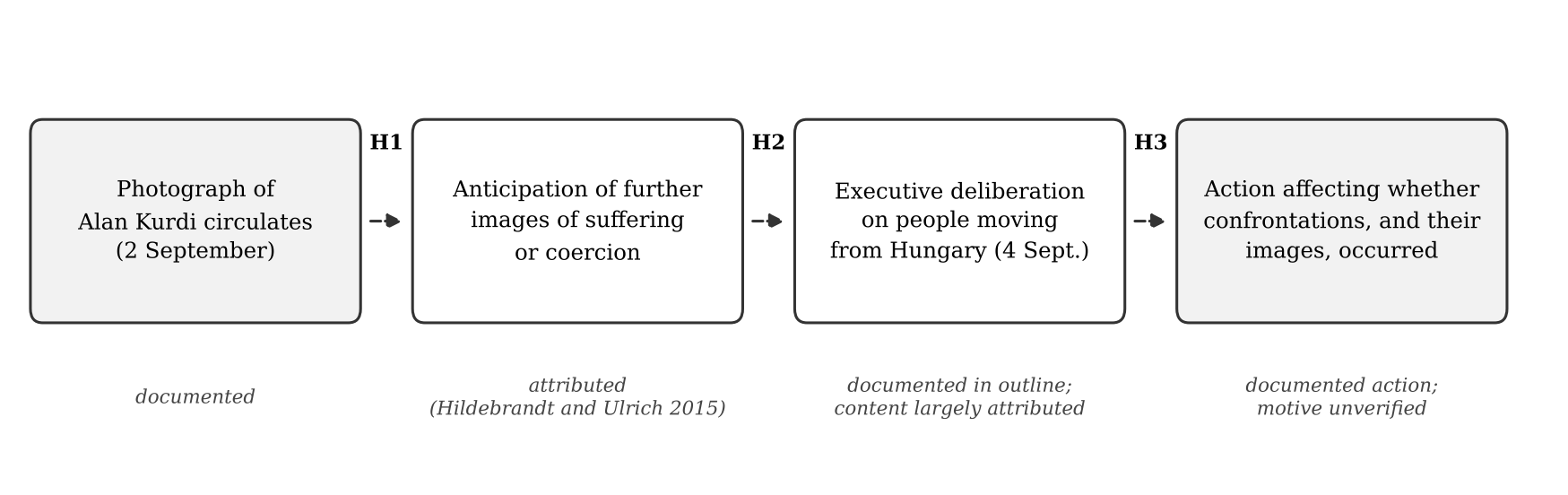
There is contemporaneous evidence that this was discussed. A reconstruction in Die Zeit reports that on 4 September Merkel feared the images that were about to emerge, of refugees run over on the motorway or of police acting against people in distress, and that a cabinet member said Europe could not be associated with such pictures (Hildebrandt and Ulrich 2015). Robin Alexander (2017) argues that when Germany reintroduced border controls on 13 September, people were not turned back in part because no one would take responsibility for the images. Both accounts rest largely on unnamed sources. They show that anticipated images were plausibly present in deliberation. They do not show that avoiding images explains the decision, and the method must not let them do so.
Nor may it assume that politicians cared only about how events would look. A leader may wish to prevent an image because she wishes to prevent the suffering it would depict, because she anticipates its political consequences, or for both reasons at once, alongside humanitarian commitment, legal obligation, and institutional responsibility. The five mediations resist a purely symbolic reading here: an anticipated photograph of police and families on a motorway is an anticipated photograph of bodies, relations, and force, and concern for the one cannot be presumed separable from concern for the other. OGT makes these alternatives investigable without collapsing them.
Bicske: an actual chain of responses
A second case complements the first. On 3 September Keleti reopened to trains, and many people boarded one they reportedly believed was bound for the Austrian border. It was halted at Bicske, near a Hungarian reception camp, where police tried to have the passengers disembark; many refused, and a long standoff followed on the train and the tracks. A Hungarian administrative act was discerned, by those aboard and by those who heard of it, as evidence that trains might be traps, and that discernment plausibly entered the decision of many to walk the next day. The walking changed what Austria and Germany had to decide.
The two cases illuminate each other. Bicske shows how actual events change participants’ possibilities. The anticipated photographs show how unrealised events can change them. Narrative reconstruction must preserve both the consequential past and the anticipated future, and a coding of published texts, which might register “refugees as victims” in the reporting of Bicske and nothing at all of photographs never taken, reaches neither.
VI. Ontologically Grounded Coding: Five Mediations, Three Counterparts, and Five Recursivity Levels
Representation and process
Table 1 sets out the coding architecture. For each mediation it distinguishes what a source represents from what the wider process requires investigating. The mediations are not five independently measurable causes, and no passage, image, or decision has to be placed in exactly one row: a single sentence about the train at Bicske may register embodiment, being-with, multimateriality, and multisymbolization together.
Table 1. Ontologically grounded coding: what the source represents and what the process requires investigating
| Mediation | What the source represents | What the wider process requires investigating |
|---|---|---|
| Multisensorial embodiment | Visible vulnerability, exhaustion, injury, death | Bodily experiences, capacities, injuries, and their practical consequences |
| Multispecies being-with | Reported relations among participants | Dependence, care, anticipation, coordination, and avoided encounters |
| Multiversal dwelling | Depicted routes, places, crossings, and seasons | Distances, seas, terrain, and differential possibilities of dwelling within inhabited worlds |
| Multimateriality | Boats, trains, buses, fences, phones, cameras | Material arrangements enabling or restricting possible actions |
| Multisymbolization | Photographs, statements, classifications, reports | Production, circulation, reception, institutional stabilisation, and anticipated representations |
A worked example
Consider a sentence of the kind that filled newspapers on 6 September, constructed here for illustration: “Hundreds of exhausted refugees, many carrying small children, arrived at Munich’s main station on special trains from Vienna, where volunteers handed out water and food.” A component scheme can find little in it without stretching: the refugees may be coded as victims and the volunteers as heroes, though the sentence casts neither, and it has no villain and no moral. Five-mediational coding registers its content directly. Embodiment is present (exhaustion, children carried); being-with is present (parents and children, volunteers and arrivals); multimateriality is present (special trains, a station, water, food); multiversal dwelling is present only implicitly, in the distance from Vienna; multisymbolization is present in the category “refugees” and in the act of reporting itself. The coding also registers what the sentence omits: where the trains came from operationally, who authorised them, what the arrivals expected, and what police were doing. Each omission is a question for mediational sampling. The finding that “hundreds arrived” is documented by the report; that they were exhausted is the reporter’s attribution; who decided that special trains would run is, from this source, unknown.
Three objects of investigation
The method distinguishes three objects, each of which can be investigated through the five mediations and none of which may be collapsed into another. The representation is what is actually available in a document, image, interview, or narrative. The represented process is what happened in the living situation to which the representation refers. The process of representation and reception is how the representation was produced, circulated, encountered, interpreted, and made consequential. The photograph of Alan Kurdi is a representation; the crossing and the drowning are the represented process; Demir’s photographing, the editors’ decisions, and the responses of millions of viewers are the process of representation and reception.
Evidentiary statuses
Every coded finding carries one of five statuses. It may be directly documented or observed. It may be attributed, resting on a participant’s interpretation or recollection. It may be inferred, supported by several traces taken together. It may be an investigable but unverified possibility. Or it may be unknown, because the relevant evidence is unavailable. The first three support reconstruction in different ways, the fourth generates further research questions, and the fifth preserves the limits of knowledge. A possible but unverified event is never coded as though it occurred. This rule is what makes it safe to study hidden intentions, suppressed questions, and prevented encounters at all. In the German case, that anticipated images were discussed on 4 September is attributed; that they shaped the decision is, at present, an investigable possibility.
Recursivity levels
The five recursivity levels distinguish forms of coordination available to inquiry. At L1 activity proceeds through absorbed routines; at L2 something is felt as salient, urgent, or misaligned before it is articulated; at L3 it is articulated in questions and judgements; at L4 it is authorised or stabilised institutionally; at L5 the grounds through which a situation has been understood become open to reconsideration. A railway timetable is the product of L4 stabilisation while being enacted habitually at L1 by drivers, dispatchers, and passengers. The levels are not a mandatory progression, and L5 should be claimed only where there is evidence of reconsideration of underlying grounds rather than a change of policy. The practical consequence for coding is that public statements, which belong to L3 and L4, are not taken to exhaust the recursive organisation of an event.
Counterparts and recursive attribution
The coding also records which kind of counterpart a source engages. A printed photograph is a nonrecursive counterpart: it does not interpret the politician who looks at it. Yet the politician may take it as evidence of how recursive others, voters, party colleagues, other governments, will act and respond. The image then operates as a symbolic and material deposit inside a wider interrecursive field, and what matters causally may be the attribution the politician makes rather than anything in the image itself. Such attributions may be correct or mistaken and still be consequential, so a reconstruction must record both what was attributed and what publics in fact did. Much of what a corpus presents as the circulation of narratives between media and politics consists, reconstructed, of attributions of this kind running in several directions at once.
VII. Rigorous Reconstruction and Causal Testing
An OGT protocol
Table 2 sets out the protocol. Its steps are not a once-through sequence. New evidence may reopen the definition of the explanandum, alter the chronology, or reveal that an apparently minor detail was consequential, as Bicske becomes consequential only once one asks why people walked. The protocol thus requires provisional closure that remains open to revision, the same combination of recursive opening and closure that it studies in its objects.
Table 2. An Ontologically Grounded Theory protocol
| Step | Task |
|---|---|
| 1. Specify the explanandum | Identify the particular event, decision, encounter, or nonoccurrence that requires explanation, distinguishing authorization, articulation, implementation, and later reconsideration. |
| 2. Audit the five mediations | Identify the living worlds and processes implicated in the explanandum, not merely the aspects the available sources represent. |
| 3. Establish a chronology of events and evidence | Distinguish when something happened, when it was represented, when participants became aware of it, and when its consequences emerged. |
| 4. Reconstruct counterparts and possibilities | Determine who was responding to whom, what participants could know, and which possibilities they anticipated, without importing hindsight. |
| 5. Investigate silences, avoidance, and nonoccurrence | Ask what participants tried to prevent, which encounters were avoided, what remained unarticulated, and which absent events may have structured decisions. |
| 6. Test competing reconstructions | Distinguish media influence, common responses to events, administrative necessity, prior commitments, anticipated public reactions, and combinations of these. |
| 7. Produce an evidence-disciplined narrative | Preserve the context needed for causal intelligibility and mark the evidentiary status of every disputed link. |
| 8. Compare reconstructed processes | Identify what recurs across cases only after each case has been reconstructed on its own terms. |
Selecting what to retain
No reconstruction can include everything, so selection must be principled. The rule of recursive relevance holds that a detail belongs in a reconstruction when its removal would materially change the intelligibility of a consequential response, of a participant’s available possibilities, or of a later development. Extended to nonoccurrence, it holds that an unrealised possibility belongs in a reconstruction when there is evidence that its anticipation contributed to consequential living coordination. This keeps OGT from becoming an invitation to narrate every imaginable counterfactual. Good reconstruction is the selective preservation of causally consequential context, and maximal detail is no part of its aim.
A rule for absences
A missing observation alone can never establish that an event was prevented. Before a prevented event can be claimed, five questions must be answered. Is there evidence that participants anticipated the possibility? Is there evidence that the anticipated outcome mattered to them? Is there evidence of action directed towards preventing it? Did the anticipated event then fail to occur? And which rival explanations could account for the same actions and the same nonoccurrence? For the German case, the Die Zeit reconstruction bears on the first two questions, the decision and its implementation on the third and fourth, and the fifth remains largely open: the buses, the motorway, and Hungary’s determination to move people on may account for the decision without any reference to images.
Discriminating evidence
Evidence compatible with an interpretation must be distinguished from evidence that discriminates among interpretations. Contemporaneous discussion of the Kurdi photograph in government would show that it entered deliberation, but not that it changed the decision. Evidence of a changed preference explicitly tied to the photograph would support a stronger claim. Evidence that plans were settled before the photograph circulated, such as the German asylum office’s handling of Syrian Dublin cases in late August or Merkel’s “Wir schaffen das” of 31 August, would weaken any simple account of media causation. Process tracing supplies well-developed techniques for such within-case tests (Beach and Pedersen 2019), and event-structure analysis shows how narrative sequences can be formalised and interrogated (Griffin 1993; see also Abbott 1992). OGT complements these techniques by specifying the constitution of the processes being traced, including processes whose effect consists in preventing particular outcomes.
Comparison after reconstruction
The eighth step reverses the usual order of comparative research, since cases are compared only once each has been reconstructed. The British government’s expansion of its Syrian resettlement programme, announced on 7 September, shared a week, a photograph, and the label “migration crisis” with the German decision. A reconstruction may find that it shared little else. It enlarged an existing scheme over several days, with no people approaching a British border, no trains to authorise, and no confrontation to prevent. If anticipated images entered British deliberation at all, they did so through a different configuration of the five mediations: the photograph that existed, petitions, party pressure, and European partners, without any motorway on which the feared pictures could have been taken. What the two cases share, if anything, is a finding, and it can be stated only once both are intelligible on their own terms.
Narrative without fiction, and the limits of certainty
Narrative reconstruction is vulnerable to retrospective coherence and to the attraction of a good story; Hayden White (1973) showed how much historical writing depends on emplotment brought to the material. The evidentiary statuses are the discipline that answers this. Some processes will remain unreconstructable: British cabinet papers from 2015, for example, will stay closed for years, and records of telephone calls between heads of government may never be released. The reconstruction offered here also draws on published and journalistic sources, and a full demonstration of the method requires primary sources, in particular the executive and administrative records of the German, Austrian, and Hungarian governments and testimony from those who walked from Budapest. Where such evidence is unavailable, an adequate reconstruction establishes a range of plausible explanations and marks its limits at the specific links where they occur.
VIII. Conclusion
Five claims follow from this argument. First, narrative-component coding may be useful for investigating particular symbolic forms, but those forms cannot be assumed to constitute all narratives or all political communication. Second, the five mediations of LVT provide a universal architecture for investigating human living coordination, without requiring narratives to possess any particular dramatic structure. Third, narratives themselves can be analysed through this architecture, while historical reconstruction must investigate the processes beyond what narratives represent. Fourth, living coordination includes prevented events, avoided encounters, suppressed articulations, and anticipated futures, and these can be historically consequential precisely because they never become observable events. Fifth, Ontologically Grounded Theory combines universal ontological questions with evidence-disciplined reconstruction. It does not infer hidden events from theory; it makes them available as empirical questions and specifies what evidence would answer them.
These claims reach well beyond migration and political communication. Ethnography, history, organisational research, medical anthropology, legal inquiry, and studies of technological change all investigate situations in which participants’ responses transform one another’s possibilities, and in which much of what matters is never said or never happens: the treatment not offered, the complaint not made, the meeting arranged so that a dispute never surfaces. In each, a method confined to available representations studies the visible fraction of a process. OGT offers such fields a common architecture for asking about the rest, together with the evidential discipline needed to answer without inventing.
The narrative form of the resulting explanation follows from the organisation of the processes themselves. Where the consequential organisation of a process cannot survive contextual stripping, because participants were responding to one another’s responses and anticipating one another’s anticipations, explanation must preserve the changing possibilities through which it unfolded, and narrative is the form that preservation takes.
The photograph that was taken helps us understand why photographs that were never taken may nevertheless have shaped history. More generally, the observable record is not coextensive with the consequential organisation of living coordination. A rigorous methodology of living coordination must be able to investigate what happened and what was said, and also what living beings continuously coordinated to ensure would never happen or be said.
References
Abbott, Andrew. 1992. “From Causes to Events: Notes on Narrative Positivism.” Sociological Methods & Research 20 (4): 428–455.
Alexander, Robin. 2017. Die Getriebenen: Merkel und die Flüchtlingspolitik. Report aus dem Innern der Macht. Munich: Siedler.
Aristotle. 1996. Poetics. Translated by Malcolm Heath. London: Penguin.
Beach, Derek, and Rasmus Brun Pedersen. 2019. Process-Tracing Methods: Foundations and Guidelines. 2nd ed. Ann Arbor: University of Michigan Press.
Charmaz, Kathy. 2014. Constructing Grounded Theory. 2nd ed. London: Sage.
Clarke, Adele E. 2003. “Situational Analyses: Grounded Theory Mapping After the Postmodern Turn.” Symbolic Interaction 26 (4): 553–576.
Clarke, Adele E., Carrie Friese, and Rachel S. Washburn. 2018. Situational Analysis: Grounded Theory After the Interpretive Turn. 2nd ed. Thousand Oaks, CA: Sage.
Entman, Robert M. 1993. “Framing: Toward Clarification of a Fractured Paradigm.” Journal of Communication 43 (4): 51–58.
Glaser, Barney G., and Anselm L. Strauss. 1967. The Discovery of Grounded Theory: Strategies for Qualitative Research. Chicago: Aldine.
Goffman, Erving. 1963. Stigma: Notes on the Management of Spoiled Identity. Englewood Cliffs, NJ: Prentice-Hall.
Griffin, Larry J. 1993. “Narrative, Event-Structure Analysis, and Causal Interpretation in Historical Sociology.” American Journal of Sociology 98 (5): 1094–1133.
Hildebrandt, Tina, and Bernd Ulrich. 2015. “Im Auge des Sturms.” Die Zeit, no. 38, 17 September. Translated excerpt in German History in Documents and Images, “Angela Merkel’s Policy towards Refugees (2015).”
Jones, Michael D., and Mark K. McBeth. 2010. “A Narrative Policy Framework: Clear Enough to Be Wrong?” Policy Studies Journal 38 (2): 329–353.
Khan, Adnan R. 2015. “Inside the Tragedy That Woke Up the World.” Maclean’s, 13 September.
Ricoeur, Paul. 1984–1988. Time and Narrative. 3 vols. Translated by Kathleen McLaughlin and David Pellauer. Chicago: University of Chicago Press.
Sewell, William H., Jr. 2005. Logics of History: Social Theory and Social Transformation. Chicago: University of Chicago Press.
Shanahan, Elizabeth A., Michael D. Jones, and Mark K. McBeth. 2018. “How to Conduct a Narrative Policy Framework Study.” The Social Science Journal 55 (3): 332–345.
Slovic, Paul, Daniel Västfjäll, Arvid Erlandsson, and Robin Gregory. 2017. “Iconic Photographs and the Ebb and Flow of Empathic Response to Humanitarian Disasters.” Proceedings of the National Academy of Sciences 114 (4): 640–644.
Smellie, Saskia, and Christina Boswell. 2025. “The Influence of Media Narratives on Political Debate: Narratives on the 2015 Migrant ‘Crisis’ in Five European Countries.” Journal of Ethnic and Migration Studies 51 (16): 4181–4200.
Vis, Farida, and Olga Goriunova, eds. 2015. The Iconic Image on Social Media: A Rapid Research Response to the Death of Aylan Kurdi. Sheffield: Visual Social Media Lab.
White, Hayden. 1973. Metahistory: The Historical Imagination in Nineteenth-Century Europe. Baltimore: Johns Hopkins University Press.