Ontologically Grounded Theory from Existing Data: A Guide for Qualitative Data Reanalysis
Abstract
Every qualitative dataset is a selective symbolic deposit of a continuous, living coordination. It can symbolically inscribe some forms of coordination in detail and leaves others almost unrecorded. This guide extends Ontologically Grounded Theory (OGT) into the systematic reanalysis of existing ethnographic and other qualitative records. OGT starts from the five ontologically irreducible mediations of human living (multisensorial embodiment, multispecies being-with, multiversal dwelling, multimateriality and multisymbolization), three types of recursive counterpart and five levels of recursivity. It uses this architecture to ask what a record has preserved, what its production has left inaccessible, and what should be investigated next. The guide develops eight successive readings, from the research's own account of its field to an assessment of how well its concepts fit the coordination they describe. It treats the general skew of qualitative records as a working hypothesis, not a finding. It describes the close reading on which reanalysis depends, including how traces of absorbed coordination can be identified in incidental passages, and introduces material buffering to clarify how found conditions reach human living through made arrangements. A procedure for comparative reanalysis distinguishes change in the world from differences between research instruments, and identifies shared absences as the clearest guide to what a field's methods systematically miss. The guide closes with guidance on writing up a reanalysis and on the ethics of rereading other people's lives.
I. Introduction: Reading for the Living Coordination Behind the Record
Qualitative research produces deeply insightful knowledge about living, and yet it cannot preserve the living itself. What survives a study is a body of durable traces: fieldnotes, interview transcripts, recordings, photographs, coding schemes, memos, and the published ethnography that draws them together. Later readers, including the original researcher returning years afterwards, encounter those traces and reorganize them. Every reanalysis of qualitative data is therefore an encounter with a deposit, and the question of how such a deposit should be read is less settled than the frequency of reanalysis suggests.
Ontologically Grounded Theory (OGT) offers one answer. It reads qualitative records through the process ontology of Living Value Theory (LVT), whose single generative principle is that life is recursive mediation in a mesocosm. From that principle follows an architecture: five irreducible mediations through which living coordination proceeds, three types of recursive counterpart with which it proceeds, and five levels of recursivity across which it can move. OGT uses this architecture to ask what a dataset has preserved of the coordination it documents, what its production has left inaccessible, and what should be investigated next.
The central methodological proposition of this guide is that every qualitative dataset is a selective multisymbolic deposit of living coordination, and OGT investigates both what that deposit preserves and what its processes of production, selection, and interpretation have left inaccessible. The task is to make the difference between the documented and the lived mesocosm analytically productive, since recovering the totality of the original mesocosm lies beyond any rereading.
An ethnographer may write an excellent account of a religious ceremony without recording the temperature, the participants’ fatigue, the material stability of the ceremonial objects, or the many ways in which participants coordinated without reflection. Far from showing that the ceremony lacked embodiment, dwelling, or absorbed competence, these omissions show that the ethnography preserved a selective symbolic account of a much more extensive living process. OGT begins from this unavoidable difference.
The guide proceeds in four movements. It first sets out the relation between ontology and evidence on which any OGT reanalysis depends, situates the approach within existing debates about the secondary analysis of qualitative data, and describes the practice of close reading on which every later step relies. It then develops eight successive readings, each with its own questions and products, from the research’s own account of its field through to an assessment of its explanations. It next extends the method to the comparison of two or more studies of related fields, where the difficulty of distinguishing change in the world from change in the record becomes acute. It closes with a worked example, guidance on turning a reanalysis into a written argument, and the ethical responsibilities that rereading other people’s lives entails.
II. Ontology Before Evidence
The most consequential error an OGT reanalysis can make is to treat LVT’s architecture as a classification system whose elements might or might not be found in a dataset. That procedure reverses the relation between ontology and evidence. Far from being provisional variables to be checked against an ethnography, the five mediations follow from the generative principle once it is asked a concrete question: what, exactly, must a living being mediate? It must mediate its own ongoing organization, which is multisensorial embodiment; other living beings capable of responding in turn, which is multispecies being-with; and the found conditions within which life occurs but which do not respond to it, which is multiversal dwelling. These three zoetic mediations are sufficient for a complete living mesocosm. Human mesocosms add two coupled poietic mediations, multimateriality and multisymbolization, through which recursive coordination is deposited into durable material and symbolic form. In every human mesocosm all five are present and irreducible: none can be derived from another, and each contributes something the others cannot supply.
The question for a reanalysis is therefore never whether an ethnographer encountered a mesocosm containing embodiment or dwelling. These are already implicated in the living process being studied. The question is whether the research provides evidence that allows us to understand how these mediations actually coordinated in the particular case. An ethnography silent about dwelling has not discovered a human mesocosm without dwelling; it has produced an account in which dwelling is insufficiently documented, and the specific question of how dwelling mattered there remains open.
The same holds for the levels of recursivity and the types of counterpart. Human mesocosms make all five levels available, but particular persons and episodes need not exercise every level, and most coordination proceeds at L1 most of the time. Counterpart types are settled aspect by aspect: an encountered entity may present aspects that answer back and others that do not. None of this can be read off a dataset by searching for keywords; it has to be reconstructed from what the dataset makes available.
Two kinds of claim must accordingly be kept apart throughout. At the level of ontology, the presence of the five mediations in human mesocosms is the framework’s starting commitment and not an empirical outcome of recoding. At the level of method, OGT can succeed or fail, and its success is heuristic: it succeeds when it reconstructs documented coordination more precisely, identifies consequential omissions and biases, and produces better-grounded explanations or new empirical questions; it fails when its concepts add nothing, generate misleading distinctions, or encourage unsupported inferences. The two registers do not defer to each other. A reanalysis should not treat the ontology as uncertain every time it is applied, and it should never treat the ontology as proof that a particular empirical interpretation is correct. LVT states the conditions under which its ontology would fail, such as a form of living coordination that required a sixth irreducible mediation, and a reanalysis that encountered such a case would have done the theory a service. The conditions under which a particular reading fails are far more ordinary: the reading does not see more than the original.
A third register lies between these two and is easily confused with both. Because the ontology explains why symbolic records preserve some forms of coordination better than others, it yields general expectations about how any qualitative record will be skewed. These expectations, set out in Table 2 below, are useful for directing attention. They are neither commitments of the ontology nor findings of a reanalysis. A reanalysis that concludes only that a record underrepresents dwelling and documents little absorbed coordination has restated its own starting assumptions. Its findings lie elsewhere, in the specific reconstructions and the specific discrepancies that the expectations helped it to see.
III. Reanalysis and the Problem of Context
Debates about the secondary analysis of qualitative data have long turned on context. Natasha Mauthner, Odette Parry, and Kathryn Backett-Milburn (1998) argued that qualitative data are so bound to the reflexive circumstances of their production that they cannot simply be lifted from one research project into another. Martyn Hammersley (2010) responded that all data are in some sense reconstructed, that the problem of context is one of degree, and that secondary analysis can be legitimate provided its limits are respected. Niamh Moore (2007) proposed that reuse be understood as a recontextualization that produces new data rather than recovering old ones, and Janet Heaton (2004) set out the range of forms reanalysis can take. In anthropology, the restudy has a longer history, and Michael Burawoy’s (2003) theory of the ethnographic revisit distinguished changes in the world from changes in the observer and the theory brought to it.
These debates locate context chiefly in the research encounter: who asked what, of whom, under what relationship, and with what purpose. OGT accepts all of that and adds a second context that the debates leave largely implicit. Behind the research encounter lies the mesocosm in which participants were living, and its coordination exceeded what any encounter could have registered. The problem of context is therefore double. A reanalysis must reconstruct how the deposit was produced, and it must reconstruct what the deposit was a deposit of. When two or more studies are reread together, the problem doubles again, since each record has its own conditions of production and the differences between records must be sorted into differences between mesocosms and differences between deposits. Section XIV takes up that problem.
LVT supplies a precise way of stating the second problem. A deposit is nonrecursive without qualification: a transcript does not alter its course in response to being reread. Recursion does not disappear when coordination is deposited; it relocates to uptake, to the interpretation, maintenance, and revision of the deposit by living readers. A reanalysis is such an uptake. It cannot convert the deposit back into the living process that produced it, because deposition runs in one direction only. What it can do is treat the deposit as a set of constraints, affordances, and traces from which some of that process can be reconstructed and against which reconstructions can be tested. Fieldnotes have always been understood by anthropologists as partial and constructed (Sanjek 1990; Emerson, Fretz, and Shaw 2011), and their thinness is the condition of their analysability: an unrecorded afternoon cannot be compared, revised, or taught. OGT asks that this thinness be read systematically.
IV. What a Reanalysis Can Achieve, and What It Cannot
An OGT reanalysis has four principal functions. It can reconstruct what the original research tells us about particular living coordinations, often in greater detail than the author’s own conceptual framework allowed, because ethnographies routinely document more than their arguments use. It can identify the systematic selectivity of the research record, the forms of coordination that became highly visible and those that scarcely entered the account. It can distinguish empirically documented coordination from the wider conditions that the ontology shows to be implicated but that the surviving evidence cannot specify. And it can generate new research questions, including questions the original framework made unlikely to arise.
The limits are as important as the functions. OGT cannot reconstruct unrecorded experience by deducing it from the ontology. Knowing that multiversal dwelling participated in a living situation does not reveal which particular conditions mattered, or how. Knowing that embodied selfrecursion was operating does not establish whether fatigue, hunger, pain, sensory overload, or bodily ease was consequential in a particular episode. The ontology establishes which kinds of process must be taken seriously; the dataset determines what can be said about their specific occurrence.
The success of a reanalysis is accordingly judged by whether it improves our understanding of the observed coordination, reveals significant limitations in the evidence, and identifies productive directions for further work. Finding all five mediations is no measure of success, since all five are there in any human case. Confirming the expected pattern of over- and underrepresentation is no measure of success either, since that pattern is what the method predicts of almost every record. The value of a reanalysis lies in what it shows about this record and these coordinations that could not have been predicted in advance. The eight readings that follow are arranged so that each builds on the previous one, and Table 1 summarizes them. They are analytically sequential and practically iterative: a later reading will often send the analyst back to an earlier one.
Table 1. Eight readings in an OGT reanalysis
Reading |
Guiding question |
Product |
1. Letting the research disclose its mesocosm |
What is vital here, and how does each documented episode of coordination proceed? |
A reconstruction of the living situations in the research’s own terms, and an account of the original research’s achievement |
2. The five mediations |
How do embodiment, being-with, dwelling, multimateriality, and multisymbolization operate together in each episode, and where are found conditions materially buffered? |
An account of each mediation’s documented contribution and of what the record leaves unspecified |
3. Recursivity |
What proceeds at L1, what becomes felt at L2, what is articulated, stabilized, or reopened, whose recursivity is documented, and how does coordination move between levels? |
A map of recursive organization and of recursive fluidity, with traces of L1 identified |
4. Counterparts |
Which aspects of which counterparts answer back, and, where the evidence allows, how stable, predictable, controllable, and durable are they? |
A differentiation of counterparts, changes of counterpart type, and mixed futurity |
5. Stakes and remediation |
What depends on the coordination, who bears which stakes, whose stakes are documented, and what keeps problems from arising? |
An account of stakes, their allocation, invisible value, and recursive burden |
6. Sedimentation, relevance, temporality |
What is inherited, how is relevance conferred or withdrawn, and whose tempo governs whose? |
A history of the ground on which the documented present stands |
7. Selectivity of the record |
How do research question, recruitment, and research occasion shape what became visible, and which absences are which? |
A map of the record’s field of visibility, its departures from expectation, and its three forms of absence |
8. Fit and misfit |
Do the author’s concepts track the documented coordination, where do they cease to, and what practical knowledge lies outside them? |
An assessment of bandwidth, mesocosmic fit, and specific misfits |
V. Reading Practice: Where Living Coordination Survives in a Text
An OGT reanalysis depends on a kind of reading that runs against the grain of ordinary scholarly reading. Scholars usually read for the argument: introductions, chapter openings and conclusions, the passages where the author states what the material shows. That habit selects precisely the layer of the text that OGT treats as most transformed, the L4 categories and L5 framework through which the author re-presents the material. The traces of living coordination tend to survive elsewhere: in incidental clauses, asides, descriptions of setting, reported routines, captions and photographs, footnotes, methods chapters, and the researcher’s accounts of their own discomfort, failure, or change of approach. A reanalysis therefore cannot be carried out from summaries, abstracts, reviews, or a reading of the argument alone. Each text should be read whole, or, where that is impossible, read whole in the chapters that carry the empirical material.
Several kinds of passage repay particular attention. Methods chapters often contain the richest record of found conditions and material arrangements, because researchers describe the weather, the housing, the transport, and the hours of their own fieldwork as conditions of research, while the same conditions go unrecorded as conditions of the participants’ lives. Accounts of how fieldwork failed, and of how the researcher changed approach in response, often document the distance between the articulation a method demanded and the coordination that was actually going on. Lists of times and tasks, as when a participant narrates a day, preserve sequence and tempo that analytical prose usually discards. Remarks that something “still” works, or that a person “could still” do something, mark L1 competences that have become salient because they are expected to fail. Passages the author introduces as interruptions, digressions, or anomalies are often the places where coordination escaped the framework.
Searching a text, including full-text searches of digital editions, can help to locate such passages. Searches for terms relating to weather, season, time of day, light and darkness, distance and travel, bodily functions, sleep, food, furniture, and devices will often find the scattered traces of dwelling, embodiment, and multimateriality. A search result is only a pointer. Every passage must be read in its context before it is used, since the same word may belong to the author’s metaphor, a participant’s idiom, or a description of an event, and these do different work. The reader should keep a running log of episodes, with page references, the exact wording of anything that may be quoted, and a note of whose words they are.
That last point requires discipline. A published text mixes at least four kinds of utterance: speech quoted directly from participants, speech reported indirectly, the author’s paraphrase, and the author’s analysis. A reanalysis must preserve these differences. Reported speech must never be converted into quotation, an author’s paraphrase must not be presented as a participant’s articulation, and every quotation should be checked against the source, with its page, before the reanalysis is written up. The point is more than scholarly hygiene. The distinction between what participants said and what was said about them is one of the main things an OGT reading is trying to recover.
VI. First Reading: Letting the Research Disclose Its Mesocosm
OGT must not begin by imposing LVT’s vocabulary on the research. Mesocosmography, the method through which LVT studies any mesocosm, begins by asking what is vital in a particular situation and lets the case disclose its coordinative organization before the full architecture is brought to bear. A process ontology is no taxonomy of objects, actors, behaviours, or beliefs, and applying it as one would reproduce exactly the symbolic overreach it is designed to detect.
The first reading therefore reconstructs the research on its own terms. What is being studied? What are people doing? What difficulties are they encountering, and what are they trying to sustain or change? What does the researcher observe happening, and what explanations does the researcher offer? Particular attention belongs to the difference between the phenomenon investigated and the concepts through which the author describes it. An ethnography ostensibly about identity may document coordination across households, workplaces, public institutions, and familiar environments. An ethnography about stigma may document decades of accumulated institutional exclusion and of arrangements designed to keep unwanted encounters from happening. A study about decision-making may document largely habitual activity punctuated by rare moments in which established coordination breaks down and something becomes explicitly deliberated. The first reading preserves this empirical detail without yet deciding whether the author’s concepts are right.
The most productive unit for this reading is usually an identifiable episode of coordination: a clinical consultation, a family meal, a workplace disagreement, an act of worship, a journey, an institutional decision, or an extended stretch of ordinary daily living. The analytical question concerns how the coordination proceeds, more than what the episode means. What was already working when the episode began? What changed, and what continued undisturbed? Which responses became necessary, what was repaired, and what remained unresolved? Which arrangements made the episode possible without ever becoming an object of attention?
These questions begin to recover living coordination from the symbolic record, and they shift attention away from dramatic events alone. An ethnography may devote several pages to a quarrel and a single sentence to the years of successful coordination that preceded it, though those years may be what is needed to understand what the quarrel disrupted. That single sentence should be entered in the log with the same care as the pages on the quarrel. The product of the first reading is a reconstruction of the living situations the research describes, episode by episode, in the research’s own terms, together with a record of what the original research achieved, which the written reanalysis should present before it presents anything else.
VII. Second Reading: The Five Mediations as Simultaneously Operative
The central discipline of OGT is to follow the five mediations through the material without reducing any one to another. Rather than independent variables, separate layers of reality, or rival explanations competing to account for an event, they are differentiated forms of mediation through which human living is continuously coordinated, each contributing something the others cannot, and each carrying its own stake. A reading therefore asks how they operate together while keeping their distinct contributions analytically clear. The most instructive exercise is often to take a single well-documented episode and follow all five mediations through it, noting for each what the record specifies, what it only suggests, and what it leaves blank. Such an exercise frequently shows that a breakdown the author attributes to one source drew on distinct contributions from several mediations, some recorded in detail and others in a word or two.
Multisensorial embodiment
Embodiment, which is no synonym for biology or anatomy, is the recursive maintenance of a living being’s own ongoing organization, and its characteristic counterpart is selfrecursive. What is at stake in it is the viability of the body as a medium of coordination. An ethnography may contain almost no physiological information while describing countless episodes of embodied mediation: walking, sitting, listening, waiting, eating, resting, attending, becoming uncomfortable, adjusting posture, moving confidently through a familiar setting. Much of this proceeds at L1, which makes embodiment especially vulnerable to ethnographic neglect. Researchers notice what people say, claim to believe, and report of their activities, and the continuing bodily coordination that makes those activities possible often passes without comment. The reading asks how the documented events presuppose bodily coordination and whether the record supports analysis of it. An ethnography that records an exhausting journey can support an analysis of fatigue; one that merely reports a journey cannot establish how tired anyone was.
Research oriented to care, medicine, or the body may document embodiment richly and still document it selectively. Bodies may appear mainly as objects of other people’s work, or as the site of caregivers’ costs, while the selfrecursive organization of the person cared for, their appetite, fatigue, sleep, pain, and ease, enters only incidentally. The reading should therefore ask whose embodiment the record documents, and from which position.
Multispecies being-with
Being-with is coordination with other living beings who respond in turn, human or otherwise, and what is at stake is the viability of ongoing relational responsiveness. It is likely to be among the most heavily represented mediations in conventional ethnography, which has always observed people living together, talking, arguing, helping, avoiding, and cooperating. The difficulty lies in translation: such observations are often converted into abstractions such as social relations, networks, community, or solidarity. OGT reverses that movement and asks how living beings actually coordinated with responsive others in the episodes documented. This includes conversation and conflict, and also accompaniment, ordinary co-presence, relaxed availability, shared routine, touch, and the active prevention of encounters. It is important to distinguish being-with from explicit interrecursive exchange, since another’s presence can be consequential without continuous reciprocal engagement. The reading asks when coordination demanded active responses from others and when it could continue with little recursive demand, which corrects the common assumption that more interaction means more successful coordination.
Being-with also includes the reception of a person by others: who hears whom, from which position, with what at stake. Research organized around reception can document this with great precision. The reading should then keep apart the coordination of the listeners and the coordination of the person heard, since a detailed record of the first is not a record of the second. Nonhuman others, animals in a household or a street, livestock, pests, pathogens, belong here too wherever they answer back. Where an author treats animals chiefly as symbols, the record may still support a reading of sustained coordination with them, and that reading should be attempted.
Multiversal dwelling
Dwelling requires the most careful treatment, because its meaning in LVT is far more precise than the ethnographic use of place. It is coordination with the found, nonrecursive conditions of the world, conditions no one made: gravity, terrain, geology, climate, the solar and lunar cycles, daylight and darkness, weather, season, currents, and distance. What is at stake is the viability of situatedness, the capacity to be oriented in space and time within conditions no one arranged. A house is no part of dwelling in this sense; it is a multimaterial deposit. A road is likewise made. The terrain on which the road was built, the seasons through which it passes, and the hours of light that structure its use belong to dwelling. An ethnography may devote great attention to the symbolic significance of a home or the architecture of a neighbourhood while saying almost nothing about dwelling, and much of what passes for environmental description in qualitative research concerns made arrangements. Dwelling is especially likely to escape explicit attention because it is continuously available as ground: nobody needs to think about gravity in order to remain coordinated with it.
Many found conditions reach human living through material arrangements that buffer them, and the reading needs a way of handling this without collapsing one mediation into the other. LVT calls this material buffering. Heating and cooling, shelter, lighting, water storage, stored fuel and food, and power supplies all modify the exposure of living to found conditions. The rule of classification is simple. The found condition belongs to dwelling; the buffer belongs to multimateriality; the absence or failure of a buffer is a material fact that exposes living to dwelling. Indoor temperature, the darkness of a room at night, and the time a journey takes are therefore joint products of the two mediations, and a reading should say so instead of assigning them wholly to either. Material buffering is unequally distributed, often sharply so, and the distribution of exposure to heat, cold, darkness, flood, and distance is one of the most direct ways in which inequality enters bodily life. A record that notes who is buffered and who is not has documented something important about the mesocosm even if it never names dwelling.
The reading should also notice where found conditions appear in the record and under whose name. They frequently enter as conditions of the researcher’s fieldwork, described in a methods chapter, and almost never as conditions of the participants’ lives, or they surface in a single clause of a participant’s narrative. Participants may also articulate their own situation through found conditions, in proverbs and images drawn from the seasons, the sky, water, or the weather, and such articulations are worth recording both as multisymbolization and as evidence that dwelling was salient to them. None of this means that dwelling must be the best explanation of anything. Research cannot, however, account fully for the coordination it describes without being able to investigate whether it mattered.
Multimateriality
Multimateriality concerns manufactured stability, and the mere physical presence of objects is the least of it. Its defining character is the deposition of prior coordination into durable material organization. A path is repeated movement sedimented into altered ground; a chair is an anticipated posture sedimented into joinery; a clinic is an accumulated arrangement of rooms, instruments, and stores that makes particular forms of care possible. What is at stake is the viability of the material deposits a community depends on without having personally made them. These deposits do not answer back; the recursion lies in living beings’ use, maintenance, repair, and modification of them. Contemporary research often documents technologies and built environments in detail, but description does not amount to analysis of multimateriality. A study may ask what a technology symbolizes, how users perceive it, or how it changes relations between people. OGT asks in addition what earlier coordination has been sedimented into the material arrangement, and what later living its continued availability sustains or forecloses. Precise descriptions of furniture, beds, seating, and the arrangement of rooms often record who is placed where in a household or institution, and can document hierarchies of care and labour more exactly than the author’s commentary does. Material arrangements that exist but do not work, because a complementary arrangement was never provided, deserve particular notice, since the living that continues around them shows what the failed deposit left to bodies, other people, and found conditions.
Multisymbolization
Multisymbolization lets a distinction, once drawn, persist across absence, delay, distance, and death. What is at stake is the viability of the symbolic deposits a community depends on: its names, records, rules, and reckonings. It will almost inevitably dominate the available evidence, and the reason has nothing to do with symbolic coordination carrying the greatest stakes. Qualitative research itself produces symbolic deposits. OGT must therefore examine multisymbolization in two places: in the living mesocosm being studied, through its language, documents, diagnoses, categories, images, rules, and narratives; and in the researcher’s own production of evidence.
These are different processes. A participant’s experience becomes an interview statement; the statement becomes a transcript; the transcript becomes a coded theme; the theme becomes an argument about the phenomenon. At each transition some features are preserved, others are lost, and new symbolic stabilizations are introduced. LVT’s distinction among symbolic modes makes the transitions precise. In coordination mode, a symbol participates in the coordination it names: a warning shouted during an argument is part of the argument. In reference-to-absence mode, a symbol stands for something not present: the same warning, quoted in a fieldnote, refers to an absent event. In re-presentation mode, a symbol claims to make present again what was once present or never directly experienced: the author’s theoretical interpretation re-presents the argument through an L4 or L5 framework. The same words are now doing three different things, and a great deal of ethnographic overinterpretation arises when the differences disappear. A researcher who records conversations from memory at the end of each day has moved them into reference-to-absence mode before any analysis begins, and the reading should register that. Figure 1 sets out the sequence.
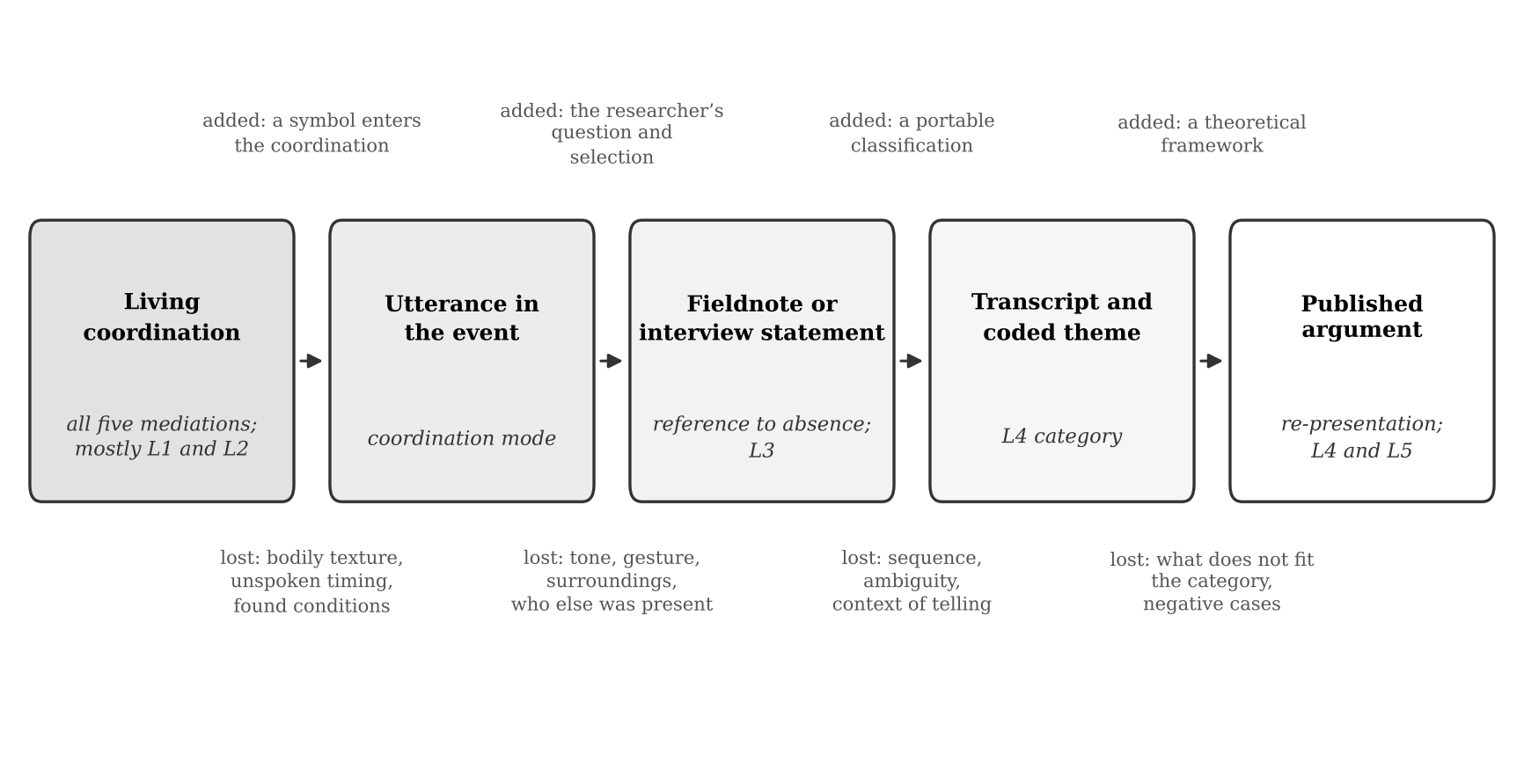
Figure 1. From living coordination to published argument. At each transition some features are lost and new symbolic stabilizations are added, and the same words change their symbolic mode. An OGT reanalysis reconstructs these transitions instead of treating the published argument as a transparent account of the coordination.
VIII. Third Reading: The Depth and Movement of Recursivity
Rather than compartments into which observations should be sorted, the five levels of recursivity describe the range of recursive engagement available to human living, and their availability does not mean that living ordinarily proceeds at the higher levels. L1 is coordination proceeding without becoming separately salient. L2 occurs when coordination becomes salient through disturbance, discrepancy, attraction, or interruption, something felt before it is named. L3 is articulation of a distinction in symbolic form for a particular situation. L4 is the stabilization of articulations into portable grounds: categories, classifications, doctrines, procedures. L5 is the repositioning of those stabilized grounds themselves. The dependency runs one way, and none of it is a hierarchy of worth.
The reading begins with the recursive organization of each episode, rather than with a search for examples of every level. What proceeded at L1, and which habits, arrangements, and skills allowed living to continue without reflection? What became felt at L2, and how did the texture of coordination change before anything was said? What was articulated at L3, and how did articulation enter the coordination? Which earlier articulations operated as L4 grounds? Where, if anywhere, were those grounds themselves reconsidered?
Every such question must be asked with a further question attached: whose recursivity is being documented? Much qualitative research records in detail how others perceived, discussed, and categorized a person or a group. Such a record documents the listeners’ L2 salience and L4 attribution. It documents the recursive organization of the person described much less, and a reanalysis must not mistake the one for the other. A rich typology of how people are heard can coexist with almost no evidence about how those people were coordinating at the time.
The central analytical task is to identify movement between levels. What brought something out of absorbed coordination? What made articulation possible, what became stabilized, what was reopened, and what allowed a return to coordination that no longer needed attention? Where symbolization is remedial, called up by disturbance, its aim is to return to L1 with better coordination, and successful remediation is often visible precisely as a return to unremarkable routine. LVT calls the capacity to move between levels in ways that preserve and repair coordination recursive fluidity, and the distribution of that fluidity, who can move between levels, who is locked into L4 categories, whose L2 signals are disregarded, is a dimension of power that ethnographies often document without naming.
L1 is the level hardest to find in a text, because it ordinarily needs no articulation and therefore leaves few traces. Several kinds of evidence nevertheless recur, and the reading should look for them deliberately. The first and most reliable is a discrepancy between an attributed category and an incidental description of action: a person described as incapable, immobile, or confused is reported, in passing, doing something that the category says they cannot do. The category is an L4 attribution; the incidental description is often the only surviving trace of the L1 coordination that contradicts it. The second is a competence that appears abruptly when a stake is engaged, a capacity no one expected that becomes evident the moment something the person cares about is threatened. The third is coordination restored by a change in another’s response, where an offered cue, a gesture, a first line, or a change of tone allows an activity to proceed that explicit questioning had blocked. The fourth is a routine narrated as a sequence of times and tasks, which preserves the shape of absorbed daily coordination even when the narrator presents it as a list. The fifth is the researcher’s own change of approach: when an elicitation strategy fails and the researcher begins instead to be present, to touch, to accompany, or to join an activity, the account of that change documents both the distance between the articulation demanded and the coordination available, and some of the coordination itself. Evidence of each kind is often confined to a clause or a sentence. It should be reported as a trace, with its limits stated, rather than inflated into a reconstruction the record cannot bear.
This reading also corrects a familiar bias of qualitative research. That someone can explain an experience at L3 or L4 does not show that the experience originally occurred through those forms of engagement, since an interview may produce an articulation that did not exist at the time. Nor does a participant’s inability to give such an explanation show that the coordination was deficient. L2 contains no unspoken proposition waiting to be released, and reading a felt disturbance as though a sentence were latent in it is one of the most consequential forms of symbolic overreach. When a recorded reply can be read in several ways, as confusion, as irony, or as refusal, and the record cannot decide between them, the reanalysis should say so and leave the question open. A good reading preserves coordination before, beneath, and beyond symbolic reflection.
IX. Fourth Reading: Counterparts and Their Gradable Properties
Recursivity is categorical and settled aspect by aspect: an aspect of a counterpart either answers back or it does not, and a single entity can present both kinds of aspect at once, as a horse answers to the rider’s hand while its weight in the saddle answers to nothing. Four further properties are gradable and vary independently of recursivity: stability, the rate and extent of a counterpart’s own variation; predictability, whether its variation can be anticipated; controllability, whether its future state can be shaped by design; and durability, whether a formed state persists beyond the activity that produced it.
The reading identifies the counterparts in each episode and asks how their different forms of responsiveness shaped what happened. With nonrecursive counterparts, an engaged aspect does not change course because of the engagement. With selfrecursive counterparts, living processes adjust in relation to their own ongoing state. With interrecursive counterparts, living beings respond to one another’s responses. These ordinarily operate together. A patient speaking with a clinician coordinates their own bodily state, responds to another responsive being, and works through records and instruments that do not respond at all.
Particular attention belongs to analyses that conflate recursivity with one of the gradable properties. A storm is nonrecursive and highly unpredictable; a ritual greeting is interrecursive and highly predictable; a device may produce elaborate outputs without answering back in the way a living counterpart does. Such distinctions explain why remediation succeeds or fails. An intervention built around fixed categories may work well where the relevant regularities are nonrecursive and fail where the intervention itself changes how participants respond. LVT calls the condition in which nonrecursive, selfrecursive, and interrecursive processes unfold together, each contributing its own kind of unpredictability, mixed futurity. Institutions designed for predictability characteristically succeed by bracketing recursive dynamics, and they produce systematic misfit when the regularities so achieved are mistaken for the full character of the domain.
Qualitative records often contain too little information to assess the gradable properties with confidence. Few ethnographies record how stable a counterpart was over time, how far its variation could be anticipated, or how controllable its states were, and a reanalysis should not force such assessments where the evidence does not support them. The fourth reading tends to be most productive at two points. The first is a change of counterpart type, where an intervention replaces a coordination that depended on another’s response with an arrangement that no longer depends on it, or the reverse. A device or procedure that secures an outcome by removing the need for response may secure one stake while bracketing the interrecursive coordination through which another stake was met, and the record may say a great deal about the first and nothing about the second. The second is a nonrecursive object whose relevance derives from transaction more than function, such as a gift, a medicine, a document, or a test result whose value in a household lies in what giving, obtaining, or holding it signifies to others. In both cases the reading should state which stakes the counterpart served and which the record leaves undocumented.
Beneath these attributions lies recursive discernment: the continual activity, mostly at L1, through which participants determine which aspects of an entity matter and whether they answer back. A reanalysis can often recover discernment from what participants did, such as how they approached an animal, handled a document, or anticipated a colleague, even where they never stated what they took the counterpart to be.
X. Fifth Reading: Stakes, Remediation, and Invisible Value
The analysis now returns to the question with which mesocosmography begins: what is vital here? Stakes are facts about what depends on a coordination’s success, what would be lost, damaged, or made unavailable if it failed. They need not be articulated to exist. Someone may sustain a form of living for years without once having to explain why it matters, and the stake may become apparent only when the coordination begins to fail.
This suggests one of OGT’s most important tasks. Instead of concentrating only on the problems participants identify, the reading investigates the arrangements that prevent those problems from arising. What keeps a household functioning? What makes a journey uneventful? What prevents an institutional disagreement from becoming a confrontation? What lets a person continue an activity without needing help? Conventional ethnographies may barely mention these achievements because they produce no dramatic event, yet they may be among the most consequential processes the research documents or presupposes. LVT calls this the principle of invisible value: the coordinations that most fully meet a stake are the most likely to disappear from view, precisely because they no longer need attention. Symbolic systems, research among them, tend to overvalue what can be named, measured, and displayed, and to undervalue what has succeeded well enough to need none of that.
The principle has a practical corollary. Successful coordination usually becomes visible in a record at a moment of displacement: when it begins to fail, when it is performed by an unexpected person, or when it is transferred to someone who must learn it explicitly. Authors often flag such moments as anomalies. The reading should treat them as windows onto the ordinary coordination that elsewhere went unrecorded, and ask how many other households, workplaces, or institutions in the study sustained the same coordination without remark.
The reading must also distinguish successful muting from foreclosure. A coordination that runs quietly may have been muted because it works, or a disturbance may simply have been prevented from becoming askable. Silence is not sufficient evidence of success. Where a record contains a person who is silent or withdrawn, it will rarely allow the reanalysis to decide whether the silence was repose or foreclosure, and the question should be kept open. Redundancy complicates matters further: several coordinations often support the same stake, so that a failing coordination can be quietly compensated by others until they too are exhausted, which is why breakdown is often delayed well past the point at which the underlying coordination began to fail.
Stakes are allocated, typically asymmetrically. In a hospital, a patient, a nurse, a doctor, and an administrator take part in the same coordination while bearing very different stakes. Who depends most heavily on the coordination’s success? Who can change its terms? Who must adapt when something fails, who bears the labour of repair, and who benefits from arrangements that others must continuously sustain? LVT calls the unequal distribution of anticipatory and remedial work recursive burden. It often falls on particular bodies in identifiable ways, through gender, age, class, kinship position, and employment, and records that report who did which task, for how many hours, and with what physical cost allow it to be stated precisely. These questions connect OGT to political and institutional analysis without beginning from a predetermined theory of power.
A record’s documentation of stakes is itself unevenly allocated. The stakes of those who speak readily to researchers, who control access to a household or institution, or whose labour is the explicit subject of the study tend to be documented richly. The stakes of those whose articulation is limited, interrupted, or disregarded tend to be documented through others, if at all. Where a record preserves the stated wishes of such persons, including wishes that those around them set aside, the reanalysis should preserve those wishes as evidence about stakes, without presuming to overrule the judgement of the people who had to live with the decision. The aim is to keep visible what the record shows was at stake for each party, so that an account of a coordination’s success does not silently adopt the criteria of whoever was best placed to describe it.
XI. Sixth Reading: Sedimentation, Relevance, and Temporality
Qualitative research often describes a present without accounting for how earlier coordination became its ground. In human mesocosms, prior coordination is sedimented into multimaterial and multisymbolic deposits that persist across generations and organize what later people can do, often without their knowing what coordination first produced them. The reading asks which arrangements participants inherit, how those arrangements were produced, and how they are sustained, maintained, or neglected.
The mere presence of an inherited arrangement does not establish its importance. LVT distinguishes recursive attribution, what kind of responsive counterpart something is engaged as, from recursive relevance, how much of ongoing coordination depends on it. The two vary independently: a commodity is attributed as nonrecursive yet may carry great relevance, while an ancestor may be attributed interrecursive capacities and carry little relevance where veneration has lapsed. Attribution is historically conservative; relevance is the principal engine of change, redistributed through conferral, when an entity newly comes to matter; withdrawal, when it is progressively removed from active coordination; and restoration, when relevance is rebuilt around it. A reanalysis can often trace such redistributions in data collected for other purposes: an institution that persists while becoming irrelevant to everyday living, a minor technology that becomes indispensable without any change in how it is understood.
Claims about withdrawal need care, because the disappearance of a term, practice, or object from a record may reflect the record more than the mesocosm. Before concluding that relevance has been withdrawn, the reading should ask whether the people among whom the item would still be relevant could have entered the record at all. That question belongs to the seventh reading and should be put before any historical conclusion is drawn.
Sedimentation is half of a cycle whose other half is recursive opening: the return to recursion of a question a deposit had closed. Openings may be disruptive, forced by a breakdown; induced, brought about by a party with standing to do so; or scheduled, built into the closure from the start, as with a review date. Reopening is rarely symmetrical, since it typically demands more of those disadvantaged by a closure than the closure ever demanded of those who benefit from it. Ethnographies of disputes, appeals, and complaints are often, read this way, ethnographies of the unequal burden of reopening. Doubt is a frequent and quiet form of opening: a category that an institution has closed may be held open within a household for years, privately and without consequence for the official record.
Finally, the mediations do not share one temporality. Embodiment unfolds through metabolic spans; dwelling ranges from the passing of a cloud to the slow shifting of terrain; being-with has the most open temporality, since its future is jointly generated; and material and symbolic deposits let earlier coordination act long after it ended. A good deal of coordination failure consists in the tempo of one mediation being imposed on another. Does an institution impose deadlines on bodily recovery? Does a family anticipate a future that the person concerned does not share? Does a long-established arrangement continue to structure living after its purpose has gone? Do seasons alter what everyday coordination makes possible? Whose daily rhythm adapts to whose, and at what cost? Such questions reveal processes that ethnographic chronologies, organized by the researcher’s calendar of visits, easily overlook. Records of particular hours, of what happens at night, at dawn, at mealtimes, or in a given season, are especially valuable here and should be logged wherever they appear.
XII. Seventh Reading: How the Record Selects What Becomes Visible
This reading is the methodological centre of the guide. OGT approaches any qualitative record expecting that the mediations and levels will be documented unevenly, and it states its expectations as hypotheses about research practice, open to correction case by case. Table 2 sets them out.
Table 2. Expected representation in qualitative records (working hypotheses, not findings)
Mediation or level |
Typical representation |
Reason |
Multisymbolization |
Overrepresented |
Research preserves symbolic traces and analyses through L4 categories and L5 theory |
Multispecies being-with |
Strongly represented |
Ethnography has long concentrated on interaction, kinship, social organization, and reception |
Multimateriality |
Uneven |
Extensive in studies of technology and material culture; elsewhere often treated as symbol or instrument |
Multisensorial embodiment |
Frequently underrepresented |
Bodily coordination runs largely at L1; research oriented to medicine or care may document it chiefly as an object of others’ work |
Multiversal dwelling |
Often least investigated |
Found conditions serve as continuously available ground; much “environment” turns out to be made; found conditions often appear only as conditions of fieldwork |
L1 |
Hard to document |
Absorbed coordination needs no articulation while it works |
L2 |
Vulnerable to distortion |
Felt disturbance is easily read back as an unspoken proposition |
L3 to L5 |
Readily documented |
Interviews elicit articulation; coding produces L4 categories; theory works at L5 |
Multisymbolization will usually be overrepresented, because research primarily preserves symbolic traces and much of its analytical work operates through L4 categories and L5 theory. Being-with will be strongly represented, since ethnography has long concentrated on interaction, kinship, and social organization. Multimateriality will be represented unevenly, extensively in studies of technology, infrastructure, and material culture, thinly or merely as symbol elsewhere. Multisensorial embodiment will frequently be underrepresented unless the research is phenomenological, sensory, or medical in orientation, and even then it may be documented chiefly as an object of others’ work. Multiversal dwelling will often be the least explicitly investigated mediation, and much of what appears as environmental description will turn out to concern made arrangements. None of this says anything about the relative importance of the mediations in living, and LVT gives reason to suspect the opposite relation in many cases: the more successfully a coordination has been established, the less likely it is to become separately salient, and therefore to be recorded.
Because these expectations will be confirmed by most records, confirming them is the least informative thing a seventh reading can do. Its work lies in specifying how this record departs from them, where its selectivity has an unexpected shape, and which particular episodes and absences carry the most consequence. A record may document one mediation better than expected because of its research question, its sites, or its author’s training, and such departures are often where the record is most valuable.
The same selection operates across levels. L3 articulations are accessible through interviews and reported speech; L4 categories organize research questions, coding, and findings; L5 is where researchers engage competing theories. L1 coordination is hard to document because it ordinarily needs no articulation, and L2 is vulnerable to distortion when researchers infer a fully formed question from a felt disturbance. Qualitative research may therefore give rich accounts of how people explain their experience while documenting much less of how the relevant coordination proceeded.
Selection also operates through the conditions under which a study gained access to its participants. A study that recruits through an institution, an organization, a registry, or a clinic makes contact with that institution a condition of entering the record, and whatever the institution requires, a diagnosis, a membership, a complaint, an enrolment, becomes a feature of everyone the study can see. The absence of an idiom, practice, or category from such a record establishes only that it is absent from the research account, since those among whom it persisted may never have reached the study. Recruitment routes also shape the class, age, and social position of participants, and therefore which stakes, burdens, and found conditions the record can register.
The research occasion selects as well. Visits are events in participants’ lives, and households and institutions prepare for them, presenting persons, rooms, and routines in their best form. Interviews may be collective and interrupted; the researcher may be assigned an institutional role, as a doctor, an official, a patron, or an inspector, that shapes what participants show and ask. Records that report these effects are more analysable than records that do not, and the reading should collect every passage in which the author describes how the research occasion changed what could be seen, including the point at which presentational care relaxed and other things became visible. Where an author has subjected their own record to an L5 reconsideration, identifying its biases in their own terms, the reading should take that self-criticism seriously as evidence and reformulate it ontologically, asking which mediations and levels the bias the author identified actually concerned.
Part of this selectivity is structural to symbolic life itself. Ordinary symbolic practice hides its own operations: symbols that constantly announced their mode, level, and bandwidth would be unusable. The cost of this trapdoor is that a coordination act can be mistaken for a description, an L4 abstraction for an L3 name, a concept operating across all five mediations for one confined to a single mediation. The most consequential form is the disguised L4, an abstraction such as “depression,” “the economy,” or “the community” presenting itself as though it named something directly present. Coding schemes are especially prone to producing disguised L4s, because a category that organizes hundreds of excerpts comes to look like a thing found in the field.
Three forms of absence must be distinguished at this point. Absence from the research account means that the ethnography does not discuss a form of mediation or coordination. Absence of sufficient evidence means that the ethnography contains relevant observations, but too few to establish how the coordination proceeded. Empirically demonstrated nonoccurrence means that a specific action, intervention, encounter, or opening did not take place under the circumstances examined. A decision that every participant in a sample made the same way, with no one considering the alternative, is a demonstrated nonoccurrence within that sample and one of the more valuable findings a record can contain. Only the third form establishes that something did not happen, and even then it concerns particular events in a particular population, never the absence of a mediation from the mesocosm. Keeping the three apart prevents a reader from converting a researcher’s silence into a finding about the world. It also opens the way to investigating the considerable work through which some events are prevented from occurring at all: the avoided encounter, the question never raised, the confrontation forestalled.
XIII. Eighth Reading: Fit, Bandwidth, and Misfit
Only now does the reanalysis return to the author’s conceptual claims. The question is whether the author’s concepts adequately describe the living coordination the research documents, and never whether the research uses LVT’s terminology.
Two forms of bandwidth help answer it. Mediational bandwidth is the range of mediations a concept can hold in view simultaneously; recursivity bandwidth is the range of levels it can distinguish. Low bandwidth is not in itself a deficiency, since specialized concepts often work precisely by narrowing. The difficulty arises when a narrow concept is extended to a coordination that operates across all five mediations and presented as an adequate explanation of it, or when an account able to recognize experience only through L4 categories is applied to coordination that ran at L1 and L2. An ethnography may document interpersonal conflict accurately and explain it inadequately because its account excludes the bodily, material, and environmental conditions of the breakdown. A study may record institutional classifications accurately and fail to distinguish them from the everyday coordination they purport to describe. A single concept may also achieve high fit across two mediations and lose it where it absorbs the others: a concept that tracks how a person is received by those around them, for instance, can become a misfit where it folds the person’s bodily, material, and environmental situation into the signification of their relationships.
LVT distinguishes three kinds of fit. Mesocosmic fit is the degree to which an articulation tracks stable, recurrent patterns across the mediations of lived coordination. Intersymbolic fit is coherence among symbolizations once they have been stabilized together. Cosmic fit, the correspondence between a nonrecursive symbolic system such as mathematics and the physical world, is rarely at issue in qualitative research. The danger for ethnographic explanation lies in treating intersymbolic fit as though it settled mesocosmic fit: an argument whose concepts cohere beautifully with one another and with a theoretical literature may track the documented coordination poorly. Intersymbolic fit can never validate itself.
The reading assesses mesocosmic fit directly. Does the explanation track recurrent patterns in the documented coordination? Does it preserve distinctions that matter empirically? Does it attribute an event to a plausible source of disruption? Does it distinguish symbolic articulations from the processes they describe, and show how successful coordination is sustained and repaired? Does it acknowledge the limits of its data? LVT’s typology of misfit, set out in Table 3, provides diagnostic concepts for the answers. It is also useful to ask which kind of L4 operation an author’s key concepts perform: protective, interrupting a harmful naturalization and making it askable; extractive, capturing coordination for institutional or theoretical purposes; mechanical, applied because inherited theory expects it; disguised; or runaway, no longer checked against the coordination it once named. And where an ethnography critiques or debunks a coordination, the reading can ask whether its justification re-coordinates what it disrupts or leaves those whose coordination was disrupted without remedy.
Table 3. Forms of mesocosmic misfit as diagnostic questions
Misfit |
What goes wrong |
Diagnostic question for a reanalysis |
Original misfit |
The account begins from a poor description of the domain |
Does the first reading already diverge from the documented coordination? |
Mediational misfit |
Several mediations are collapsed into one |
Is a coordination across five mediations explained through one? |
Recursivity misfit |
An account operates at one level while presenting itself as another |
Is an L4 category presented as though it described L1 or L2 coordination? |
Type misfit |
Nonrecursive logic is applied to selfrecursive or interrecursive coordination |
Does persistent coordination failure follow from treating responsive counterparts as fixed? |
Causal misfit |
The wrong source of a breakdown is identified |
Does the record support the disruption the author names, or another? |
Evaluative misfit |
Criteria of success are imposed that do not belong to the coordination |
By whose criteria is the coordination judged to succeed or fail? |
Action misfit |
Recommended interventions would worsen the coordination they address |
What would the author’s recommendations do to the documented coordination? |
These are diagnostic concepts, to be used with judgement and never as labels to be distributed. The typology is a menu: most reanalyses will find two or three forms of misfit relevant to a given account, and an attempt to locate all seven usually signals that the concepts are being applied mechanically. An explanation need not be globally wrong to suffer a particular misfit, and one of OGT’s most valuable achievements may be to show exactly where an otherwise valuable account ceases to track the coordination it seeks to explain.
The reading should also look for fit outside the author’s main concepts. Practical advice given in the field, remediations that participants or researchers devised on the spot, and rules of thumb recorded in passing sometimes track the coordination more closely than the book’s theoretical apparatus does. Where they do, the reanalysis should identify them, assess what they achieved, and state the principle of remediation they embody. An ethnography may contain a better practical theory than its argument recognizes.
XIV. Comparative Reanalysis and the Revisit
OGT is often applied to more than one study at a time: to two ethnographies of related fields, to a study and its later restudy, or to a series of studies of the same kind of situation across places and decades. Comparison raises a problem that a single reanalysis does not face. Every difference between the records must be sorted into differences between the mesocosms and differences between the deposits. Burawoy’s theory of the revisit distinguished changes in the world from changes in the observer and the theory brought to it. OGT adds a third source of difference, the instrument: what each study was built to register, through which sites and recruitment routes, by what methods, over what span of time, and with what kind of attention. Two studies of the same field may differ chiefly because they were tuned to different signals, one to what people say about one another, another to what they do with their hands, one to institutions, another to households.
A comparative reanalysis therefore begins by reconstructing each study’s instrument before comparing any findings. For each record, it establishes the sites, the recruitment route and what it made a condition of entry, the length and character of research occasions, the kinds of evidence collected, and the signal the author was chiefly attending to. It then carries out the seventh reading for each record separately, mapping each field of visibility on its own terms. Only when both maps exist should findings be set side by side.
Each apparent difference between the records is then tested by a single question: could the other record have registered it? Where both instruments were capable of registering a phenomenon and only one did, the difference is a candidate for change in the mesocosm, though it still requires corroboration. Where only one instrument could have registered it, the difference is undetermined, and the comparison should say so instead of presenting it as historical change. Where a later study is assumed to describe a later state of the same world, the reading should check whether differences of class, region, institutional access, or research design explain the contrast better than the passage of time. Chronology is the easiest organizing principle for a comparison and often the least reliable.
Continuities deserve as much attention as changes. An idiom, explanation, or practice prominent in one record may reappear in another under a different name, in another language, or in a private remark recorded in passing, and such reappearances are easily missed because each author’s framework names them differently. Continuity registered by two differently tuned instruments is stronger evidence than change registered by only one. Changes in material deposits, by contrast, are often among the most reliable markers of difference between mesocosms, since objects, devices, institutions, and costs tend to enter records whatever the author’s theoretical orientation.
The most important result of a comparative reanalysis is frequently the set of shared absences: forms of coordination that neither record documents, although the two instruments were tuned to different signals. A shared absence of this kind is unlikely to reflect the idiosyncrasy of one researcher. It indicates what the methods of a field systematically miss, and it defines with some precision what a new study would have to observe. Table 4 summarizes the sorting that a comparative reanalysis should perform.
Table 4. Sorting differences in a comparative reanalysis
Category |
Test |
Treatment in the written reanalysis |
Candidate change in the mesocosm |
Both instruments could have registered the phenomenon, and only one did |
Report as a probable change and seek corroboration |
Difference of instrument |
The difference follows from sites, recruitment, methods, research occasion, or the signal the author attended to |
Report as a difference between records, not between mesocosms |
Undetermined |
Only one instrument could have registered the phenomenon |
State that the comparison cannot decide |
Continuity |
The phenomenon appears in both records, possibly under different names or in passing |
Report as stronger evidence than change registered by one record alone |
Shared absence |
Neither record documents the phenomenon, although the instruments were tuned to different signals |
Treat as a systematic blind spot of the field’s methods and a priority for new observation |
XV. A Worked Example: Rereading an Ethnography of Workplace Meetings
Consider an ethnography of how employees negotiate professional identities in meetings. It rests on observation of meetings and on interviews, and its findings concern identity performance, status differences, and the language through which authority is negotiated. An OGT reanalysis would first recognize that these findings may be accurate and valuable, and the first reading would reconstruct the meetings in the author’s own terms. A close reading would log not only the analysed disputes but every incidental remark about the room, the time of day, the length of meetings, and who arrived tired or left early.
The second reading would reconstruct the meetings as sustained living coordinations. Participants remain bodily engaged for long periods: they sit, listen, tire, shift attention, and adjust to discomfort, mostly without acknowledgement. They coordinate with one another through active conversation, through avoidance, and through shared silences that let work continue. They occupy a room furnished with inherited arrangements: seating, tables, screens, documents, and digital systems that make some forms of participation easy and others awkward. They coordinate within found conditions of daylight, temperature, and season, which reach them partly through the building’s heating, cooling, and lighting, and which the research may never have investigated. And they use classifications, titles, agendas, and procedures that organize what can be said and by whom. These are five irreducible mediations of one continuously unfolding coordination, rather than five different meetings.
The third and fourth readings would trace its recursive organization and counterparts. Much of each meeting proceeds at L1 through established routine. A disagreement makes something salient at L2; someone articulates an objection at L3; the objection meets an established procedure at L4; occasionally participants question the legitimacy of the procedure itself. The agenda is a nonrecursive deposit, highly stable and controllable; the chair is an interrecursive counterpart; each participant’s attention is selfrecursive and, late in a long meeting, poorly predictable. An incidental report that a colleague described as disengaged nonetheless steered the meeting back on course at a critical moment would be exactly the kind of discrepancy between attribution and action that the third reading looks for.
The ethnographer may have documented only the articulated dispute and interpreted it through a theory of professional identity. Without inferring that the identity analysis is false, OGT would ask whether that analysis explains how the meeting was sustained, how the disagreement arose, why it became consequential, and what restored coordination afterwards. The reading might find that professional identity mattered greatly to the visible conflict and little to the meeting’s ordinary continuation, which depended on a chair’s repair work and on an agenda that kept contentious items until the end. It might find that the disagreements clustered in late-afternoon meetings, which would raise questions about fatigue, light, and scheduling that the identity framework could not have posed. Where the record cannot establish such matters, OGT identifies them as questions, and specifies the observations that would answer them. If a second ethnography of meetings in another organization were available, a comparative reading would first ask what each study was built to register before treating differences in how authority was negotiated as differences between the organizations. That discipline is what allows a reanalysis to move beyond the original framework while remaining empirically responsible.
XVI. Writing Up a Reanalysis
The eight readings are analytical operations and not chapters. A written reanalysis, especially one of article length, will rarely give each reading its own section, and it should not try to. A completed reanalysis should contain five substantive parts, forming a continuous argument rather than an inventory of isolated findings, and these provide a better backbone for the text than the sequence of readings.
First comes the empirical achievement of the original research: what the author discovered about living coordination, and which episodes, observations, and descriptions are particularly valuable. This draws chiefly on the first reading and should come first in the text, both because it is owed to the original researcher and because everything that follows depends on it. Second comes the research’s selective field of visibility: which mediations, levels, and counterpart dynamics are well documented and which are largely unexamined, and how the framework, methods, recruitment, and writing produced that selection. This draws on the second, third, and seventh readings. Third comes an OGT reconstruction of the central coordinations: what becomes intelligible when the same episodes are reconsidered through continuous mediation, recursive fluidity, counterpart differentiation, sedimentation, temporality, and vital stakes. This draws on the third through sixth readings, which can often be combined in a single section. Fourth come the limits of the evidence: what can be reconstructed from the record, what is only suggested, what remains inaccessible, and which specific observations would be needed. Fifth comes the assessment of fit and the resulting research programme: where the author’s concepts track the documented coordination and where they cease to, which explanations can now be improved, and which questions could not have been asked within the original framework.
A written reanalysis should lead with particulars. Its findings are the specific episodes it reconstructs, the specific discrepancies it identifies, and the specific absences it establishes, each with page references to the source. General statements about the representation of the mediations belong in the background, stated briefly, as the frame against which the particular findings stand out. A reanalysis that reaches the same verdict that any record would yield has not yet done its work. Every quotation should be checked against the source before publication, with the distinction between participants’ words, reported speech, and the author’s paraphrase preserved throughout.
XVII. The Ethics of Rereading
Rereading carries responsibilities, and LVT names them. A symbolic account applied to people who have not consented to it remains accountable to the coordination it claims to describe; LVT calls this requirement conceptual justice. A reanalysis adds a further layer of articulation to people who were already articulated once by the original researcher, and it must not override their own askability with a more sophisticated vocabulary. It should be particularly alert to forced misarticulation, the harm that arises when people are required to speak only in symbolic forms that distort what they are trying to say. Interview schedules, consent forms, assessment questions, and coding frames can all force misarticulation, and a reanalysis that detects it in the record should take care not to reproduce it, above all by attributing to participants propositions that the record shows only as felt disturbance.
The responsibilities are sharpest where a record concerns people whose articulation was limited, interrupted, or set aside by those around them. Such people are articulated almost entirely by others, first by those they lived with, then by the researcher, and finally by the reanalysis. The reanalysis should preserve whatever the record holds of their own words and actions, including wishes that went unheeded, and should state plainly where the record cannot tell what they wanted or experienced. It should not settle, from the comfort of rereading, decisions that participants had to make under pressures the record only partly conveys.
The original researcher is owed comparable respect. OGT identifies the limits of an ethnography’s bandwidth without devaluing what the ethnographer accomplished; most of what a reanalysis can see, it sees because the original researcher recorded more than the argument needed. Researchers who reported their own failures, their changes of approach, the effects of their presence, and the biases they later recognized in their work have made their records more analysable, and a reanalysis should acknowledge that this candour is what made its own findings possible.
XVIII. Conclusion
Qualitative research produces selective, durable symbolic traces of living that later readers interpret and reorganize. Those traces are shaped by what became observable, what became askable, what participants could articulate, what researchers considered important, how participants came to enter the study, and what disciplinary concepts made intelligible. Ontologically Grounded Theory rereads them through a process ontology that explains why every symbolic account must be partial. It begins with the living mesocosm, whose coordination proceeds through five irreducible mediations, across the levels of recursivity available to its living beings, and with counterparts of different kinds, and it then asks which aspects of that coordination the research actually preserved.
The aim is neither to discard the original ethnography nor to translate its findings into another vocabulary, but to recover more of the living coordination that generated the data, to recognize where the record falls silent, and to open new empirical questions. That aim requires a particular kind of reading, attentive to the incidental clause as much as to the argued conclusion, and, where several studies are compared, a disciplined separation of change in the world from change in the record. The central question of OGT is therefore something other than which elements of LVT can be found in a dataset. It asks of any study: given that the research concerns living coordination in a mesocosm, what has its symbolic record enabled us to understand about that coordination, what has it systematically obscured, and what must we investigate next? An ethnography can be exceptionally rich in description and still possess very limited mediational and recursivity bandwidth. OGT provides a principled means of identifying that limitation, and its ambition is progressively more adequate understanding of living coordination, guided by an ontology that explains why exhaustive representation was never available.
Selected References
Burawoy, Michael. 2003. “Revisits: An Outline of a Theory of Reflexive Ethnography.” American Sociological Review 68 (5): 645–679.
Emerson, Robert M., Rachel I. Fretz, and Linda L. Shaw. 2011. Writing Ethnographic Fieldnotes. 2nd ed. Chicago: University of Chicago Press.
Hammersley, Martyn. 2010. “Can We Re-Use Qualitative Data via Secondary Analysis? Notes on Some Terminological and Substantive Issues.” Sociological Research Online 15 (1): 5.
Heaton, Janet. 2004. Reworking Qualitative Data. London: Sage.
Mauthner, Natasha S., Odette Parry, and Kathryn Backett-Milburn. 1998. “The Data Are Out There, or Are They? Implications for Archiving and Revisiting Qualitative Data.” Sociology 32 (4): 733–745.
Moore, Niamh. 2007. “(Re)Using Qualitative Data?” Sociological Research Online 12 (3): 1.
Sanjek, Roger, ed. 1990. Fieldnotes: The Makings of Anthropology. Ithaca, NY: Cornell University Press.