Abstract
Conventional market intelligence begins with surveys of existing products, defined customers, and articulated needs. As such, it starts far downstream of where startup ideas actually emerge. This article develops Living Value Theory into a new methodology of pre-demand discovery. It begins with living coordination within specific mesocosms, seeks under-realised values that surface in felt misalignments, asks why their realisation is problematic or newly possible, and then considers whether a new product or service could descend into primary recursivity as made ground, rather than found ground. A sixteen-step pipeline, with a commercial gate, is illustrated through in-depth business case studies of Facebook and Quibi. The article also proposes methods for collecting the evidence and for testing hypotheses.
I. Where Do New Startups Come From?
Every startup rests on an answer to a question that is seldom asked with any rigour: where did the idea come from? The usual answers are biographical. A founder had a problem, noticed a gap, was irritated by something, built a tool for friends. Investors have learned to read such stories as evidence of fit between founder and market, and accelerators advise applicants to work on problems they have themselves. The advice is sound as far as it goes, and what it concedes is striking: the discovery of what a new company should be for is left to the accident of who happens to live where, among whom, and at what moment.
Market research does not close this gap, because it is structurally downstream of it. A market can be sized only once there is a category of thing being bought and sold, a customer surveyed only once a population has been specified, a need ranked only once it has been put into words. Even the more searching traditions ordinarily begin with a user, a product class, or a problem already in hand: latent-needs research (Slater and Narver 1998), jobs to be done (Christensen et al. 2016), lead users (von Hippel 1986), the build, measure, learn cycle (Ries 2011). These are powerful instruments for refining a candidate. They are silent on where the candidate came from.
The harder problem is the prior one. How could a value that people are already trying to realise be discovered systematically, before anyone possesses a settled articulation of the need, and well before any product category corresponds to it?
This article argues that Living Value Theory (LVT) can be developed into a methodology of startup incubation that operates at this prior point, before conventional market research has anything to measure. Rather than beginning with markets, products, consumers, or articulated needs, it begins with living coordination within a specific mesocosm. It seeks to identify under-realised values, meaning values whose realisation keeps surfacing at L2 as felt strain or attraction, determine why their realisation has become problematic or newly possible at a particular historical moment, and only subsequently investigate whether a new deposit, a made thing of some kind, could let that coordination settle, and whether an organisation can be sustained around it. The next section defines L1, L2, and mesocosm. For now it is enough to say that L1 is seamless being in the world, in which nothing is attended to because everything is working, and that L2 is the point at which coordination becomes felt as strain or attraction without yet having been put into words.
The proposal turns on an inversion. A startup is better understood, at the outset, as a possible intervention into coordination already under way than as a product in search of customers. People were coordinating their bodies, relationships, surroundings, tools, and words before the product existed, and will go on doing so after it is gone. The product is one more made thing entering a field that is already full, and whether it matters depends on what it lets that field do.
Four claims organise what follows. The first concerns the object of discovery: a pre-market method should look for a value whose realisation explains observed coordination, which is a different object from a need, a preference, a complaint, or a purchase. The second concerns time: a startup opportunity is a temporarily available configuration within recursive coordination, so that “why now?” belongs to the definition of the opportunity and cannot be added afterwards. The third concerns where to look: although LVT cannot identify a value without a mesocosm in which to find it, the choice of mesocosm need not be left to founder biography, and can be approached by comparing where living coordination is dense with where entrepreneurial attention is directed. The fourth concerns the end of the pipeline: discovering a deposit that would remediate a value is different from establishing a viable company, and incubation needs an explicit commercial gate between the two.
The claim is deliberately limited. Nothing here asserts that LVT can predict which startups will succeed, or that nobody has investigated pre-market phenomena before. Existing approaches contain techniques for reaching parts of this prior space. What LVT adds is a different object for it and an integrated architecture around that object: living coordination, under-realised value, possible deposit. The claim is that this yields a distinctive and testable methodology of pre-market discovery, and the final section states the test.
II. Living Coordination, L1, and L2
LVT has one generative principle: life is recursive mediation in a mesocosm (Ecks 2026). Living beings do not first know, judge, or choose, and only afterwards act. Before anything is named or decided it is already being lived, in the ease or difficulty with which a body moves through its day, a relationship holds, a place remains habitable. This ongoing process is coordination, and the theory starts from it rather than from thought, meaning, or transaction.
Coordination always occurs somewhere. The mesocosm is the specific, textured, historically accumulated field within which living beings coordinate: the world as it is lived, shared and contested, layered with the results of earlier coordination. It takes the place that “culture” and “society” occupy in other frameworks, and for the purposes of this article it also takes the place of “the market” and “the user’s context.” A mesocosm is where a startup would have to work, long before it is where a startup would have to sell.
Three distinctions give the mesocosm its analytic structure, and together they form the 5×5×3 framework. The first is between five mediations, the irreducibly different ways in which coordination occurs. Embodiment is coordination with one’s own living body. Being-with is coordination with other beings who respond in turn. Dwelling is coordination with found conditions that no one made: terrain, climate, season, the solar day. These three are sufficient for a complete living world. Multimateriality and multisymbolization are the two poietic mediations, in which coordination is deposited into durable made things and durable symbolic forms: a path, a chair, a building, a name, a law, a calendar, money. All five are always present, and what varies is which are salient.
The second distinction is between five levels of recursivity. L1 is primary recursivity: seamless being in the world, coordination that proceeds without becoming separately salient. A healthy body does not have to be monitored, a relationship that holds does not announce itself as holding, and a road is walked without a thought for the road. L1 is far from empty or merely natural. It includes massive amounts of poietic deposit, both multimaterial and multisymbolic, that were once made by someone and have since descended into L1: the language one speaks without attending to its grammar, the calendar one lives by, the pavement underfoot, the lock on the door. This is what LVT means by made ground. It was made, and it has become ground. At L2, coordination becomes salient through disturbance, discrepancy, uncertainty, or attraction: something feels off, or newly compelling, before it can be named. L3 is the level at which that salience is first articulated in words for this situation. L4 is the level at which articulations are stabilised into portable categories, classifications, and procedures that travel beyond the coordination that produced them. L5 is reflection on those categories themselves. The dependency runs one way. L1 and L2 can exist without language, while nothing at L3 or above can exist without an L2 disturbance to articulate.
The third distinction is between three types of recursive counterpart. A nonrecursive counterpart does not alter course in response to being engaged: a boundary marker, a form field. A selfrecursive counterpart responds to its own monitoring: a body under a diet, an organisation adjusting to its own metrics. An interrecursive counterpart is another being responding to one’s responses: conversation, negotiation, care. Rules and measurements fit nonrecursive domains well, selfrecursive domains moderately, and interrecursive domains poorly, because any rule introduced there becomes part of the dynamics it was meant to govern.
One feature of L2 matters more than any other for what follows. L2 does not contain an unspoken proposition waiting to be released, since it is the condition from which articulation can arise and not articulation already present in hidden form. Treating a felt disturbance as though a sentence were secretly latent inside it makes prelinguistic experience look like an incomplete draft of language.
Value, in this architecture, is what sustains, repairs, intensifies, or improves coordination, as distinct from what is measured, exchanged, or symbolically recognised. Life succeeds by muting the recursive workload a coordination requires, until that coordination disappears into L1. The consequence is the principle of invisible value: the coordinations that most fully meet a vital stake are also the most likely to vanish from view, because they no longer need attention.
Three expressions used throughout this article can now be defined. A deposit is a made thing, material or symbolic, that holds coordination in durable form: a tool, a building, a form, a name, a procedure, an application. A newly made deposit is not yet ground. It is noticed, evaluated, learned, and argued over, and all of that is recursive work at L2 and above. A deposit succeeds when it descends into L1 and becomes made ground, when people stop attending to it and simply live through it, as they live through a road or a grammar. An under-realised value is one whose coordination cannot at present settle into L1. It surfaces repeatedly at L2 as felt strain, discrepancy, or attraction, and whatever allows it to continue does so at the cost of recursive workload that has to be performed again and again. On this vocabulary a startup is an attempt to make a deposit into which an under-realised value can settle.
The decisive claim follows. People are not fundamentally attached to products as products. Living coordination continues; particular deposits enter it and leave it. A deposit matters insofar as it lets a value that surfaces at L2 settle, within a particular configuration of mediations, counterparts, and other deposits. The historical side of this is recursive relevance, how much of ongoing coordination depends on a given entity, which is the principal engine of change. Relevance is redistributed by conferral, withdrawal, and restoration while the settled sense of what kind of thing an entity is remains conservative. The moon has been the same kind of thing throughout human history, while its relevance for night travel and navigation collapsed once lighting and instruments took over the stakes it served. Products rise and fall in the same manner, while the stakes they served carry on.
This makes temporality constitutive. Deposits accumulate, each layer becoming part of the ground on which the next round of coordination proceeds, and a deposit never preserves the living recursion that produced it. It relocates recursion to maintenance, interpretation, exception, and revision. Any configuration in which a particular deposit lets a particular value settle is therefore dated. It holds for a population, in a mesocosm, at a time, given whatever else has already been made.
III. Why Market Research Comes Downstream
Seen through the levels of recursivity, market research has a characteristic address. Its objects are L4 stabilisations: the market, the segment, the customer, the category, the user. Its data are of two kinds. Stated data, from surveys, interviews, and focus groups, are L3 articulations elicited inside L4 frames that the researcher usually supplies. Behavioural data, from sales, clicks, and search volumes, are traces of past coordination recorded in categories that somebody chose. Both are retrospective in structure.
Three features make conventional research a poor instrument for the prior space. The first is the asymmetry between past and future. The past can be deposited and counted; the future can only be anticipated, projected, or modelled from within the present. Statistics operate on sedimented traces of past activity and do not recover the recursive processes that generated them. A product that has never been transacted has left no traces to count. Dawn Nafus, writing as an anthropologist inside Intel, puts the point with unusual candour: when a product is so new that no money has changed hands, the existence of a market for it is “at best virtual,” and a new market is a model in the purest sense (Nafus 2014).
The second is the vocabulary of need itself. To speak of an unmet, latent, or unarticulated need is to picture L2 as containing a sentence that research will release. On the account given above there is no sentence there. There is felt strain or attraction within ongoing coordination, and whatever gets said about it at L3 is an achievement that could have gone otherwise. Where the instrument is rigid, it produces something worse: a questionnaire that asks a respondent to rank features of a product class requires that person to speak only in the form of the category, which LVT calls forced misarticulation, a distortion that presents itself as participation.
The third is that the L4 terms of market research are disguised. “The user” and “the consumer” present themselves as names for what is simply there, when each is an abstraction generalised from many cases. The disguise suppresses the question of whether the category serves the coordination of the people it describes.
These limits have not gone unnoticed. The Handbook of Anthropology in Business (Denny and Sunderland 2014) documents, across forty-three chapters, substantial practice at exactly the points where conventional research is weakest. Ethnographers distinguish their work by its attention to the latent needs of everyday life that subjects cannot easily state (Patel 2014), and designers look for points of frustration as a route to unmet needs, often detecting through observation what the person observed never says (Neese 2014). Some contributors push past the need frame altogether: Hasbrouck and Scull (2014) argue that research for systemic change cannot be framed solely as the fulfilment of unmet needs, and Cefkin (2014) insists that what matters is who people understand themselves to be becoming.
LVT owes a great deal to this tradition and departs from it at one point. The handbook’s editors note that anthropologists in business are typically inserted into existing research and design processes, and that being inside the frame of a design process limits the ability to question it (Sunderland and Denny 2014). A brief, a client, or a category precedes the fieldwork, and within that position the contribution is to recontextualise the problem to be solved. LVT proposes a different object of discovery: the value whose realisation explains the observed coordination, sought before there is a business problem to see differently. Its first question is the one with which mesocosmography always begins: what is vital here, and what would count as its loss?
A second difference concerns bandwidth. Much business anthropology explains what it finds in terms of meaning, which LVT treats as a late stabilisation within one mediation, multisymbolization. A great deal of what a new deposit might do lies in embodiment, being-with, dwelling, and multimateriality, at L1 and L2, where there is as yet nothing to mean.
None of this makes market research an error. Once a candidate exists, sizing it, testing it, and pricing it are indispensable, and the pipeline set out below gives them a place. The argument concerns sequence and object. Existing traditions contain techniques for reaching parts of the prior space, and LVT draws on several of them. What it adds is a different object for that space, living coordination and the under-realised values that surface within it, and an integrated architecture for working on that object.
A second set of neighbours lies in entrepreneurship studies proper, where three positions bear directly on the argument. The discovery view treats opportunities as existing independently of entrepreneurs, in the form of market inefficiencies or unmet demand that an alert person can notice and exploit (Kirzner 1973; Shane and Venkataraman 2000). The creation view holds that opportunities do not pre-exist and are brought into being by the entrepreneur’s own actions and the responses they elicit, an argument developed most fully in the effectuation literature, where the entrepreneur starts from available means and lets the market be made through commitments from partners (Sarasvathy 2001; Alvarez and Barney 2007). The alertness literature, finally, locates the difference between those who see an opportunity and those who do not in a cognitive capacity to notice what others miss (Kirzner 1973).
LVT sides with neither of the first two and borrows from both. Against the discovery view, it denies that an opportunity is simply out there, because a value surfaces at L2 only for a population, in a mesocosm, at a time, given the deposits already available. Against the creation view, it denies that the opportunity is simply produced by entrepreneurial action, because the coordination whose remediation is at issue was under way before any entrepreneur arrived and carries stakes of its own. What it affirms is a pre-existing coordination whose possible remediation is real, together with the recursive fact that the deposit that realises it changes the coordination and so partly creates the market that later research will measure. The two views each capture half of this sequence, and the date of the intervention divides the halves. The alertness literature treats as a trait of persons what LVT treats as a relation between a person and a mesocosm, since immersion supplies discernment that is unavailable from outside.
IV. From Unmet Needs to Under-Realised Values
If L2 contains no hidden sentence, an under-realised value cannot be collected by asking. It has to be inferred, and the evidence for it is what people do to keep a coordination going when nothing available lets it settle.
Such evidence is abundant and mostly unremarked. People maintain private spreadsheets alongside the official system. They ask the same colleague for the same information every week. They use three incompatible products together and carry the results between them by hand. Employees route around procedures. A daughter holds her mother’s medication schedule in her own head and telephones each evening to check. A ward keeps a paper list taped to a desk because the record system cannot show what the night shift has to see. Institutions run compensatory procedures whose origin nobody remembers. People repeatedly spend time solving something that nobody calls a problem.
LVT has an exact account of why this goes unremarked. A vital stake is rarely supported by a single mechanism. Several coordinations usually support it at once, and when one fails the others compensate, which is why a failing coordination can persist for years without visible collapse. A workaround is redundancy at work: the stake is still being met, so nothing registers as missing, and yet it is met through effort that is never muted. The effort is typically unpaid, unrecorded, and carried by those with the least authority over the arrangement. Patricia Ensworth, describing her work as an ethnographer on troubled IT projects at a large investment bank, observes that the users most likely to be ignored because of low status are often the ones who develop the most creative workarounds (Ensworth 2014). Who carries the compensating workload is a question of stake allocation, and stake allocation is seldom symmetrical.
The crucial theoretical move concerns the status of all this evidence. A workaround is evidence of a value surfacing at L2, and must never be mistaken for the value. The same holds for everything else that research ordinarily collects. A complaint is an L3 articulation, shaped by what the speaker believes can be complained about and to whom. A stated preference is an answer to someone else’s question. A purchase is a trace, recording that an available deposit was taken up and saying little about what it was taken up for. A product category is an L4 stabilisation that formed around earlier deposits. None of these is the value, which has to be inferred from the living coordination that makes these behaviours intelligible.
The distinction has practical force. To build the product that a workaround suggests is to automate the compensation. A better spreadsheet, a tidier version of the paper list, a reminder service for the evening telephone call: each takes the form of the workaround for the form of the value, and leaves the underlying coordination as unsettled as it found it. The discipline of the method lies in refusing the jump from observed friction to product idea, and asking first what this coordination is for, which stake it serves, and why it cannot settle with what is already available.
Friction is only half of the evidence. L2 is salience through disturbance or through attraction, and some of the strongest signs of an under-realised value are positive: people lingering, returning, improvising a use that nobody designed, spending energy well beyond what the task requires. The case in the next section is of this second kind.
What, then, should a candidate formulation of the value look like once it is put into words? The analyst’s formulation is itself an L3 act performed on behalf of other people, and it should be held as a hypothesis under five constraints. It is stated as a coordination and a stake, with no reference to any product. It specifies which mediations are involved and what kinds of counterpart. It renders several otherwise unrelated workarounds intelligible at once. It names who currently carries the recursive workload. And it says what observation would count against it, including the observation that the people described do not recognise it when it is offered back to them. This is what LVT calls conceptual justice: a symbolic account must stay accountable to the coordination it describes.
The invented examples above can serve as an illustration. The evening telephone call, the paper list on the ward, and a pharmacist’s repeated queries to a family might all be made intelligible by a single formulation: knowing, without having to ask, that a person one is responsible for and not present with is all right tonight. This is a being-with stake carried across distance, concerning another person’s embodiment, with interrecursive counterparts on every side, and its workload falls on relatives and night staff. It mentions no device, no application, and no service. It would be weakened by finding that the calls continue unchanged when reliable information is already to hand, which would suggest that the calls serve the relationship itself and that information was never the point.
The preference for “under-realised” over “unmet” can now be justified. In most of these cases the stake is being met. Nothing is absent, which is why there is no demand signal for a survey to detect. Something is costing, continuously, in a place where costs are not recorded. What a new deposit contributes is the recursive workload it allows to fall silent.
V. Facebook: Startup Emergence as Mesocosmic Value Detection
The purpose of this case is to reconstruct a well-documented emergence in the terms of the method, so as to show what mesocosmic L2 detection would consist of. It is not offered as an explanation of why Facebook succeeded. Retrospective explanations of success are cheap, and the final section returns to what would make this one expensive.
The mesocosm is Harvard College in the academic year 2003 to 2004. Several thousand undergraduates, most of them between eighteen and twenty-two, lived within walking distance of one another in residential houses, ate in shared dining halls, and sat in the same lecture theatres. They had been selected by one institution, were mostly unknown to each other, and had a great deal riding on who knew whom. Their rooms were connected to a fast network, and the houses kept “face books,” directories of names and photographs, some of them online, none of them covering the whole college.
Mark Zuckerberg’s significance within this picture is poorly described as entrepreneurial brilliance. What he possessed was unusually dense epistemic access, because he was immersed in precisely the coordination into which the emerging deposit would intervene. Recursive discernment, the ongoing working out of which aspects of a counterpart matter and how they respond, operates primarily at L1, in attunement, before any symbolic elaboration. An insider has it without knowing that it is knowledge, and an outsider has to acquire it by immersion.
Read through the 5×5×3, the coordination of this mesocosm has a clear profile. Being-with is overwhelmingly salient, and its counterparts are interrecursive: friendship, sexual availability, status, affiliation, reputation. Embodiment enters through faces and attraction, multimateriality through the rooms, the network, and the newly common digital cameras, and multisymbolization through names, directories, and the exclusivity of an address ending in harvard.edu. Dwelling, in the compactness of a walkable campus and the rhythm of the term, is the least salient mediation. Most of this ran at L1 and L2, in the felt texture of living among thousands of consequential near-strangers.
The ecology of available deposits was thin where it mattered. There were partial house directories, email, and instant messaging, and there were Friendster and MySpace, open to anyone and unanchored in any institution (boyd and Ellison 2007). The workarounds were what they had always been: asking friends of friends, looking people up one house at a time. In the autumn of 2003 Zuckerberg’s Facemash pulled house photographs into a site that invited comparison of faces, drew heavy traffic within hours, and was shut down by the university (Kirkpatrick 2010). That episode is evidence of the positive kind, uptake far beyond anything a task required, and it is not yet the value.
The relationship-status scene in The Social Network (Fincher 2010) is analytically useful at exactly this point. In the film, a friend asks whether a particular woman in one of his classes is seeing anyone, and the question sends the protagonist back to his room to add one more field before launch. Its usefulness does not depend on the scene being literal historical reportage, since the film is a dramatisation. It models an ontologically plausible mesocosmic event: “Is she seeing anyone?” is an apparently trivial question that reveals a recurring informational requirement of coordination within that form of life.
The question is an L3 articulation, put to an intermediary. Behind it lies an L2 of attraction joined to uncertainty, with a real stake in not misreading the situation, since an approach to someone unavailable has costs in a dense field where everyone will hear of it. The workaround is inquiry through third parties, which is slow, unreliable, and consequential in its own right, because asking discloses the interest that prompted it.
The sequence can now be stated. An observation, the question asked in passing, points to a recurring coordination problem: people in this mesocosm continually need to orient themselves towards particular others and can do so only by exposing themselves. A candidate formulation of the value follows, stated without reference to any product: being able to orient towards particular others within a bounded population of consequential near-strangers, who they are, whom they know, whether they are available, without incurring the exposure of asking. A deposit realises it. The profile, with its fields, converts an interrecursive inquiry into a nonrecursive symbolic deposit that can be consulted silently, and the requirement of a university address made it trustworthy by borrowing a symbolic anchor the mesocosm already possessed. The site opened on 4 February 2004, and by most accounts more than half of Harvard’s undergraduates had registered within a month (Kirkpatrick 2010). The test of a deposit is whether it descends into L1, and for those undergraduates the site appears to have done so, becoming something consulted as a timetable is consulted, without reflection.
Then coordination changed, and here the reconstruction meets recursion. A deposit relocates recursion to interpretation, maintenance, and revision. Relationship status became something to set, to change, to announce, and to read. Altering it became an act within a relationship and a message to everyone else. The successful intervention changed the mesocosm it had entered.
It went on changing. The site spread to other universities during 2004, to secondary schools in 2005, and to anyone with an email address in September 2006, the month the News Feed turned profile changes into broadcasts. New populations entered, parents and employers among them, so that a student’s profile now coordinated with counterparts it had never been built for. “Social network” stabilised as an L4 category with its own metrics and its own market research. What Facebook realised for one population at one moment need not be what it realised later, even under the same name.
The general form of this result can be written compactly:
L2 = L2(P, M, T, E)
Here P is the population, M the mesocosm, T historical time, and E the ecology of existing deposits, the made ground and made things already on offer. The notation makes a methodological demand and is no metaphysical thesis: for startup analysis, every candidate formulation of an under-realised value has to be indexed by all four. P and E could be treated as components of M, and in a fuller analysis they are. They are separated here because the repertoire of deposits already available is specifically consequential for startup possibility, since it fixes what a new deposit has to improve on, combine with, or displace. Harvard undergraduates in early 2004, with house directories and open-identity sites as the alternatives, specify one formulation. Adults across several continents a decade later, with smartphones and a dozen rival feeds, specify another, whatever the continuity of the brand.
One caution belongs here. Uptake is not value. LVT’s standing question, whenever relevance is redistributed, is whether the underlying vital stakes are still being met by whatever has taken over, and the later history of the platform makes that question a serious one. The method described here concerns discovery, and discovery does not discharge the obligation of assessment.
VI. Startup Temporality and Recursive Markets
A startup opportunity is commonly pictured as a gap, an empty slot in the market waiting for whoever sees it first. The four indices make that picture untenable. An opportunity is a temporarily available configuration within recursive living coordination. It opens when population, mesocosm, historical time, and the ecology of existing deposits come into a particular relation, and it changes or closes when any one of them moves.
The fundamental startup question is therefore double. “What is needed?” has to be asked together with “why now?” Investors ask the second question routinely, usually as a check on timing once the idea is on the table. In LVT it belongs to the definition of the opportunity. A value that could have been realised in the same way at any time in the past thirty years, and was not, calls for an explanation before it calls for a company.
The theory offers three ways in which a moment becomes available. The first is a change in the ecology of deposits. New made things alter what can be made next and at what cost. At Harvard in early 2004 these included broadband in student rooms, digital photographs, cheap web hosting, and a cohort that had grown up with institutional email. None of these was the opportunity, though each changed what a deposit could be.
The second is a redistribution of relevance. When relevance is withdrawn from a mechanism that used to carry a stake, whether relatives living nearby, a departmental secretary, or a local bank branch, the stake does not vanish with it. Redundancy thins, the remaining supports carry more, and a coordination that had been muted begins to surface at L2. Relevance withdrawal is in this sense a generator of under-realised values, and many good answers to “why now?” take the same form: something that silently carried this stake has gone.
The third is recursive opening. Every deposit is only provisionally closed, and closures become available to recursion again in three ways. A disruptive opening is forced by a breakdown the closure did not anticipate, such as an epidemic, a scandal, or the failure of a supplier. An induced opening is brought about by a party with standing to do so, as when a regulator revises a rule. A scheduled opening is built into the closure from the start: a contract renewal, a procurement cycle, a standards review. Scheduled openings matter greatly in institutional mesocosms, where a startup that arrives between the fixed dates may find nothing to enter.
What opens also closes, and recursion is the reason. Once a new deposit appears and begins to settle, it changes expectations. Users reorganise their practices around it. Competitors respond. Institutions react by adopting, regulating, or forbidding. The technologies involved become cheaper. Categories become articulated, so that what had been a felt strain becomes a named need with a product class and analysts to cover it. At that point market research can finally measure it, and the pre-market stage is over. The value that had been surfacing at L2 may by then have become obvious, or be realised differently, or have been transformed into something else, or have disappeared.
This is what it means to call markets recursive. A market is composed of buyers, sellers, rivals, and regulators, each responding to the others’ responses, alongside nonrecursive regularities such as cost curves and demographics and selfrecursive ones such as firms adjusting to their own metrics. LVT calls this condition mixed futurity. Institutions built for prediction succeed by suppressing recursive dynamics and amplifying nonrecursive regularities, which works where a domain holds still and fails systematically where it answers back. A forecast of market size for a product that will itself alter the coordination it enters is a clear instance, and a launch, a pitch, even a rumour of a launch, is an intervention in the future it describes.
Three consequences follow for method. The first is that every candidate formulation of a value carries a date and should be kept in versions. A formulation that fits the spring of 2004 does not thereby fit the autumn of 2006, and treating it as timeless is how a company comes to serve a value that its own success has already changed.
The second is that being too early and being too late are distinct failures with distinct structures. Too early means that the ecology lacks deposits on which the new deposit depends, so that the workload it promised to mute returns as the workload of making it function. Too late means that the value has already been muted by another deposit, or has been articulated up to L4 and crowded with entrants.
The third is that the method cannot stop at intervention. A deposit that is taken up will alter the coordination it was aimed at, and the altered coordination has to be observed with the same care as the original. What the trade calls a pivot appears, on this account, as the ordinary consequence of recursion, the next observation in a series, and need not be read as the correction of a founding mistake.
VII. A Negative Case: Quibi
A method that only reconstructs successes proves little, so a case of failure belongs in the body of the argument. Quibi is a convenient one because it was lavishly funded and is well documented. It raised $1.75 billion, launched on 6 April 2020 with five- to ten-minute episodes formatted for phones, charged about eight dollars a month, or five with advertising, and announced its closure six months later (Arbel 2020; Fortune 2020). The reconstruction that follows uses only facts that were public, and it carries the usual caution about hindsight. The trial described in the last section is designed to remove that hindsight. This case shows only the questions that the method would have put to the evidence.
The value implied by the design is easy to state: filling the idle moments of a mobile day, in commutes, queues, and waiting rooms, with something better than what was to hand. Three questions press on it. The first is whether the value was under-realised or already muted. Short videos were abundant on the internet (Arbel 2020), free to the viewer, and carried in the same pocket. On the evidence available, little recursive workload was surfacing in this coordination, so what the venture offered was a better deposit in a place where no strain was visibly asking for one.
The second question concerns the mesocosm and the date. The formulation was indexed to people who were out and about, and that mesocosm is fragile in a way no founder controls. By the time of launch lockdowns kept many viewers at home, where a television was at hand, and Quibi was slow to arrive on television (Arbel 2020). Its founder blamed the pandemic. The method’s answer is that the pandemic changed M and T, the two indices against which the formulation had never been tested, and that any formulation tied to commuting and waiting should state its dependence on them. The ecology of existing deposits, E, was equally unfavourable, since it already held free competitors.
The third question belongs to the commercial gate. Valuable remediation does not entail a viable company, and here the beneficiary was asked to pay a subscription for something that free alternatives approximated. A value of this kind could not be captured in proportion to the capital raised.
On this reading the venture failed on three counts that the method names in advance of launch: a deposit built for a value that was not under-realised, a mesocosm and date that were assumed and had not been examined, and a commercial form that the surrounding ecology undercut. The pipeline would have returned a rejection at the ninth or tenth step, at the price of an investigation instead of a launch. This is a retrospective plausibility argument and no more than that, and its force depends on the frozen-evidence trial.
VIII. How Does LVT Know Where to Look?
A concession comes first. LVT probably cannot identify an L2 without a mesocosm. This follows from the ontology and is no weakness of method, since values surface at L2 only through relational living coordination and there is no coordination in general. A value detached from population, mesocosm, time, and ecology is not something the theory is able to find.
The concession seems to hand the method back to biography: if the choice of mesocosm depends on where founders live, the mesocosms examined will be the ones founders inhabit. Nafus gives a precise picture of the mechanism. At an Intel planning session, a researcher offered a documented, working case of people in Cameroon using positioning technology to mark culturally significant trees, so that loggers could harvest around them and obtain sustainability certification. The example was set aside as something that could not scale and that colleagues could not relate to, and the researcher substituted a fictional scenario set in the United States, which the team found more convincing than the fact (Nafus 2014). Founders and funders belong to a symbolic class that inhabits a narrow range of mesocosms, and the principle of invisible value predicts that their attention will flow to what is symbolically legible to them.
Mesocosm selection need not, however, depend entirely on founder biography or luck. Two anthropological precedents show how it can be approached.
The first is Gillian Tett, who trained as a social anthropologist before joining the Financial Times. Her method, drawing on Bourdieu (1977), is to examine social silence: what a group does not talk about is as informative as what it does. In the mid-2000s she observed that equity markets received most of the coverage, while debt and credit derivatives, far larger and growing fast, received almost none, and the discrepancy led her to the instruments at the centre of the 2008 financial crisis well before it broke (Tett 2009, 2015). The handbook’s editors associate her anthropological “filter” with “an acute ear for the unsaid” and an ability to fit things together systemically (Sunderland and Denny 2014: 21).
The second precedent is Nafus’s own response to the planning session. Conventional measures can make emerging phenomena invisible, because the categories and indices themselves encode assumptions. Indices of technological readiness bundle wealth, infrastructure, and regulation so that countries resembling rich countries rank highly, places off the list cannot be seen, and the spread of mobile telephones across Africa is filed as an anomaly. With colleagues she built the Technology Distribution Index, which relates a country’s share of the global stock of a technology to its share of global output. The form of the measure is the point: a ratio of two shares, constructed so that a discrepancy becomes visible where the standard index showed nothing.
LVT makes its own move from here, which can be called mesocosm discovery. It begins with delimitation. No team can map society, and “society at large” is only the horizon. The search universe is chosen explicitly and in advance: residential elder care in Britain, post-secondary education in a particular region, independent retail in a set of towns. The choice may be arbitrary, but it is stated, and stating it makes the procedure repeatable and the results comparable across universes. Within the universe the method then constructs two imperfect maps and compares them.
One maps living coordination. It asks where large numbers of people are engaged in dense, effortful coordination with high stakes. Its sources are proxies: time-use surveys, hours of unpaid care, employment by sector, staff turnover, the volume of informal messaging that surrounds official systems, the frequency of regulatory contact. Each is a trace recorded in someone’s categories, with all the limits described in the third section, and the map is used only to direct attention.
The other maps entrepreneurial attention. Its sources are venture funding by sector, the composition of accelerator cohorts, the backgrounds of founders, job postings, patent filings, and coverage in the trade press.
Both maps are search instruments. They do not measure value, and neither identifies an under-realised value; their only function is to allocate ethnographic attention. This matters because the section has just criticised indices that encode their own assumptions, and a measure of living-coordination intensity is open to the same objection. The reply is that the maps are never used as readiness indices are used, to rank and to decide. A false positive costs an investigation and establishes no opportunity. For the same reason the maps should not be collapsed into a single composite score. The discrepancy is to be triangulated from heterogeneous traces that disagree with one another in informative ways, since a composite would rebuild, with different ingredients, the kind of index that Nafus shows making phenomena disappear.
The method then looks for anomalous discrepancies between the two. The anomalies of interest are the opposite of empty places. They are sites where a great deal is happening and surprisingly little entrepreneurial imagination is directed towards it. The candidate relation is:
living-coordination intensity ≫ entrepreneurial attention
Because opportunities are events, the comparison has to be dynamic as well as static. A neglected mesocosm that has been stable for fifty years is a different phenomenon from one in which a previously invisible coordination has recently become expensive because demographics, regulation, technology, or institutional arrangements have changed. Writing C for the intensity of living coordination and A for entrepreneurial attention, the ratio C/A marks where investigation might begin, and its rate of change marks when:
d(C/A)/dt
A rapidly rising ratio is the mesocosm-level counterpart of the answer to “why now?” developed in the sixth section. Relevance has been withdrawn from some mechanism, or a new deposit has changed what is possible, or a closure has come up for reopening, and the discrepancy is widening because of it. A discovery procedure that looks only at where coordination is dense will find places, when what it needs to find are moments.
Residential elder care in Britain can serve as an example of a search universe, and care homes within it as a hypothesis. A care home is a mesocosm of extremely dense coordination among residents, carers, families, healthcare providers, regulators, technologies, and material environments. All five mediations are at high salience: frail bodies that have to be lifted, fed, and settled to sleep; care relations that are interrecursive through and through; a building and its nights; charts, records, and inspection regimes. Much of it runs at L1 and L2, where successful care looks like nothing happening. The populations that found and fund startups are, for the most part, young, healthy, and mobile, and seldom spend a night in such a place, so the hypothesis is that this mesocosm is under-observed by them. It stops well short of claiming that there must be startups in care homes.
That distinction leads to the crucial correction: neglect is not opportunity. Some mesocosms may be neglected because viable commercial intervention is extraordinarily difficult. In a care home, those who bear the highest stakes rarely control the purchase. Margins are thin, procurement opens on a schedule, and regulation is close. Above all, the core coordination is interrecursive, which is where nonrecursive product logic fits worst and can do harm, by governing care as though it held still. The LVT method therefore identifies where investigation is warranted, which is a different matter from where investment is warranted. A finding, after immersion, that no deposit could mute the workload without damaging the care is a result of the method and should be recorded as one.
This is also where the method parts company with automated generators of startup ideas. Such systems recombine categories that are already articulated, and what they produce has intersymbolic fit: ideas that cohere plausibly with other ideas. Intersymbolic fit is never self-validating. No amount of coherence among symbolisations can establish that they track any lived coordination, and tracking lived coordination is the only thing mesocosm discovery is for.
IX. The LVT Startup Incubation Pipeline
The preceding sections can be assembled into a single procedure of sixteen steps in four phases, shown in Figure 1.
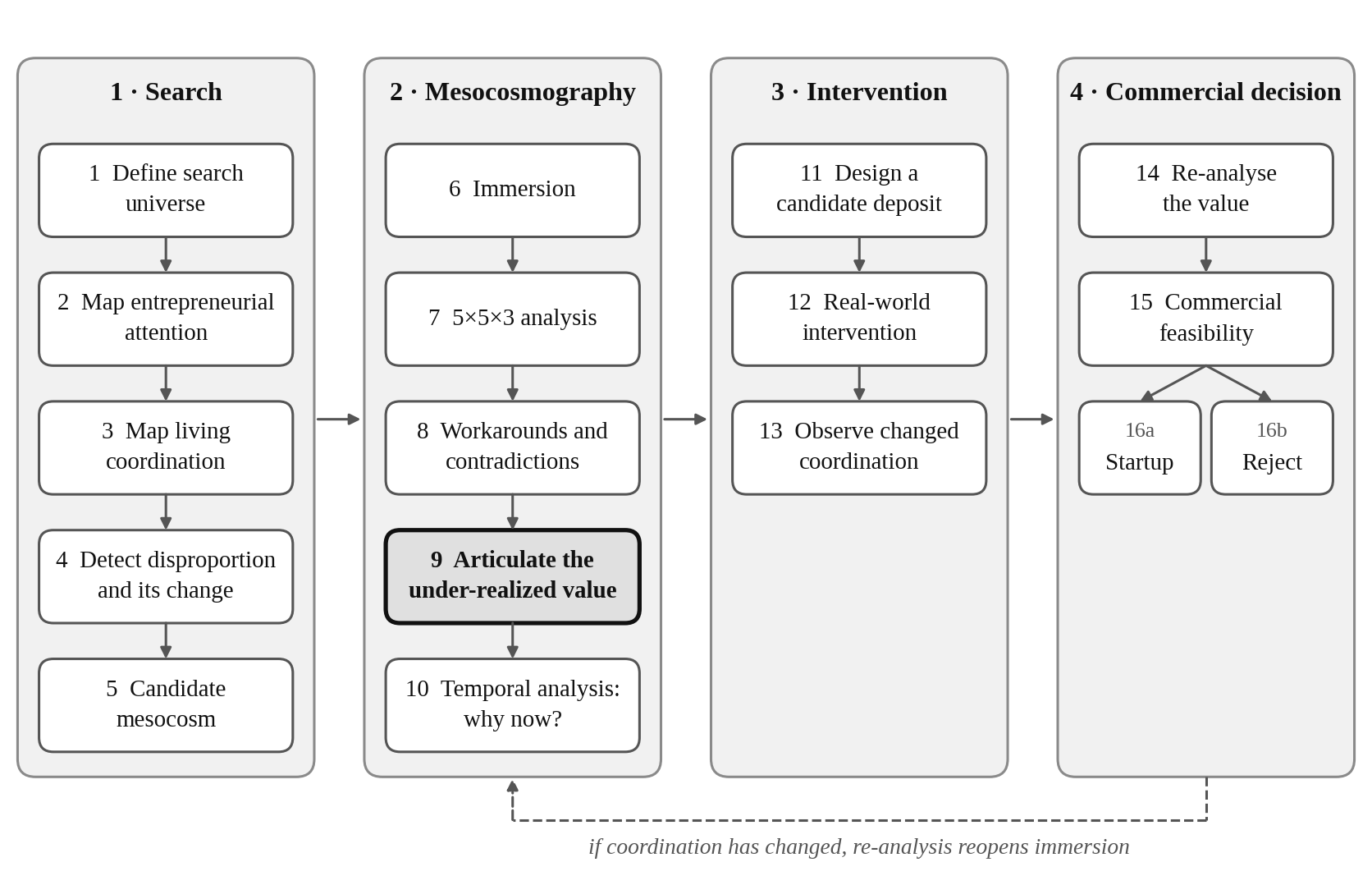
Figure 1. The LVT startup incubation pipeline: four phases, sixteen steps, one loop. Rejection is available at every gate.
The figure reads from left to right. Search delimits a search universe, maps entrepreneurial attention and living coordination within it, detects disproportion and its change over time, and ends in a candidate mesocosm. Mesocosmography proceeds through immersion, analysis by means of the 5×5×3, and the detection of workarounds and contradictions, and ends in the articulation of the value under the five constraints given in the fourth section, followed by temporal analysis of why now. Intervention designs a candidate deposit, puts it into the world at the smallest scale that can change coordination observably, and watches what changes. The commercial decision analyses the value again in the light of the changed coordination, assesses commercial feasibility, and results in the formation of a startup or in rejection.
The commercial gate is what turns a theory of pre-market discovery into a theory of startup incubation, and it rests on an LVT distinction: valuable remediation does not entail a viable startup. Feasibility covers the questions that conventional business analysis handles well. Who pays, and is the payer the beneficiary? What are the willingness and ability to pay? How is the deposit distributed, and how does procurement work? What does regulation allow? Do the unit economics hold, can the position be defended, and can enough of the value be captured to sustain an organisation? A yes to the discovery question and a no to the feasibility question is a coherent outcome, and in some mesocosms, care among them, it may be the usual one. LVT adds that feasibility must be assessed on the re-analysed value, since the deposit has by now altered the coordination the original formulation described, and that a commercial form which damages the coordination it serves counts as a rejection.
Three features of the pipeline deserve emphasis. The first is its order. A candidate deposit appears only at the eleventh step, and a market in the conventional sense does not appear until a deposit has been taken up. Everything before that concerns coordination. Conventional market research enters with the fifteenth step, after the pipeline has done its work, to size, price, and test a candidate that now exists.
The second feature is the loop. Because a deposit that is taken up changes the coordination it was aimed at, re-analysis can lead back to immersion, and the formulation of the value is rewritten in a new version with a new date. The pipeline is a cycle with an exit, and the exit is taken only when the changed coordination has been understood well enough to decide.
The third feature is that rejection has equal standing with formation. It can be reached much earlier than the end: at discrepancy detection, when neglect turns out to be explained by difficulty; at articulation, when no formulation survives the constraints, or when the value turns out to be already muted, as in the case of Quibi; at the temporal analysis, when nothing relevant has changed or the mesocosm is too fragile; at intervention, when the deposit adds workload or damages a stake it was meant to serve. A procedure that could only say yes would be an idea generator. The capacity to conclude that no commercially realisable deposit exists in a given mesocosm at a given time is what makes the pipeline a method.
A note on the twelfth step is needed. Intervention in a living mesocosm is an act with consequences for people who did not ask for it, and in mesocosms such as care those people may have little power to refuse. Conceptual justice applies to interventions as it applies to descriptions. The intervention is designed with those who carry the stakes, it is small enough to be withdrawn, and the diagnostic question is asked of it from the start: are the vital stakes still being met by whatever has taken over?
X. AI as Epistemic Accelerator
Artificial intelligence has a place in this methodology, though not the one in which it is usually offered. A language model cannot replace mesocosmic immersion. It has no body in the care home at night and no stake in what happens there. Its outputs are nonrecursive symbolic deposits, which possess intersymbolic fit by construction and acquire mesocosmic fit only when someone answerable for the coordination takes them up and checks them against it.
What AI can do, to a remarkable degree, is accelerate recursive articulation. Understanding a field moves through a cycle of observation, externalisation, interpretation, challenge, reformulation, and new observation, and each turn has traditionally been slow. With a responsive system, the interval between a partially articulated thought and a responsive externalisation of it falls from weeks to seconds, and arguments of the present kind are now commonly worked out in this way.
The shortened cycle is itself an instance of what this article describes. Thinking with others is a coordination that has always carried a heavy recursive workload: finding an interlocutor, waiting, explaining again. A new deposit has entered that coordination and muted much of the workload, and the practice is resettling around it, with the consequences for expectations and neighbouring practices that the sixth section would predict.
For the startup methodology the application is direct. Researchers could continuously feed field observations, quantitative anomalies, interview material, and 5×5×3 analyses into an LVT reasoning environment. Such a system could identify contradictions among observations, compare mesocosms, and challenge premature formulations of a value, especially those that mention a product or merely restate a workaround. It could maintain temporal versions of each hypothesis, indexed by population, mesocosm, time, and ecology, and ask what observations would falsify a given formulation, so directing the next visit to the field. In mesocosm discovery it could assemble the two maps from public data and flag disproportions for human judgement.
Three limits follow from the theory itself. The first is that articulation can outrun observation. When formulations cost nothing they multiply faster than they can be checked, and cheap L3 and L4 production tends towards the runaway form, in which abstractions validate one another and stop checking themselves against the coordination they were about. The safeguard is procedural: no formulation counts until it has been taken back to the field.
The second limit is that such a system is built from what has already been written. Its categories are the sediment of the symbolic class’s attention, and it will tend to reproduce the map of entrepreneurial attention with great fluency. Under-observed mesocosms are also under-written ones. AI is therefore weakest exactly where mesocosm discovery points, which is a further reason why immersion cannot be delegated.
The third limit is forced misarticulation in a new guise. Field notes rewritten to suit a system’s template can lose what did not fit the template, and what did not fit is frequently the evidence.
XI. Before the Market
LVT startup incubation is something other than an improved technique for generating startup ideas, because it changes the object of startup discovery.
The conventional sequence runs, approximately, from market to customer to need to product. LVT proposes a different one: living coordination, mesocosm, under-realised value, articulation of the value, possible deposit, possible market, possible startup. In the second sequence the word “possible” enters only at the fifth term, and a commercial gate stands between the deposit and the startup. Everything before “possible” is a description of what is already the case in people’s lives. Everything after it is conjecture, open to rejection at each step. The market, which the conventional sequence takes as its starting point, arrives sixth, as something a deposit might bring into being. That inversion is the argument of this article.
The method is subject to the theory that produced it. It is a product of the symbolic class, and its vocabulary could easily circulate as disguised L4: an “under-realised value” asserted in a pitch as though it named something simply there, when it is an analyst’s formulation with a date on it. It could be used extractively, capturing people’s coordination for commercial purposes and returning nothing to it. Its own criterion applies: an intervention is to be judged by whether coordination settles better for those who live it, and commercial viability is a second question that cannot stand in for the first.
The claim made here has been kept narrow on purpose. It would be premature to say that LVT can predict startups, and the account of mixed futurity gives principled reasons to doubt that anything can. The stronger claim is heuristic in the theory’s own terms: that the architecture, applied to a case, yields sharper descriptions and more productive questions than the alternatives, which can be assessed without waiting for the ontological questions to be settled.
The assessment can be designed. Suppose the informational environment were frozen at Harvard in 2003, and the procedure applied using only evidence available at that date: the directories, the student newspaper, the existing sites, accounts of daily life written before anyone knew what was coming. Would it recover something recognizably close to the value subsequently realised through Facebook? A fair trial would need analysts, human or artificial, restricted to dated material, formulations fixed in advance of comparison, and a baseline in the form of what conventional research would have recommended from the same evidence.
If the answer is yes, the trial should be repeated on other cases, and above all on negative ones, of which Quibi is a candidate: mesocosms in which well-funded ventures failed, where the procedure ought to find no commercially realisable deposit, or a mistaken answer to “why now?”, or a workaround taken for a value. A method that only ever reconstructs successes has shown nothing. A method that separates the two kinds of case from evidence available at the time has shown a good deal.
If it repeatedly succeeds, negative cases included, then what is on offer is considerably more than an attractive theory of entrepreneurship. It is the beginning of an empirically testable science of pre-market value discovery.
References
Alvarez, Sharon A., and Jay B. Barney. 2007. “Discovery and Creation: Alternative Theories of Entrepreneurial Action.” Strategic Entrepreneurship Journal 1 (1–2): 11–26.
Arbel, Tali. 2020. “Short-Video App Quibi Shutting Down Just Months after Launch.” Associated Press, 21 October 2020.
Bourdieu, Pierre. 1977. Outline of a Theory of Practice. Translated by Richard Nice. Cambridge: Cambridge University Press.
boyd, danah m., and Nicole B. Ellison. 2007. “Social Network Sites: Definition, History, and Scholarship.” Journal of Computer-Mediated Communication 13 (1): 210–230.
Cefkin, Melissa. 2014. “Work Practice Studies as Anthropology.” In Handbook of Anthropology in Business, edited by Rita M. Denny and Patricia L. Sunderland, 284–298. Walnut Creek, CA: Left Coast Press.
Christensen, Clayton M., Taddy Hall, Karen Dillon, and David S. Duncan. 2016. Competing Against Luck: The Story of Innovation and Customer Choice. New York: HarperBusiness.
Denny, Rita M., and Patricia L. Sunderland, eds. 2014. Handbook of Anthropology in Business. Walnut Creek, CA: Left Coast Press.
Ecks, Stefan. 2026. “Living Value Theory: Core Principles (August 2026 v2).” Living Value Theory, livingvaluetheory.org.
Ensworth, Patricia. 2014. “The Anthropologist as IT Troubleshooter on Wall Street.” In Handbook of Anthropology in Business, edited by Rita M. Denny and Patricia L. Sunderland, 202–222. Walnut Creek, CA: Left Coast Press.
Fincher, David, dir. 2010. The Social Network. Culver City, CA: Columbia Pictures.
Fortune. 2020. “Quibi Calls Quits: ‘Our Failure Was Not for Lack of Trying.’” Fortune, 21 October 2020.
Hasbrouck, Jay, and Charley Scull. 2014. “Hook to Plate Social Entrepreneurship: An Ethnographic Approach to Driving Sustainable Change in the Global Fishing Industry.” In Handbook of Anthropology in Business, edited by Rita M. Denny and Patricia L. Sunderland, 463–485. Walnut Creek, CA: Left Coast Press.
Kirkpatrick, David. 2010. The Facebook Effect: The Inside Story of the Company That Is Connecting the World. New York: Simon & Schuster.
Kirzner, Israel M. 1973. Competition and Entrepreneurship. Chicago: University of Chicago Press.
Nafus, Dawn. 2014. “Making Markets Emerge: Enumeration, ‘Development,’ and Technology Markets.” In Handbook of Anthropology in Business, edited by Rita M. Denny and Patricia L. Sunderland, 167–185. Walnut Creek, CA: Left Coast Press.
Neese, Megan. 2014. “How ‘the User’ Frames What Designers See: What Cultural Analysis Does to Change the Frame.” In Handbook of Anthropology in Business, edited by Rita M. Denny and Patricia L. Sunderland, 521–539. Walnut Creek, CA: Left Coast Press.
Patel, Neal H. 2014. “Methodological Rebellion: Overcoming the Quantitative-Qualitative Divide.” In Handbook of Anthropology in Business, edited by Rita M. Denny and Patricia L. Sunderland, 135–156. Walnut Creek, CA: Left Coast Press.
Ries, Eric. 2011. The Lean Startup: How Today’s Entrepreneurs Use Continuous Innovation to Create Radically Successful Businesses. New York: Crown Business.
Sarasvathy, Saras D. 2001. “Causation and Effectuation: Toward a Theoretical Shift from Economic Inevitability to Entrepreneurial Contingency.” Academy of Management Review 26 (2): 243–263.
Shane, Scott, and S. Venkataraman. 2000. “The Promise of Entrepreneurship as a Field of Research.” Academy of Management Review 25 (1): 217–226.
Slater, Stanley F., and John C. Narver. 1998. “Customer-Led and Market-Oriented: Let’s Not Confuse the Two.” Strategic Management Journal 19 (10): 1001–1006.
Sunderland, Patricia L., and Rita M. Denny. 2014. “Introduction.” In Handbook of Anthropology in Business, edited by Rita M. Denny and Patricia L. Sunderland, 13–31. Walnut Creek, CA: Left Coast Press.
Tett, Gillian. 2009. Fool’s Gold: The Inside Story of J. P. Morgan and How Wall Street Greed Corrupted Its Bold Dream and Created a Financial Catastrophe. New York: Free Press.
Tett, Gillian. 2015. The Silo Effect: The Peril of Expertise and the Promise of Breaking Down Barriers. New York: Simon & Schuster.
von Hippel, Eric. 1986. “Lead Users: A Source of Novel Product Concepts.” Management Science 32 (7): 791–805.